Most skincare apps look useful for five minutes.
Then the problem shows up.
One app scans your face but does not help you change the routine. One app checks ingredients but cannot tell you whether your skin is getting calmer. One app gives a beautiful score, then leaves you staring at your bathroom shelf with the same old question: what do I actually do tonight?
That is the difference I care about in May 2026. A good skincare app should help you make fewer frantic decisions. It should make your routine easier to follow, your progress easier to judge, and your product changes easier to understand.
The short answer
The best skincare app in May 2026 is the one that matches the job you need done. Choose a skin analysis app if you want visible-skin check-ins. Choose a product scanner if your problem is ingredients and shopping. Choose a routine tracker if you keep forgetting steps or changing products too quickly. Choose a progress-photo app if your skin looks different depending on lighting and mood.
For most people, the strongest setup is not a dramatic one-time scan. It is a simple loop: scan, log the routine, take consistent photos, watch patterns, and only change one thing at a time.
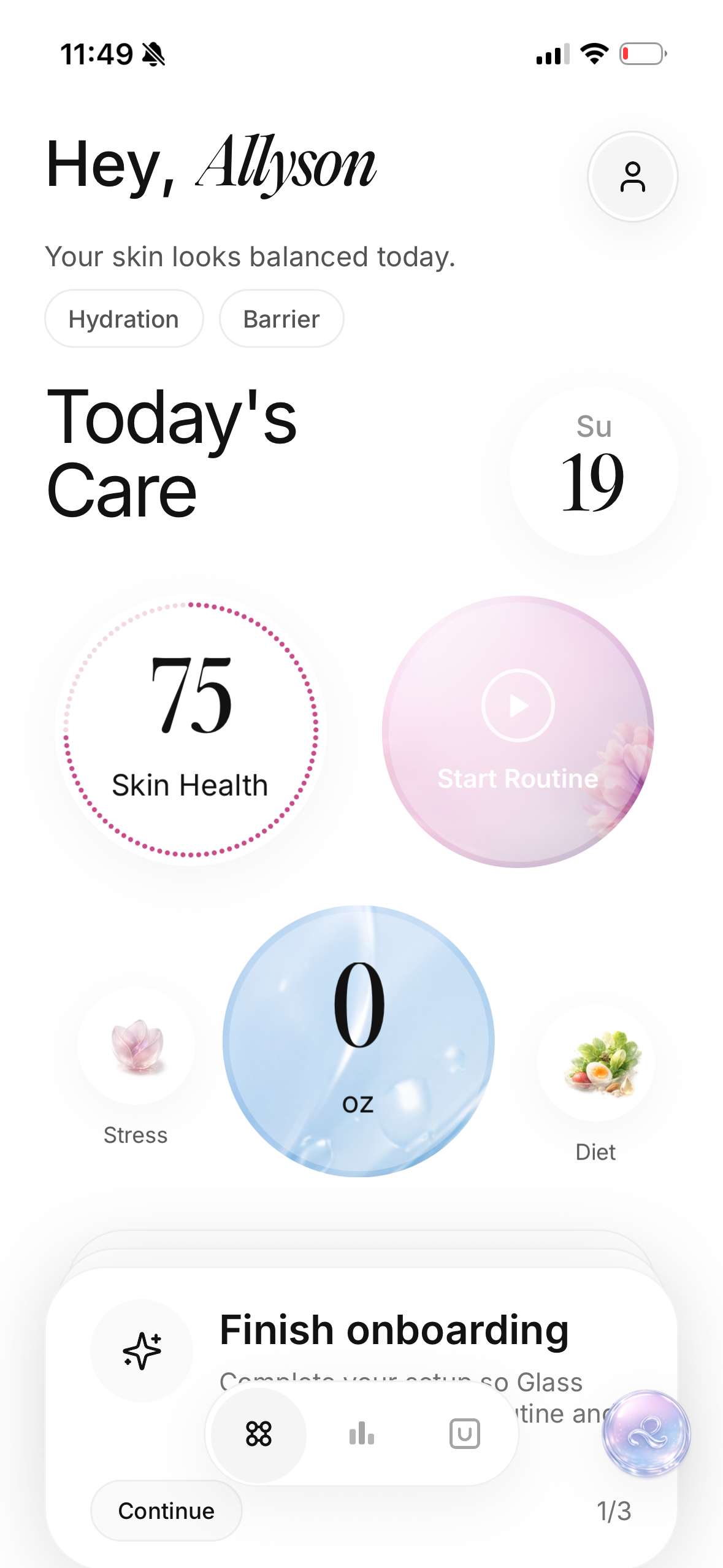
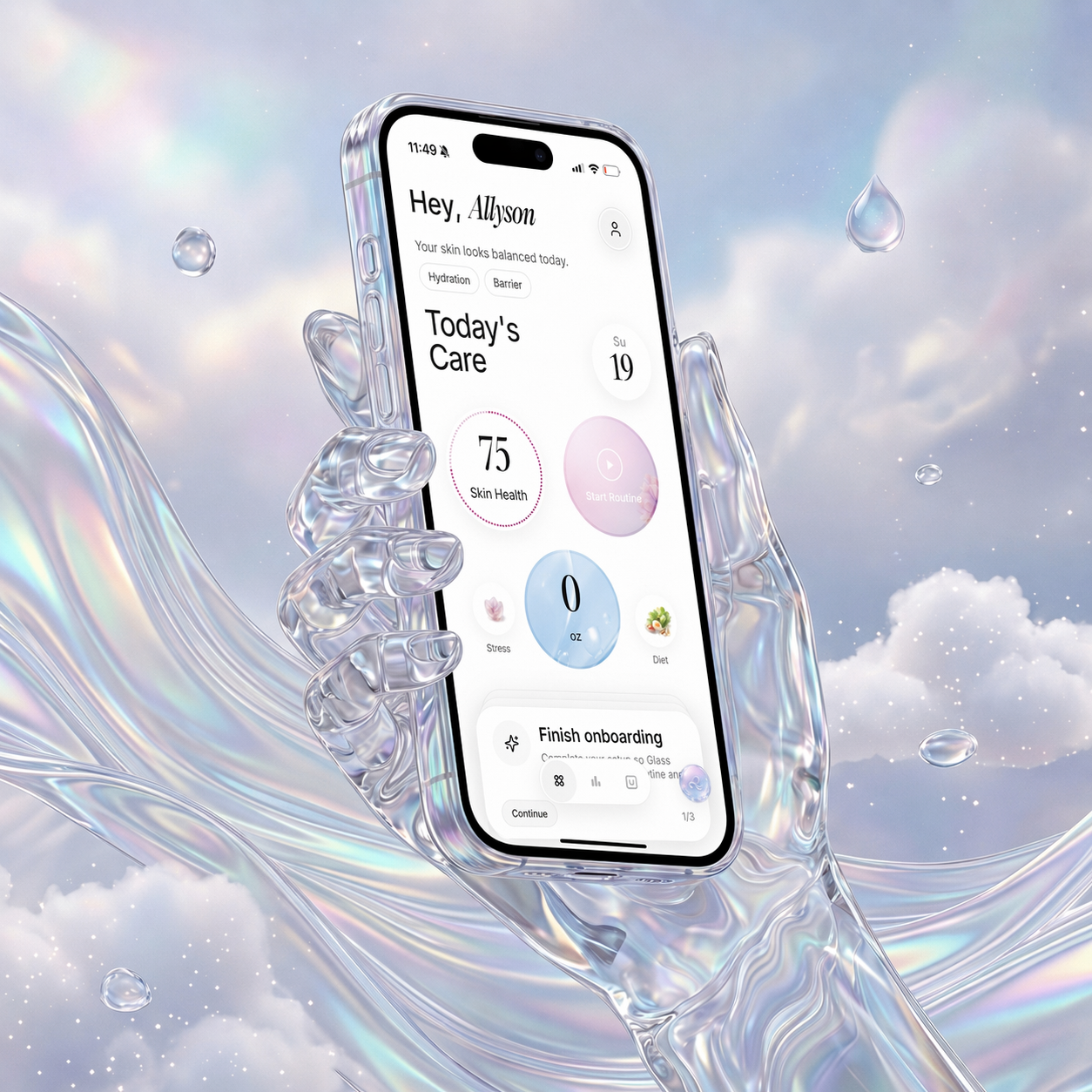
That is why I would put Glass in the routine-and-progress lane first. It is built around scans, product changes, routines, and trend tracking together instead of treating each piece like a separate problem.
What a skincare app should help you decide
I do not want a skincare app to make my skin feel more complicated.
I want it to answer one practical question at a time.
Should I keep using this moisturizer? Did my breakouts start before or after the new serum? Am I actually drier, or did I just take a photo under harsh bathroom light? Am I skipping sunscreen on the same days my dark spots look louder? Did I start retinol and an exfoliating toner in the same week, then blame the cleanser?
Those are useful questions because they lead to better behavior. They slow you down. They make the routine legible.
The weak apps do the opposite. They turn your face into a scoreboard, give you a number, and make you feel like you need to buy something immediately. A score can be helpful, but only if it connects to a calmer next step.
The four types of skincare apps
Most skincare apps fall into four lanes. Some overlap, but the main job still matters.
| Type | Best for | Watch out for |
|---|---|---|
 Skin analysis apps Skin analysis apps | Checking visible changes like acne, dryness, redness, texture, and tone | Treating a camera result like a medical diagnosis |
 Product scanner apps Product scanner apps | Reading ingredients, barcodes, and product roles before buying | Overreacting to one ingredient without your actual skin history |
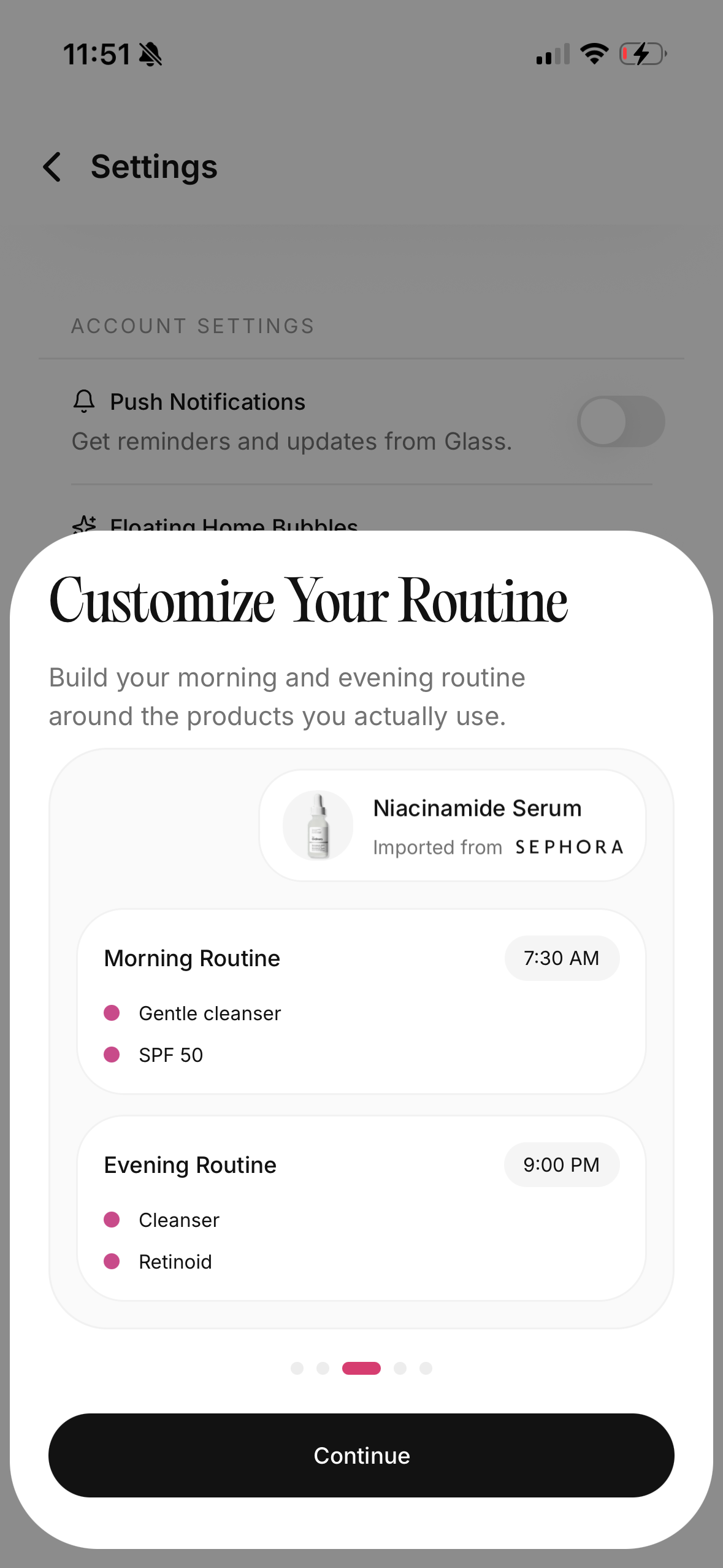 Routine tracker apps Routine tracker apps | Building morning and night consistency | Making the routine so detailed you stop using it |
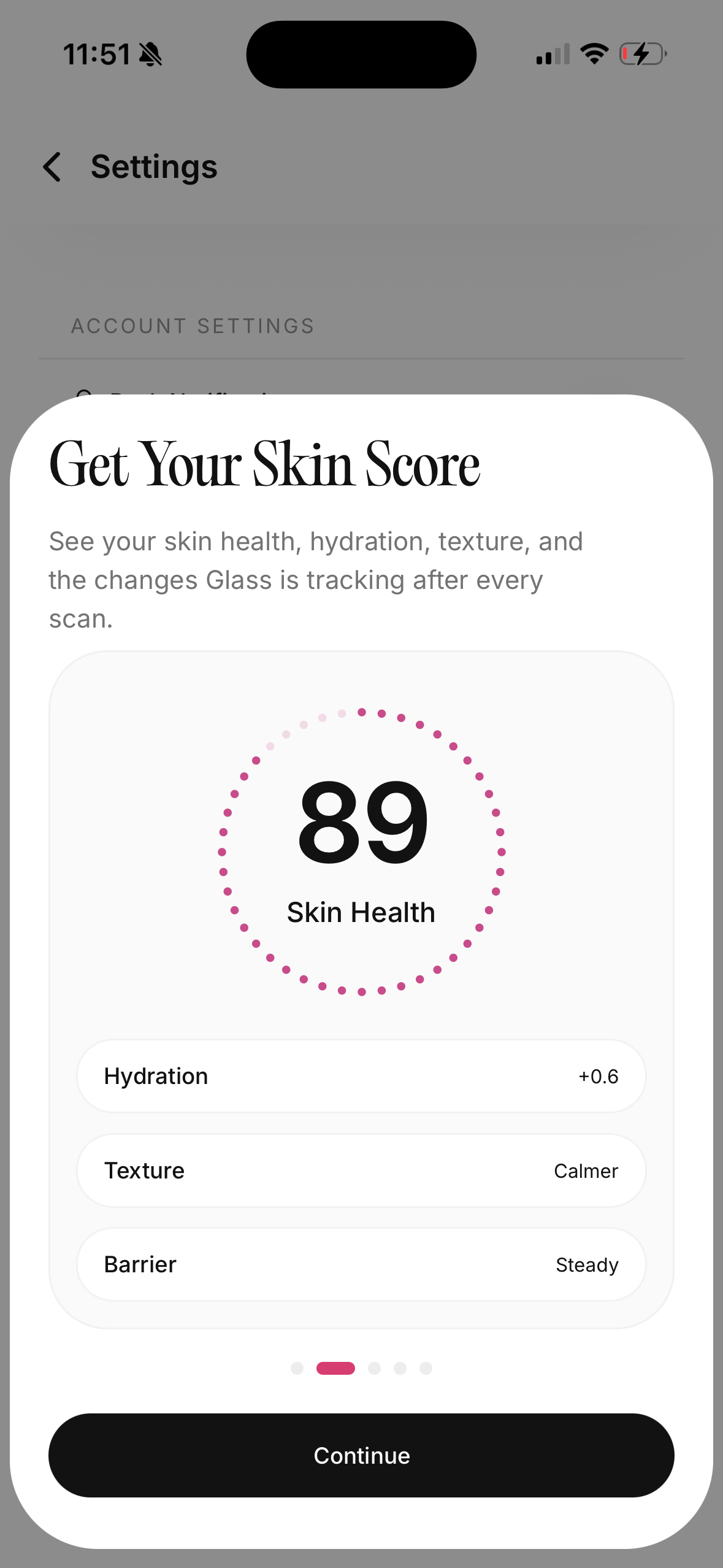 Progress apps Progress apps | Comparing photos and trends over time | Taking daily close-ups until every pore feels urgent |
If your shelf is crowded, start with product tracking. If your skin changes every week, start with progress tracking. If you keep forgetting steps, start with reminders. If you are worried about a painful rash, changing mole, infected bump, or severe acne, skip the app-first mindset and get medical care.
Best overall: Glass
Glass is the app I would choose if I wanted one place for scans, routines, products, and progress.
The reason is simple: skincare only makes sense over time. A single selfie can be noisy. A single product label can be misleading. A single breakout can make you panic. The useful signal comes from the pattern between what you used, what changed, and whether the same thing keeps happening.
Glass is strongest when you use it as a decision journal. You log the cleanser, moisturizer, sunscreen, serum, or treatment you are actually using. You scan your skin in consistent lighting. You watch whether redness, acne, dryness, or texture is moving in the right direction. You build a routine that is possible to repeat instead of a perfect routine you abandon by Thursday.
Who should use it:
- people who keep changing products too quickly
- people who want routine reminders without a cluttered spreadsheet
- people tracking acne, dryness, texture, dark spots, or irritation
- people who want photos and routine context in the same place
- people trying to understand whether a product is helping or just new
Where it can disappoint:
If you want an app to diagnose a skin condition from one photo, that is not the job I would give any consumer skincare app. Glass is better as a tracker and routine companion than as a replacement for a clinician.
Best for ingredient checking: SkinSort-style product scanners
Ingredient scanners are useful when you shop too fast.
They can help you slow down in the aisle and check whether a product contains fragrance, drying alcohols, heavy oils, exfoliating acids, retinoids, or ingredients you personally avoid. That matters if your skin reacts easily or if you keep buying products that do the same job.
The trap is thinking ingredient data tells the whole story.
It does not. A formula is more than a list. Concentration, delivery system, texture, the rest of your routine, your barrier, and your skin history all change the outcome. A product with a flagged ingredient may work well for you. A product with a beautiful ingredient list may still break you out or sting.
Use product scanners to ask better questions, not to outsource judgment.
Good fit:
- you buy too many products from similar categories
- you want to avoid specific ingredients
- you need help understanding product roles
- you want a second look before adding another active
Skip it if:
- you already obsess over every ingredient
- you treat every warning as absolute
- you need help with consistency more than shopping
Best for clean-beauty preferences: Think Dirty-style apps
Some people want an app that helps them avoid certain ingredient categories for personal, environmental, pregnancy-related, fragrance-related, or clean-beauty reasons.
That is a real use case.
The important thing is to keep the app in its lane. A clean-beauty score is not the same thing as a personalized skin-tolerance score. It may help you filter products by your values, but it cannot prove that a moisturizer will calm your barrier or that a serum will not clog your pores.
I would use this kind of app when preferences matter more than treatment planning. It is helpful for narrowing a shelf. It is less helpful for figuring out why your chin broke out after three new products and two late nights.
Good fit:
- you have ingredient categories you prefer to avoid
- you want quicker shopping filters
- you are comparing several similar products
- you like having a cleaner shortlist before reading deeper
Skip it if:
- you need acne or irritation troubleshooting
- you want progress tracking
- you feel anxious after every product score
Best for skin condition caution: Miiskin, SkinVision, and medical-adjacent apps
Some skin apps focus less on beauty routines and more on monitoring lesions, moles, or concerning changes.
That is a different category from routine tracking. It deserves more caution.
The FDA treats some software functions as medical devices when they are intended for diagnosis, treatment, prevention, or similar medical use. That does not mean every skin app is regulated the same way, but it does mean the claim matters. A beauty app that tracks dryness is not the same as a tool that suggests whether a lesion may be dangerous.
If you are tracking a mole, a changing spot, a bleeding lesion, a painful rash, or anything that scares you, the app should never be the final answer. Use photos to document change. Use reminders to avoid forgetting. Then bring the concern to a qualified clinician.
The American Academy of Dermatology also makes a plain point around acne care: a dermatologist can diagnose acne by looking at the breakouts and can tell when something that looks like acne may actually be another condition, such as folliculitis.
Good fit:
- you need organized photos of a spot over time
- you want reminders to check a lesion
- you are preparing for a dermatologist appointment
- you want a record instead of guessing from memory
Skip it if:
- you want reassurance instead of care for a changing spot
- you are using the app to avoid a necessary appointment
- the app makes medical-sounding claims without clear context
Best for routine reminders: simple habit trackers
Sometimes the best skincare app is not the smartest one.
If your real problem is inconsistency, a simple reminder can beat a complex analysis tool. Morning sunscreen. Night cleanser. Retinoid twice a week. Moisturizer after actives. No picking. Clean pillowcase. Replace the sunscreen in your bag.
Those habits sound small because they are small. That is why they work.
I like routine reminders when the routine is already chosen. They are less useful when you are still trying to understand your skin. A reminder to use the wrong product every night is not progress. It is just organized irritation.
Good fit:
- you forget sunscreen
- you skip moisturizer when oily
- you need retinoid spacing
- you want weekly photo reminders
- you are rebuilding after a messy routine
Skip it if:
- your routine is not stable yet
- your skin is reacting badly
- you need to track product changes, not just habits
The app stack I would actually use
I would keep the stack simple.
One app for routine and progress. One optional ingredient checker. That is enough for most people.
If I were rebuilding a routine from scratch, I would use Glass as the home base. I would log the current products, take a baseline scan, build a realistic morning and night routine, and track for two to four weeks before making big changes. If I were shopping, I might use an ingredient scanner to double-check a product before adding it.
I would not use five apps at once. That creates the same problem as using five new serums at once. Too much input, no clear signal.
How to compare apps without getting fooled by the demo
Every skincare app looks best in its screenshots.
The real test is what happens after the first scan.
Ask these questions:
| Question | Why it matters |
|---|---|
| Does it help me decide what to do next? | A score without a next step becomes noise |
| Can I track products and photos together? | Skin changes need routine context |
| Does it separate routine advice from medical claims? | Beauty tracking should not pretend to diagnose |
| Can I use it in under two minutes? | A tracker you avoid is not a tracker |
| Does it work with my real routine? | The best app is useless if it assumes perfect habits |
| Does it respect sensitive skin? | Aggressive advice can make irritation worse |
I would also check how the app handles privacy, subscriptions, cancellation, and data storage. Face photos are personal. Skin concerns are personal. You should understand where your data goes before you upload months of progress photos.
What I would ignore
I would ignore any app that makes your skin feel like a daily emergency.
Daily scoring can be useful for some people, but it can also make normal skin variation feel like failure. Lighting changes. Sleep changes. Hormones change. Weather changes. Your face is not supposed to look identical every morning.
I would also ignore overly confident product recommendations that appear after one scan. Good skincare decisions need context: what you already use, how long you used it, what your skin tolerates, what you can afford, what you will actually apply, and whether the issue needs medical care.
The best app does not make you dependent. It makes you more observant.
A safer way to use skin analysis
Use the same lighting.
Use the same angle.
Use the same distance.
Do not scan with makeup one week and bare skin the next, then treat the results like a perfect comparison. Do not scan after crying, a hard workout, a hot shower, or a sunburn and assume your skin suddenly changed forever.
Weekly photos are enough for most routine tracking. If you are treating acne, irritation, or dryness, daily close-ups can make you overreact before the skin has time to respond.
I would use this rhythm:
- Take a baseline scan.
- Log the current routine.
- Change only one product or habit.
- Track for two to four weeks.
- Review photos in the same lighting.
- Keep, pause, or adjust based on the pattern.
That rhythm is boring. It is also how you stop blaming random products.
When an app is not enough
A skincare app is not enough when the problem is painful, spreading, infected-looking, rapidly changing, bleeding, crusting, or severe.
See a dermatologist or clinician if you have deep cystic acne, acne that is scarring, sudden severe breakouts, a changing mole, a lesion that will not heal, a rash near the eyes, swelling, fever, or anything that feels medically wrong.
This is where apps can still help, but only as support. Bring progress photos. Bring your product list. Bring the timeline. Bring the pattern. That makes the appointment more useful.
The app should help you explain what happened. It should not replace the person trained to diagnose it.
The best choice by situation
If you want one app for routine and progress, use Glass.
If you mainly shop too much, add an ingredient scanner.
If you want clean-beauty filtering, use a clean-beauty app as a preference filter, not as a skin verdict.
If you are tracking a concerning spot, use photos as documentation and get medical care.
If you only forget steps, a habit tracker may be enough.
If you keep changing products because every bad skin day feels like proof, use a tracker before buying anything else.
The routine reset I would start today
Open the app you choose and log only what you currently use.
No fantasy routine. No planned haul. No wishlist. Just the real morning and night steps.
Then ask:
- Which products touch my face every day?
- Which products are new in the last month?
- Which actives am I stacking?
- Which steps do I skip?
- Which concern am I actually trying to improve?
- What would I stop changing for the next two weeks?
That last question is the one most people avoid. But it is often the answer.
Skincare gets clearer when the inputs get quieter.
Bottom line
The best skincare app in May 2026 is not the one with the loudest AI claim or the prettiest score screen. It is the one that helps you understand your own pattern.
Use Glass if you want scans, routines, products, and progress in one place. Use an ingredient scanner if shopping is the problem. Use medical-adjacent tools carefully, and never let an app talk you out of getting a changing, painful, or worrying skin concern checked.
Your skin does not need more panic. It needs better notes, steadier habits, and fewer guesses.
Useful references: FDA on AI in software as a medical device, FDA on mobile medical app policy, and AAD on acne diagnosis and treatment.