The first page looked convincing.
So did the second.
That is the problem with looking for skin care near you. Every clinic can sound clean, modern, and results-driven from a distance. Every facial menu can promise glow. Every med spa can use words like advanced, customized, and rejuvenating until the whole thing starts to blur.
I stopped looking for the prettiest page first.
I started looking for the safest match.
That one change makes the whole decision calmer. You are not trying to find the most impressive clinic in your area. You are trying to find the right kind of appointment for your skin, your risk level, your budget, and the amount of medical judgment the treatment actually needs.
The quick way to choose
If your skin concern is mild and mostly about maintenance, start with a facial or esthetician-led consult.
If the concern is persistent, painful, scarring, spreading, changing, or hard to identify, start with a dermatologist or medical clinician.
If you want injectables, lasers, prescription-strength peels, body contouring, or any treatment that can burn, scar, bruise, or change your face for months, treat the choice like a medical decision, not a beauty errand.
That sounds obvious until you are staring at a menu with thirty options and a first-time discount. The discount is not the decision. The person evaluating your skin is the decision.
Start with the problem, not the service
Most bad bookings begin with the service name.
You see hydrafacial, microneedling, laser facial, chemical peel, acne facial, Botox, filler, dermaplaning, or skin tightening, and you try to guess which one fits. That puts you in the wrong position. You are choosing the tool before anyone has named the problem.
I would start with one plain sentence:
What am I trying to change?
Not the fantasy version. The real one.
Maybe your skin feels dull and congested before an event. Maybe makeup is sitting badly. Maybe your cheeks keep flushing. Maybe your chin acne is leaving marks. Maybe your forehead texture looks bumpy in side light. Maybe you are curious about Botox but nervous about looking frozen. Maybe you have a dark spot that has changed enough to make you uneasy.
Those are different appointments.
The right skin care place should help separate them. A good consult does not rush you straight from complaint to procedure. It asks what changed, how long it has been happening, what you already use, what your skin reacts to, what medications or prescriptions matter, and what result would actually satisfy you.
If the clinic cannot slow down enough to ask those questions, I would not trust it with a stronger treatment.
Facial, esthetician, med spa, or dermatologist?
The easiest way to sort local skin care is by risk.
| Need | Better first stop | Why |
|---|---|---|
| Dullness, dryness, mild congestion, routine confusion | Esthetician or facial studio | Lower-risk support, product guidance, maintenance |
| Acne that scars, painful cysts, rashes, changing spots, rosacea-like flares | Dermatologist or medical clinician | Diagnosis matters before treatment |
| Botox, filler, laser, deep peels, microneedling, body contouring | Qualified med spa or physician office | Medical oversight and complication planning matter |
| Product overload and inconsistent routine | Routine consult plus tracking | The fix may be fewer steps, not more services |
A facial can be excellent when your skin needs maintenance, hydration, extractions from trained hands, or a cleaner routine plan. An esthetician can often see product mistakes quickly because they spend all day looking at real skin under real lighting.
A dermatologist is different. That is where I would go for diagnosis, persistent acne, eczema-like patches, suspicious lesions, severe irritation, hair loss, infections, scarring, medication questions, or anything that feels medically uncertain.
A med spa sits between beauty and medicine. That can be useful, but it also means you need to ask better questions. Botox, filler, lasers, and stronger resurfacing treatments are not casual glow appointments. They require training, screening, sterile habits, emergency planning, and a provider who knows when to say no.
The consultation tells you almost everything
I care less about the lobby and more about the consult.
A strong first consult usually has a few signals:
- They ask what you are currently using.
- They ask what has irritated you before.
- They ask about medications, pregnancy, allergies, recent procedures, and sun exposure when relevant.
- They explain why a treatment fits, not just what it costs.
- They tell you what the treatment will not fix.
- They give aftercare that sounds specific.
- They are comfortable telling you to wait, simplify, or see a dermatologist.
That last one matters most. A place that can say “not today” is usually safer than a place that says yes to everything.
I get suspicious when a clinic turns every concern into the most expensive service on the menu. I also get suspicious when the plan sounds identical no matter what skin type, tone, medication history, or goal you bring in. Skin is not that generic.
What to ask before you book
You do not need to interrogate anyone. You just need a few adult questions.
For facials:
- What skin concerns is this facial best for?
- Will you do extractions, and how do you decide when not to?
- What products or ingredients should I pause before coming in?
- What should I avoid for the next few days?
- If my skin reacts easily, how will you adjust the treatment?
For med spa treatments:
- Who will perform the treatment?
- What license or training do they have for this procedure?
- Who is the supervising medical professional?
- Will someone review my medical history first?
- What are the common risks for my skin tone and concern?
- What happens if I have a complication after I leave?
For injectables:
- What product are you using?
- How many units or syringes are you recommending, and why?
- What result are you trying to avoid?
- Can we start conservatively?
- What is your plan if I bruise, swell, dislike the result, or need follow-up?
For lasers and peels:
- Is this safe for my skin tone?
- How much downtime is realistic?
- What should I stop before treatment?
- What does a burn, pigment change, or bad reaction look like?
- Who handles complications?
The goal is not to sound difficult. It is to see whether the provider becomes clearer when the stakes get more specific.
Red flags I would not ignore
Some red flags are obvious. Dirty rooms. Rushed intake. No aftercare. Prices that feel too good for a medical treatment. A provider who gets annoyed when you ask about credentials.
Others are quieter.
I would be careful if the clinic pushes same-day treatment before understanding your skin, especially for injectables, lasers, peels, or anything with downtime. Same-day treatment is not always wrong, but pressure is wrong.
I would also be careful with vague supervision. A medical director on a website is not the same as meaningful oversight. You want to know who is responsible if something goes wrong and whether that person is actually available.
I would pause if every before-and-after photo looks filtered, cropped, or impossible to compare. Good results should not need bad lighting tricks.
I would leave if the consultation makes you feel embarrassed into buying. Skincare already makes people vulnerable. A good provider should help you think more clearly, not make you feel like your face is a sales problem.
Price is useful, but it is not the main filter
I understand why price matters. Local skin care can get expensive fast.
But the cheapest med spa is not always the best value, and the most expensive clinic is not automatically the safest. The better question is what the price includes.
Does it include a real consultation? Follow-up? Photos? Conservative planning? Medical review? Clear aftercare? A provider who will answer if something feels wrong the next day?
For a basic facial, a lower price may be perfectly reasonable. For filler near the eyes, aggressive resurfacing, or laser on pigment-prone skin, I would not make price the first filter. I would rather do less, less often, with someone better.
The expensive mistake is not skipping a discount. The expensive mistake is paying to create a problem that takes months to calm.
Match the treatment to your tolerance for downtime
People underestimate downtime because marketing language makes procedures sound tidy.
Glow facial. Lunch break laser. Baby peel. Preventative Botox. Skin tightening. Collagen boost.
Those names can be softer than the actual recovery.
Before booking, ask what your face may look like that night, the next morning, three days later, and two weeks later. Ask whether you should avoid sun, workouts, makeup, retinoids, exfoliating acids, waxing, shaving, heat, swimming, or alcohol. Ask what is normal and what is not.
If you have a wedding, trip, photoshoot, presentation, or first date soon, do not gamble on a new aggressive treatment. Maintenance facials are one thing. Lasers, deep peels, filler, and strong actives deserve more margin.
Skin tone should change the conversation
Any provider offering lasers, peels, microneedling, or pigment work should be comfortable talking about skin tone and post-inflammatory hyperpigmentation.
This is not a niche concern. Some treatments carry a higher risk of dark marks, light marks, burns, or uneven pigment depending on skin tone, device settings, aftercare, and provider experience. If your provider brushes that off, I would not proceed.
Ask directly:
How do you adjust this treatment for my skin tone?
A good answer should be specific. It may mention conservative settings, pre-treatment routines, sun avoidance, patch testing, slower treatment plans, or choosing a different procedure entirely. A weak answer sounds like “everyone does fine.”
Everyone does not do fine with every treatment.
Do not book a procedure to solve a routine problem
Sometimes the local appointment is not the missing piece.
Sometimes your routine is simply too chaotic.
If you are using a cleanser that strips your face, three actives that overlap, a moisturizer you secretly hate, and sunscreen only when you remember, a facial may make you look better for a week. Then the same pattern comes back.
That is where I would clean up the daily system first:
- Gentle cleanse.
- Moisturizer that matches your skin feel.
- Daily sunscreen.
- One treatment lane at a time.
- Photos and notes in consistent lighting.
An appointment should add judgment to that system. It should not become a substitute for it.
How Glass fits before and after an appointment
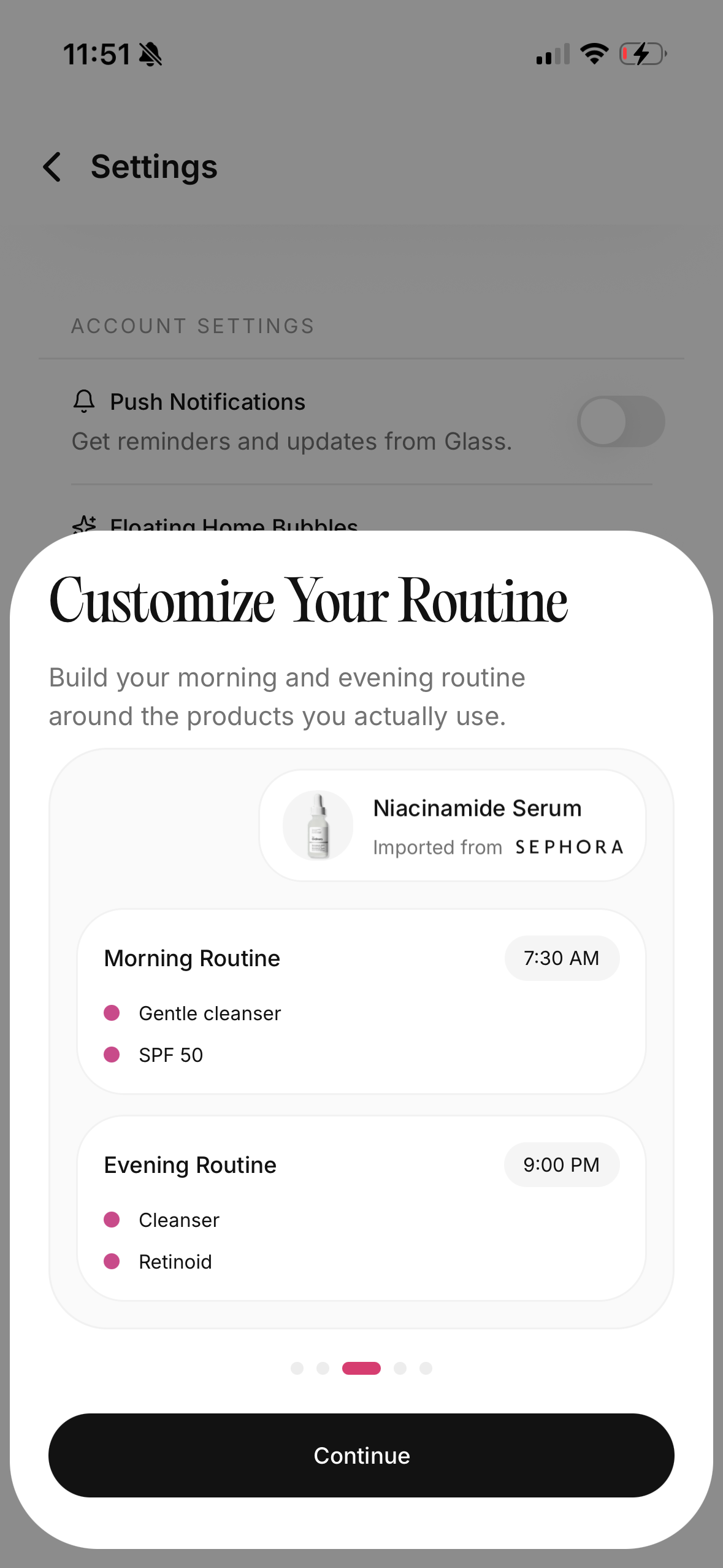
I would use Glass as the memory layer around local skin care.
Before an appointment, it helps you bring cleaner context:
- current morning routine
- current night routine
- products you recently added
- progress photos
- flare timing
- dryness, oiliness, redness, or texture changes
- lifestyle factors that may be obvious only after tracking
After an appointment, it helps you avoid the classic mistake: changing everything at once.
If a provider gives you aftercare, put it into your routine. If they tell you to pause retinoids or acids, log that. If they recommend a new cleanser or moisturizer, add it as one change instead of replacing the whole shelf.
That is how you learn from the appointment instead of turning it into another blur.
The treatment menu, translated
Local menus can make normal services sound mysterious. Here is the plain-English version.
| Treatment | Usually for | Be careful if |
|---|---|---|
| Classic or custom facial | Hydration, congestion, maintenance, routine guidance | You have active rash, infection, severe irritation, or painful cysts |
| Hydrafacial-style treatment | Glow, congestion, smoother feel, event prep | You expect it to fix deep acne, pigment, or scarring alone |
| Chemical peel | Texture, pigment, acne marks, dullness | You have sensitive skin, recent sun, darker pigment risk, or no downtime |
| Microneedling | Texture, acne scars, collagen support | You have active acne, infection risk, keloid tendency, or poor aftercare |
| Laser | Pigment, redness, hair, resurfacing, vessels | Provider cannot explain device choice and skin tone risk |
| Botox or similar neuromodulator | Movement lines, frown lines, forehead lines, crow's feet | You feel pressured into more units than you understand |
| Filler | Volume, contour, selected folds or hollows | Provider cannot explain vascular risk and reversal planning |
This table is not a prescription. It is a filter. If the service does not match the problem, do not force it.
When to choose a dermatologist first
I would start with dermatology if the issue is painful, spreading, scarring, recurring, bleeding, changing, infected-looking, or hard to identify.
That includes:
- deep cystic acne
- acne leaving pits or scars
- sudden severe breakouts
- rosacea-like flushing and bumps
- eczema-like patches
- new or changing moles
- persistent rashes
- hair loss with scalp symptoms
- dark spots that are changing
- reactions that keep returning
An esthetician may help with supportive care, but diagnosis changes the plan. Treating the wrong condition aggressively can make it worse. Perioral dermatitis, rosacea, folliculitis, allergic contact dermatitis, acne, and irritation can overlap visually when you are looking in a bathroom mirror.
If you are not sure what it is, do not let a treatment menu decide for you.
When a facial makes perfect sense
A facial makes sense when you want maintenance, comfort, gentle exfoliation, hydration, extractions, or help understanding your routine. It can also be useful before you overhaul products because a good esthetician can tell you what your skin looks like in person.
I like facials most when the goal is realistic:
- skin feels smoother
- congestion is reduced
- hydration improves
- the routine gets simpler
- you understand what to stop doing
I like them least when they are sold as a cure for everything. A facial cannot replace acne medication when acne is severe. It cannot remove deep scars in one visit. It cannot outwork a routine that irritates your face every night.
The best facial is often the one that gives you fewer things to do afterward.
When to walk away and think
You can always leave and decide later.
That is a rule worth keeping.
Walk away if you do not understand the treatment, the risk, the price, the aftercare, or who is responsible for follow-up. Walk away if the provider seems rushed. Walk away if the plan changed from one mild concern to a thousand-dollar package before anyone explained why.
Good providers do not need panic to close the appointment.
If you still want the treatment tomorrow, next week, or after reading the aftercare twice, you can book it. Your skin will not punish you for taking one more day to think.
My personal checklist before booking
This is the checklist I would use now:
- Can I explain the skin concern in one sentence?
- Do I know whether this is cosmetic, medical, or unclear?
- Does the provider have the right training for the treatment?
- Did they ask enough questions before recommending anything?
- Do I understand the realistic result?
- Do I understand the risks and downtime?
- Do I know what to stop before and after?
- Is there a clear follow-up path?
- Am I choosing this because it fits, or because I feel pressured?
If too many answers are fuzzy, I would not book yet.
A better way to use local skin care
The best local skin care appointment should make you feel more oriented.
You should leave knowing what your skin needs, what it does not need, what to do at home, and what would be worth considering later. You should not leave with a bag of products you cannot explain and a procedure plan you agreed to because the room moved too fast.
Use local expertise for what it does best: eyes on skin, trained hands, better judgment, and procedures that should not be guessed at alone.
Use your daily routine for what it does best: consistency, barrier support, sunscreen, product discipline, and pattern tracking.
That combination is calmer than chasing every treatment in your area.
If you want to compare nearby options, start with skin care near me, then narrow by the service you actually need: facials, chemical peels, microneedling, laser, Botox, fillers, or Hydrafacial.
Then bring your routine with you.
FAQ
What kind of skin care appointment should I book first?
Book a facial or esthetician consult first if your concern is mild, cosmetic, or routine-related. Book a dermatologist or medical consult first if the concern is painful, persistent, scarring, spreading, changing, or hard to identify.
Is a med spa the same as a dermatologist?
No. A med spa may offer medical-style cosmetic treatments, but that does not make it the same as a dermatology practice. For diagnosis, prescriptions, suspicious lesions, severe acne, rashes, or complex skin disease, start with a dermatologist or qualified medical clinician.
What should I ask before Botox, filler, or laser?
Ask who performs the treatment, what their training is, who supervises them, what product or device they use, what risks apply to your skin, what aftercare looks like, and who handles complications.
Are cheap med spa deals a bad sign?
Not always, but unusually low pricing for injectables, lasers, or stronger procedures should make you ask more questions. For higher-risk treatments, training, screening, follow-up, and safety planning matter more than getting the lowest price.
Should I stop my skincare before a facial or peel?
Ask the provider before you go. Many treatments require pausing retinoids, exfoliating acids, benzoyl peroxide, waxing, strong vitamin C, or sun exposure beforehand. The right pause depends on the treatment and your skin.
How do I know if I need a doctor instead of a facial?
Choose medical care if you have deep painful acne, scarring, severe irritation, a spreading rash, infection signs, a changing mole, unexplained pigment changes, or symptoms that keep returning despite gentle care.
Useful medical references: American Academy of Dermatology on selecting a dermatologist, AAD questions to ask before cosmetic treatment, American Society of Plastic Surgeons on choosing a medical spa, and American Medical Association on medical spa oversight.