
The menu is the trap.
Not always.
But often enough.
You search for a facial, find a med spa near you, open the treatment page, and suddenly every option sounds like the responsible choice. Hydrating facial. Acne facial. Chemical peel. Microneedling. IPL. Laser resurfacing. Botox. Filler. Memberships. Packages. A first-time special with a countdown timer.
That is a lot to process when your skin is already making you feel impatient.
If I were booking a med spa facial or skin treatment in May 2026, I would slow the decision down before picking a service. Not because med spas are bad. A good provider can be incredibly helpful. But the right treatment depends on what your skin is doing, who is performing the service, what credentials sit behind the room, and whether the plan fits your actual goal.
The question is not "Which facial is best?"
The better question is: "What am I trying to fix, and is this the safest treatment for that job?"
The quick answer
I would book a med spa facial when I want a professional skin reset, extractions from someone trained, hydration support, texture help, or a treatment plan that connects home care with in-office work.
I would not book one blindly for painful cystic acne, spreading irritation, a suspicious lesion, a rash, infection signs, or anything that feels medical before cosmetic. Those belong with a dermatologist, primary-care clinician, or qualified medical provider first.
Here is the decision table I wish more people used before booking.
| What you are dealing with | Better first move | What to avoid |
|---|---|---|
| Mild clogged pores and dull texture | Consultation plus gentle facial or extraction-focused facial | Jumping straight to an aggressive peel |
| Inflamed acne with tender bumps | Acne-focused consult, possibly dermatologist care | Deep picking, harsh exfoliation, strong same-day add-ons |
| Post-acne marks | Ask about pigment-safe options and sunscreen plan | Expecting one facial to erase discoloration |
| Fine lines or movement lines | Medical consult for neuromodulators if appropriate | Buying units without understanding placement and follow-up |
| Texture, scars, or sun damage | Consult for microneedling, peel, IPL, or laser suitability | Booking device treatments without skin-type screening |
| Sensitive or barrier-damaged skin | Calm the barrier first, then reassess | Heat, fragrance-heavy facials, stacking actives |
I would start with the skin problem, not the treatment name
Treatment names are marketing language.
Skin problems are more concrete.
"Acne facial" can mean a gentle cleanse and extractions at one place, a stronger exfoliating treatment at another, and a branded protocol somewhere else. "Laser facial" can mean several different technologies. "Glow facial" may mean hydration, resurfacing, dermaplaning, LED, oxygen, or a mix of steps that sound relaxing but may not match your skin.
Before I book, I would write down the actual problem in plain language:
- My pores feel congested and makeup sits badly.
- I keep getting inflamed chin breakouts.
- My skin feels tight and burns after products.
- I have dark marks after acne.
- I want forehead lines softened.
- I want smoother texture, but I scar or pigment easily.
- I have redness and do not know if it is acne, rosacea, irritation, or something else.
That list changes the appointment.
If the concern is clogged pores, an extraction-focused facial may make sense. If the concern is deep painful acne, a spa facial may not be enough. If the concern is brown marks, sunscreen and pigment-safe planning matter more than chasing the strongest peel. If the concern is facial movement lines, a facial is not the same lane as Botox.
The more specific you are, the less likely you are to be sold the treatment that happens to be available that afternoon.
Acne facials can help, but they are not acne treatment for everyone
An acne facial can be useful when the problem is mild congestion, blackheads, whiteheads, surface breakouts, or a routine that needs professional cleanup.
It is less useful when acne is deep, painful, cystic, scarring, sudden, or spreading.
The American Academy of Dermatology recommends seeing a board-certified dermatologist when acne is severe, painful, leaving scars, or not improving with treatment. That line matters. If your bumps are deep under the skin, if they leave dents, or if you are cycling through products without progress, a facial may feel productive while the real treatment is being delayed.
I do not think of acne facials as fake. I think of them as limited.
They can support a plan. They should not replace diagnosis when the skin is giving stronger warning signs.
For mild acne-prone skin, I would ask:
- Will you do extractions, and who performs them?
- What do you do if a bump is too inflamed to extract safely?
- Which actives are used during the facial?
- Should I stop retinoids, acids, or benzoyl peroxide before the appointment?
- What should I expect the next day?
- What would make you refer me to a dermatologist?
That last question tells you a lot. A careful provider knows where their lane ends.
The consultation should feel like a filter
A good consultation does not feel like ordering from a menu.
It feels like narrowing risk.
The provider should ask about your skin history, medications, recent procedures, allergies, pregnancy status when relevant, cold sore history before certain resurfacing treatments, isotretinoin history, current products, sun exposure, and how your skin heals. They should look at your skin in good light. They should be able to explain why a treatment fits and why another treatment does not.
If someone barely looks at your skin before recommending a package, I would pause.
If someone cannot explain downtime, side effects, contraindications, or aftercare in normal language, I would pause.
If someone makes you feel embarrassed for asking about credentials or pricing, I would leave.
This is especially true for injectables, laser, deeper peels, and microneedling. Those are not just "beauty services." They are procedures with real technique, real risk, and real aftercare.

Credentials matter more when the treatment breaks the skin
I care less about credentials for a gentle hydrating facial than I do for a laser, injection, or procedure that creates controlled injury.
But I still care.
For a facial, I want to know the esthetician is licensed where licensing applies and trained on the specific protocol. For injectables, I want to know who is injecting, what license they hold, who supervises the practice, what product is being used, and what happens if something goes wrong. For lasers, I want to know the device, the provider's training, skin-type experience, eye protection process, and whether a medical professional is involved when required.
The U.S. Food and Drug Administration warns that injectable dermal fillers should be administered by licensed healthcare providers and that complications can include infection, lumps, discoloration, and rare but serious vascular problems. That is not meant to scare you away from all injectables. It is meant to remind you that a discount is not a qualification.
For Botox and similar neuromodulators, I would ask:
- What product are you using?
- How many units are you recommending and why?
- What areas are you treating?
- What result is realistic for my face?
- When is follow-up included?
- Who handles complications or asymmetry?
For filler, I would be even more conservative:
- What filler are you using?
- Why that product for this area?
- Do you have hyaluronidase available for hyaluronic acid filler issues?
- What are the emergency signs I should know?
- Can I see before-and-after photos of your own work?
If the answer sounds rushed, I would not book the needle.
Pricing should be understandable before you are in the chair
I do not need every med spa to be cheap.
I need the pricing to be clear.
There is a difference.
A provider may not be able to quote exact Botox units without seeing your face move. A laser package may depend on area size and settings. Acne treatment may need a consult before the right plan is obvious. That is fair.
But you should still be able to understand the pricing structure before you feel committed.
Ask:
| Question | Why it matters |
|---|---|
| Is this priced per session, area, unit, or package? | You need to know what the number actually means |
| What is included in the appointment? | Consultation, numbing, aftercare, follow-up, and photos may vary |
| What is optional? | Add-ons can quietly change the real cost |
| How many sessions are typical? | One visit may not match the result you expect |
| What happens if I stop after one? | Some plans only make sense as a series |
| Is there a membership commitment? | A monthly fee can be useful or annoying depending on your habits |
The moment I feel pressure to decide before I understand the cost, I slow down.
That is not being difficult. That is protecting the relationship.
I would not stack aggressive treatments on reactive skin
Reactive skin needs fewer variables, not more.
If your face is already burning, peeling, tight, rashy, or freshly irritated from a new product, a stronger treatment is usually not the smartest next move. A facial that includes heat, exfoliation, fragrance, extractions, dermaplaning, or acids can turn a shaky barrier into a worse week.
I would first rebuild the boring basics:
- gentle cleanser
- moisturizer that does not sting
- sunscreen you can tolerate
- no scrubs
- no new strong actives
- no product hopping for a few days
Then I would reassess.
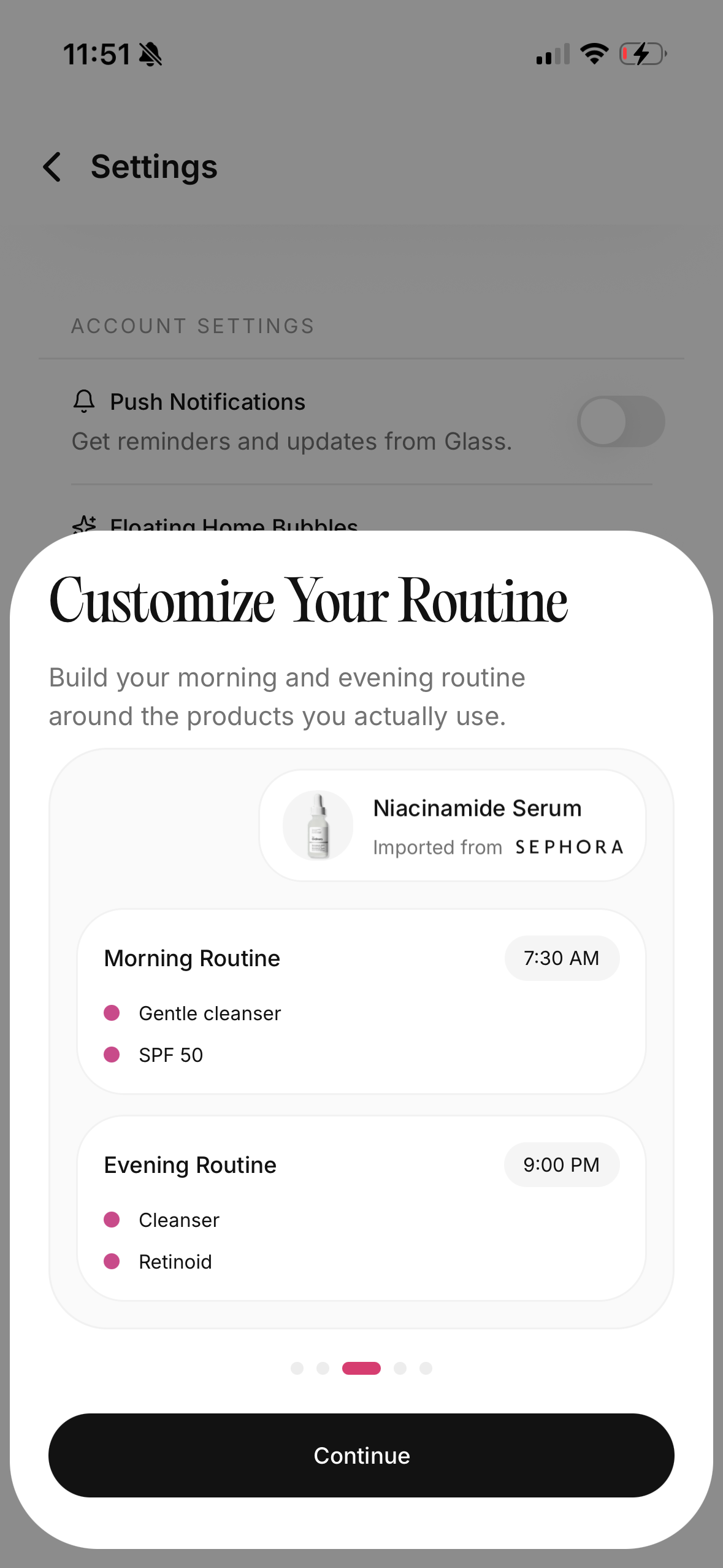
Glass is useful here because it gives the chaos somewhere to go. You can log what you used, what burned, what you paused, and whether your skin calmed down. That record is much better than trying to explain three weeks of product changes from memory during a consult.
If you are deciding between a facial and repairing your barrier, repair the barrier first.
The facial will be easier to judge when your skin is not already angry.
What I would ask before a chemical peel
Peels live on a spectrum.
Some are superficial and gentle. Some are stronger. Some are not appropriate for every skin tone, every season, or every recent product history. The word "peel" by itself does not tell you enough.
I would ask:
- What acid or blend is being used?
- How strong is it?
- Is this appropriate for my skin tone and pigment history?
- What should I stop before and after?
- How much peeling, redness, or darkening can happen?
- How many sessions are usually needed?
- What sunscreen plan do you expect from me?
If the provider cannot talk about pigment risk, especially for deeper skin tones or people who mark easily, I would be careful.
Post-inflammatory hyperpigmentation is not a tiny detail. It can last longer than the breakout or texture issue that made you book the peel in the first place.
What I would ask before laser or IPL
Laser and IPL are where I get strict.
Different devices do different jobs. Hair removal, redness, brown spots, acne marks, scars, resurfacing, and general glow are not the same target. Your skin tone, tan status, medications, history of melasma, and tendency to pigment all matter.
I would ask:
- What device are you using?
- Is it laser or IPL?
- What exactly are we treating?
- How do you adjust settings for my skin tone?
- What are the risks for burns or pigmentation?
- What should I avoid before and after?
- How many sessions are realistic?
- What will my skin look like tomorrow, in one week, and in one month?
I would also ask who is allowed to operate the device in that state and who supervises complications.
That may feel awkward the first time.
Ask anyway.
What I would ask before microneedling
Microneedling sounds simple because the concept is easy to understand: create controlled micro-injuries so the skin can remodel. The execution is what matters.
I would ask about device type, needle depth, sterile process, numbing, aftercare, downtime, and whether active acne is present in the treatment area. I would not microneedle over infected, inflamed, or suspicious skin.
If the goal is acne scars, I would want a realistic answer about scar type. Rolling scars, boxcar scars, ice-pick scars, and discoloration do not all respond the same way. Sometimes microneedling is part of the plan. Sometimes laser, subcision, TCA CROSS, filler, or a combination is discussed by a dermatologist or qualified medical provider.
One treatment can help some people look fresher. Scar remodeling usually takes more patience.
What to do the week before the appointment
The week before a med spa facial is not the time to test your entire shelf.
I would keep the routine steady and simple. No surprise peel pads. No new retinoid. No aggressive scrub because you want to "prepare." No self-extraction the night before because you got nervous.
Bring a list of:
- current cleanser, moisturizer, sunscreen, and treatments
- prescription topicals or oral medications
- recent peels, lasers, waxing, filler, Botox, or microneedling
- allergies or reactions
- history of cold sores if resurfacing is discussed
- pregnancy or breastfeeding status if relevant
- your actual budget
- photos of flare-ups if your skin is calmer that day
The budget belongs on the list.
Not because you owe anyone your private finances. Because a good plan should fit your life. If the plan only works when you buy six sessions, three products, and a membership you did not want, you need to know that before the treatment starts.
What to do after
Aftercare should be boring.
That is usually a good sign.
Most people do not need to punish their skin after a facial or procedure. They need to follow the provider's instructions, avoid picking, protect from sun, pause strong actives if told to, and watch for symptoms that do not match the expected recovery.
For a basic facial, you may be told to keep the routine gentle for a day or two. For peels, lasers, microneedling, or injectables, the instructions can be much more specific. Follow the exact plan from the provider who treated you.
If you get new pain, swelling, heat, pus, blistering, vision symptoms, severe headache, spreading redness, fever, or anything that feels wrong, do not try to solve it with a skincare product. Contact the provider or seek medical care.
How I would compare two med spas
If two places look similar online, I would compare the parts that are harder to fake.
| What I would compare | Better sign | Worse sign |
|---|---|---|
| Consultation style | They ask before recommending | They sell before listening |
| Credentials | Clear provider role and supervision | Vague "expert team" language |
| Photos | Their own before-and-after work | Stock-looking images only |
| Pricing | Structure explained early | Price appears after pressure |
| Treatment menu | Clear indications and limits | Every treatment promises everything |
| Aftercare | Written instructions and contact path | "You'll be fine" with no detail |
| Referrals | They know when to send out | They claim to handle every skin issue |
I also look for how they talk about no.
A provider who can say "I would not do that today" is usually safer than one who can turn every concern into a same-day service.
Where Glass fits before and after the visit
Glass is not a replacement for a trained provider.
It is the place I would keep the evidence.
Before the visit, I would use it to track the routine, take progress photos in consistent lighting, and write down what is changing. After the visit, I would log the treatment date, pause or restart products according to instructions, and take photos far enough apart to see real movement.
That matters because med spa results can be subtle at first.
You may feel smoother before you look different. Redness may drop before marks fade. A treatment may make skin temporarily dry before it settles. If you judge everything from one bathroom mirror moment, you can overreact.
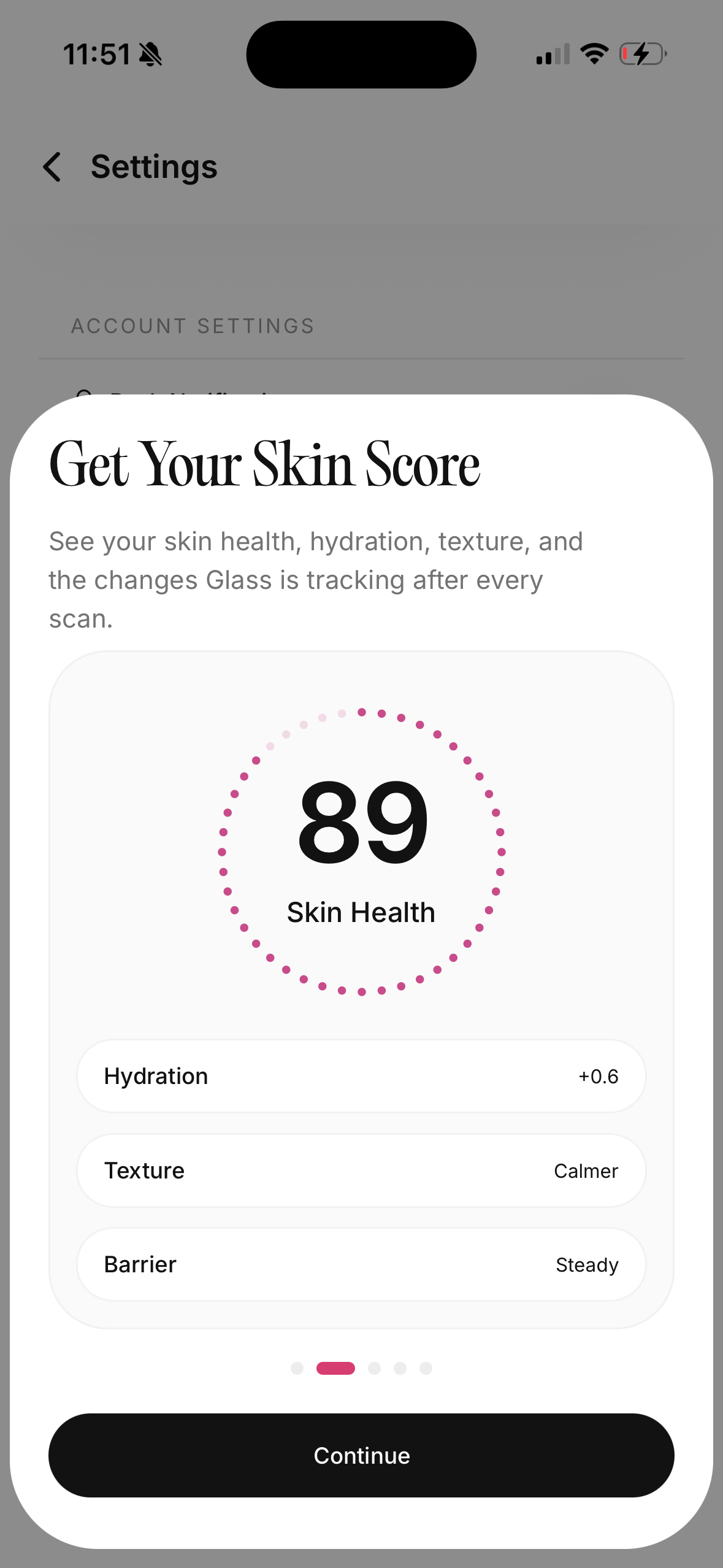
Use the app to keep the timeline honest:
- what treatment you had
- who performed it
- what products you paused
- what products you restarted
- how your skin felt the next day
- when redness, flaking, or tenderness resolved
- whether the result matched the promise
That record helps the next appointment become smarter.
The questions I would bring on my phone
I would not trust myself to remember everything in the room.
Here is the note I would bring:
- What is the safest treatment for my actual concern?
- What would you not do on my skin today?
- Who performs the treatment, and what training do they have?
- What product, device, acid, or injectable are you using?
- What are the common side effects?
- What are the rare but serious risks?
- What should I stop before and after?
- What will I look like tomorrow?
- How many sessions are realistic?
- What is the full cost before optional add-ons?
- What should make me call you?
- When should I see a dermatologist instead?
The answers do not need to be fancy.
They need to be clear.
The bottom line
A med spa facial can be worth it when the provider listens, matches the treatment to your skin, explains the risks, and gives you aftercare that makes sense.
It is not worth it when the appointment feels rushed, the pricing is foggy, the credentials are vague, or the treatment is stronger than your skin can handle.
If you are searching for a place to start, use the Glass skin care directory to compare local providers, then bring better questions to the consult. If you are trying to keep your routine steady before or after treatment, use Glass to track products, photos, and recovery notes.
The best med spa visit is not the one with the longest menu.
It is the one where you leave with a plan you actually understand.
Useful references: AAD guidance on acne, AAD guidance on acne scars, and FDA dermal filler safety information.