Facial scars are different from scars hidden under clothing.
They move when you talk. They catch light when you turn your head. They can affect how makeup sits, how sunscreen looks, how shaving feels, and how comfortable you are in photos. A small mark on the cheek can feel larger because it lives in the place people look first.
That emotional weight is real, but it can also push people into rushed choices. In 2026, I would handle facial scars with a whole-face plan: map what is visible, separate color from contour, protect the skin every day, use camouflage without shame, and prepare for a consultation only after you know what you want help with.
Why facial scars feel so visible
The face has expression, shadow, oil, hair growth, makeup, sunscreen, and constant exposure. A scar on the jaw may look quiet straight-on and obvious when you turn. A cheek depression may show only in side lighting. A raised scar near the mouth may tug when you smile.
That is why facial scar care is not just about scar type. It is also about where the scar sits and what it interrupts: cheek smoothness, jawline shaving, lip movement, brow symmetry, or the way foundation reflects light.
The goal is not to stare harder. It is to look more intelligently so the plan fits the real problem.
Make a visual map first
Before adding products or booking a procedure, divide the face into zones.
| Zone | What to notice | Why it matters |
|---|---|---|
| Forehead | Lines, acne marks, raised spots, texture under shine | Oil and expression can exaggerate unevenness |
| Temples | Pits from acne, hairline irritation | Often missed in daily sunscreen and photos |
| Cheeks | Pitted scars, rolling shadows, brown marks | Most common area for acne-scar texture |
| Nose | pores, redness, old injury marks | Texture may not always be scarring |
| Mouth and chin | movement, picking marks, shaving bumps | Motion and irritation change healing |
| Jawline | cystic acne scars, ingrown hairs, raised scars | Acne, shaving, and friction overlap |
This map keeps you from treating the whole face as one surface. A cheek acne scar, a raised jawline scar, and a flat brown chin mark should not automatically get the same plan.
Sort by color, contour, and height
Facial scars are easier to understand when you use three questions.
Is it color? Flat red, pink, purple, brown, gray-brown, or tan marks may be post-inflammatory color rather than a true textural scar.
Is it contour? Indented skin points toward atrophic scarring, including ice-pick, boxcar, or rolling acne scars.
Is it height? A raised firm scar may be hypertrophic or keloid-type tissue, especially if it extends, itches, hurts, or grows.
Cleveland Clinic explains that acne scars can result from tissue loss that creates indentations or excess collagen that creates raised scars. That simple split is useful on the face because the treatment path changes immediately.
The daily protection layer
Daily protection is not glamorous, but it decides how visible many facial scars become.
Sunscreen will not lift an indentation. It can reduce the chance that surrounding redness or pigmentation becomes darker and more stubborn. It also matters if you use retinoids, acids, pigment-support products, or any professional treatment that makes the skin more sun-sensitive.
Choose a sunscreen you can actually wear. A perfect formula that pills under makeup or stings every morning will not be repeated. For scar-prone skin, the best sunscreen is often the one that layers cleanly, does not make texture look greasy, and does not trigger breakouts.
Camouflage is a valid daily tool
Makeup, tinted sunscreen, beard shaping, hairstyle choices, and strategic powder are not failures. They are part of living with visible skin while treatment decisions unfold.
For flat redness, a tiny amount of green corrector or a flexible concealer can reduce the need for heavy foundation. For brown marks, a peach or orange corrector may help depending on skin tone. For pitted texture, very thick matte base can sometimes collect in dips, so thin layers and targeted coverage often look smoother.
For raised scars, avoid piling product around the edge if it creates a ring. Sometimes the better camouflage is evening the surrounding color, not trying to flatten the scar visually.
Makeup texture mistakes to avoid
Facial scar camouflage usually fails for one of three reasons: too much product, too much powder, or too much shine.
Heavy base can settle into atrophic scars. Dry powder can cling around healing marks. Very dewy products can reflect light off uneven texture and make shadows more obvious. None of this means you cannot wear makeup. It means the application should be thin, flexible, and tested in the light where you actually spend your day.
Take one photo in bathroom light and one near a window before deciding a product "works." Scar visibility changes with angle.
Shaving, hair removal, and friction
Facial scar care also has to account for shaving, waxing, threading, masks, helmets, collars, and hands.
If the jawline has raised scars or healing acne, shave with less pressure and replace blades often. If bumps appear after shaving, ingrown hairs or folliculitis may be part of the issue. Do not treat every bump as acne and every mark as a scar.
Avoid waxing or aggressive hair removal over irritated skin, fresh procedures, retinoid-sensitive areas, or open marks unless a clinician says it is safe. Repeated trauma can keep a scar-looking area inflamed.
A steady routine for the whole face
The routine around facial scars should be boring enough to repeat.
Morning:
- Gentle cleanse or rinse.
- Tone-support serum only if tolerated.
- Moisturizer where needed.
- Broad-spectrum sunscreen.
- Makeup or tint if desired.
Night:
- Cleanser that removes sunscreen and makeup without stripping.
- Acne-control, retinoid, or pigment-support step if appropriate.
- Moisturizer.
If you keep changing actives, it becomes hard to tell whether the skin is improving or just irritated. A routine tracker can help you notice when a scar looks worse because the barrier is dry, not because the scar itself changed.

When skincare is enough for now
Skincare may be a reasonable first phase when the concern is mostly flat color, recent inflammation, dryness around marks, or new acne prevention. It is also a useful holding pattern while you save for a consult or wait for active acne to calm.
Useful roles include azelaic acid for blemish-prone uneven tone, retinoids for acne control when appropriate, moisturizers for barrier support, and sunscreen for daily protection. For example, The Ordinary Azelaic Acid fits a simple tone-support role for some routines.
The expectation should stay conservative. Skincare can make the face look healthier; it usually cannot erase a deep depression or flatten a raised scar.
When to move from routine to consult
Consider a dermatologist visit when the scar is indented, raised, painful, itchy, growing, pulling with expression, repeatedly inflamed, or emotionally significant enough that daily camouflage is not enough.
The American Academy of Dermatology notes that acne-scar treatment should be individualized because scar type and skin type matter. That is especially true for facial scars, where pigment risk, downtime, and placement affect the outcome.
Professional options may include microneedling, radiofrequency microneedling, fractional lasers, vascular lasers for redness, chemical peels, subcision, filler, steroid injections, silicone products, surgical revision, or TCA CROSS for selected narrow acne scars. The right option depends on the scar, not on what is trending.
Build a consult packet
A good consult is easier when you bring specific information.
Bring photos in normal light and side light. Bring a product list. Note acne medications, isotretinoin history, cold sores, keloids, pregnancy plans, pigment changes after irritation, and how much downtime you can tolerate. If a scar came from an injury, surgery, burn, bite, or infection, say that clearly.
Also bring your daily reality. If you cannot avoid sun because of work, say so. If you wear makeup every day, ask when you can restart it. If shaving irritates the scar, ask how to handle that during treatment.
Questions worth asking
Ask the clinician to label what you are seeing.
- Which areas are color only?
- Which areas are indented?
- Which areas are raised?
- Is acne still active enough to treat first?
- Which treatment is meant to address which scar?
- What improvement is realistic?
- What downtime and aftercare should I expect?
- What pigment risk applies to my skin tone?
- What would you avoid doing?
A strong consultation should make the plan feel more specific, not more rushed.
Track the face you actually live in
Do not judge facial scars only under the harshest bulb in your home. That light may be useful for documenting texture, but it is not the whole truth of your face.
Track once a month with consistent photos: front, left, right, and the specific zone that bothers you. Keep the same expression. Include one everyday-light photo so you remember what others usually see.
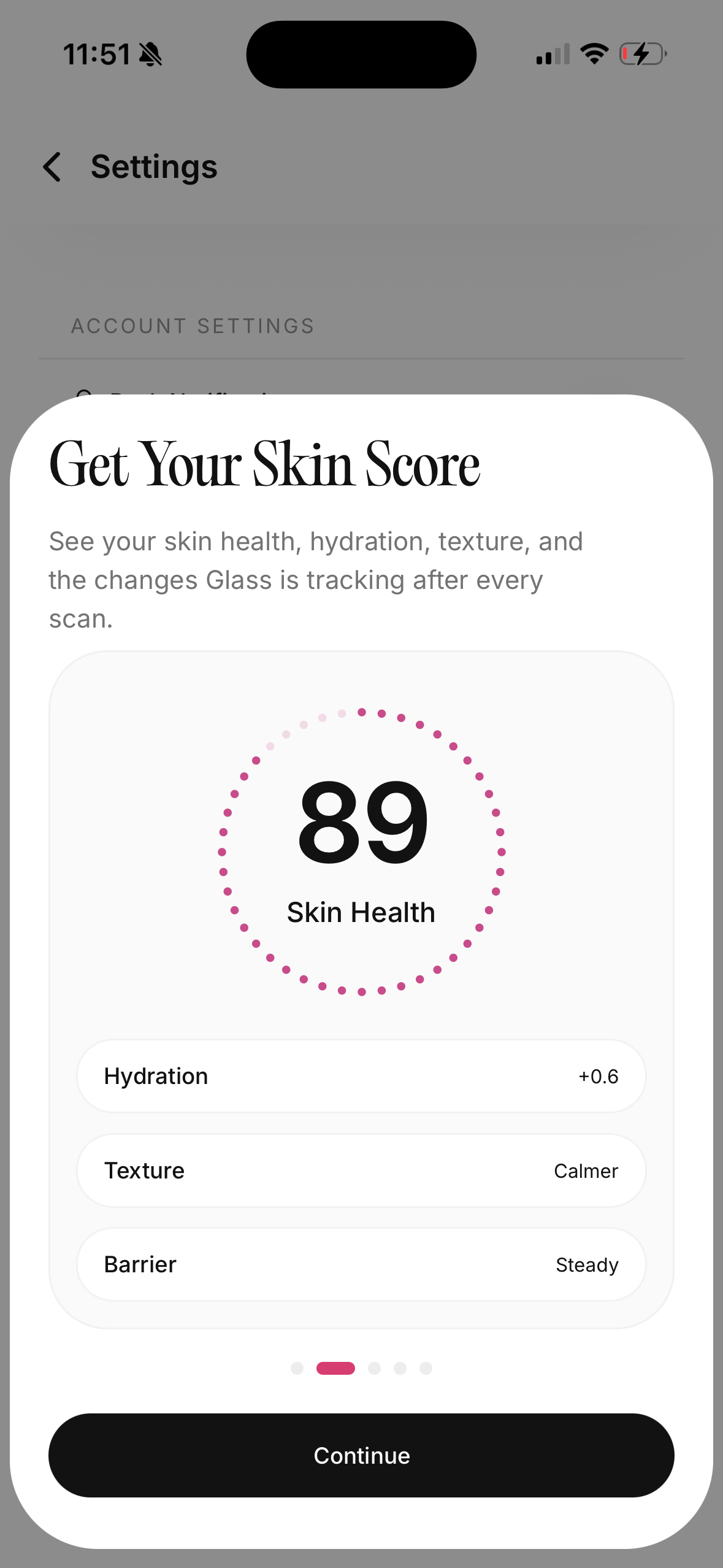
Glass can help organize routine changes and photos so you can connect flare-ups, dryness, sunscreen changes, and treatment dates instead of relying on memory.
The emotional boundary
Facial scars can pull attention into a loop. You check one mirror, then another, then a car window, then your phone camera. The face seems to change every time.
Set a boundary around checking. Use scheduled photos for decisions. Use daily camouflage if it helps you leave the house with less stress. Ask for treatment if you want it. Skip treatment if the tradeoffs are not worth it. None of those choices need to be justified by pretending you do or do not care.
The bottom line
Facial scars need a whole-face plan, not a single scar cream. Map the zone, identify whether the issue is color, contour, or height, protect the skin every day, use camouflage without shame, and prepare for a dermatologist consult when the scar is structural, raised, symptomatic, or affecting your life.
Useful references: Cleveland Clinic on acne scars, Cleveland Clinic on scars, and AAD acne scar treatment guidance.