Aklief is a prescription retinoid, and that should slow the routine down.
People often hear "retinoid" and think glow, texture, anti-aging, or a stronger version of something from a beauty shelf. Aklief is not that conversation. Aklief contains trifarotene and is used as a prescription acne medication for appropriate patients. It is especially worth discussing when acne affects the face, chest, shoulders, or back and the plan needs more than random spot treatment.
In 2026, the useful way to approach Aklief is not "should I chase this brand?" It is "is a topical retinoid plan right for my acne pattern, and can my routine support it?"
Quick answer
Aklief is the brand name for trifarotene cream, a prescription topical retinoid used for acne vulgaris in patients 9 years of age and older in the United States. It is applied as directed by a clinician, usually as a thin layer to affected areas. It can cause dryness, scaling, redness, stinging, burning, itching, and sun sensitivity.
Ask a prescriber whether your acne pattern fits, where to apply it, how often to start, what to stop using, and how to handle irritation.
What trifarotene is
Trifarotene is a topical retinoid. Retinoids are common acne medications because they help with the clogged-follicle side of acne over time. They are not instant whitehead stickers and they are not meant to be used only when a pimple looks dramatic.
Retinoid treatment is usually pattern care. The goal is to reduce new clogged lesions and support longer-term acne control, not to flatten every bump overnight.
That is why Aklief needs consistency, patience, and a routine that does not sabotage tolerance.
Why face and trunk acne matter
Aklief is often discussed because acne does not always stay on the face. Chest, shoulder, and back acne can be harder to reach, harder to track, and easier to irritate with sweat, friction, and clothing.
If a clinician recommends Aklief for body areas, ask exactly how much to use and where. Body coverage can accidentally become over-application. More surface area means more opportunity for dryness and irritation.
Useful questions:
- Which areas should I treat?
- How many pump amounts or fingertip amounts should I use?
- Should I apply after showering?
- What clothing or workout timing matters?
- Should I moisturize body areas too?
Aklief is not over-the-counter retinol
Retinol, retinal, and cosmetic retinoid serums are not the same as prescription Aklief.
If you start Aklief, do not automatically keep your retinol serum. Do not add peel pads because your skin is "used to actives." Do not assume a prescription retinoid can be layered into a routine built for glow products.
Tell your prescriber about every retinoid you already use:
- retinol
- retinal
- adapalene
- tretinoin
- tazarotene
- trifarotene from a previous prescription
They may want you to stop other retinoids.
The adjustment period
Retinoid adjustment is common. Skin may feel dry, tight, flaky, or more sensitive at first. Some people notice acne appearing to fluctuate before the pattern improves.
The key is knowing the difference between expected adjustment and a routine that is too irritating.
Possible adjustment:
- mild dryness
- light flaking
- temporary sensitivity
- manageable stinging that settles
Reasons to contact your clinician:
- severe burning
- swelling
- cracking
- intense redness
- eye-area irritation
- rash-like reaction
- acne worsening dramatically
Do not power through severe irritation to prove commitment.
The starting routine should be plain
Starting Aklief is not the time for a maximal routine.
Morning:
- Gentle cleanse or rinse.
- Moisturizer.
- Sunscreen.
Evening:
- Gentle cleanse.
- Let skin dry.
- Apply Aklief as directed.
- Moisturizer as directed.
Some clinicians may suggest moisturizer before and after, especially for sensitive skin. Ask before deciding on your own.
Sunscreen is part of the medication plan
Sun protection matters with retinoids. Skin that is dry, peeling, or adjusting can feel more sensitive in sun and wind.
Use sunscreen every morning, and use hats or shade when exposure is high. If sunscreen stings, do not skip protection entirely. Switch to a gentler formula and tell your clinician if everything burns.
If you become sunburned, ask whether to pause the medication until the skin recovers.
What to pause while starting
To judge Aklief fairly, remove avoidable irritants.
Consider pausing unless your clinician says otherwise:
- exfoliating acids
- peel pads
- scrubs
- benzoyl peroxide leave-ons
- drying masks
- retinol products
- harsh toners
- fragranced active serums
This does not mean those products are always forbidden forever. It means the first phase should show what Aklief does without a noisy routine around it.
Applying enough but not too much
Retinoids are not better in thick layers.
Use the amount your prescriber specifies. Apply to affected areas, not just the largest pimple. Avoid eyes, lips, corners of the nose, and mucous membranes. Wash hands after application.
If treating the back, ask for practical instructions. Hard-to-reach areas can lead to uneven application. A clinician may suggest a method that avoids accidental overuse.
Pregnancy, breastfeeding, and medication context
Tell your clinician if you are pregnant, trying to become pregnant, or breastfeeding. Also mention other medications, skin conditions, allergies, and prior reactions to retinoids.
Do not borrow Aklief from someone else. Prescription acne treatment depends on age, health context, acne pattern, and follow-up. A tube that makes sense for one person may be wrong for another.
How to track progress
Retinoid progress is easy to misread because improvement is gradual.
Track:
- closed comedones
- red pimples
- body acne areas
- irritation level
- missed nights
- sunscreen use
- moisturizer changes
- menstrual or stress-related flares if relevant
Photos in consistent lighting help. So does logging the exact frequency. "I used it sometimes" is not enough information to adjust a prescription well.
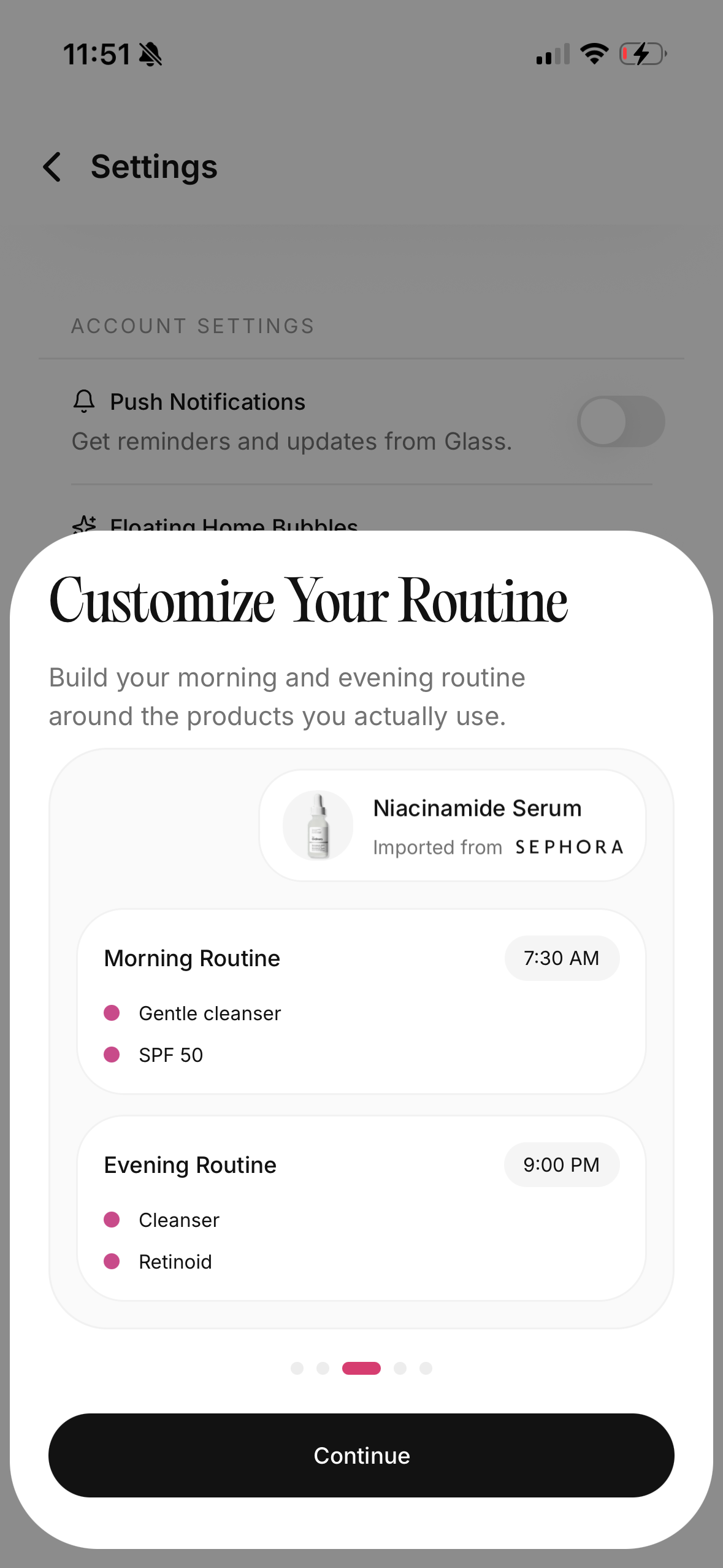
Glass can organize prescription steps beside support products so the routine stays simple.
Face irritation versus body irritation
Face and trunk skin do not always complain the same way.
On the face, irritation may show up as stinging around the nose, peeling near the mouth, burning under sunscreen, or tightness after cleansing. On the body, irritation may show up as itchy patches under clothing, sensitivity after sweating, or rough dry areas where product collected.
Tell your clinician which area is reacting. The answer may be different for face and back. You may need less product, fewer nights, more moisturizer, different shower timing, or a pause on friction-heavy workouts while skin settles.
If acne seems worse early
Some people feel their acne looks worse early in a retinoid plan. That can be frightening, especially when the skin is also dry.
Do not decide alone that the medication is failing after a few rough days. Also do not push through severe irritation for months. Track the type of lesions, where they appear, and how your skin feels. Then ask your prescriber whether this looks like an expected adjustment, irritation acne, or a reason to change the plan.
The distinction matters. More moisturizer helps one problem. Less frequent application helps another. A different medication may be needed for a third.
Practical body application
If Aklief is used on the trunk, logistics matter.
Apply to clean, dry skin as directed. Let it dry before tight clothing. Be careful with sports bras, backpack straps, shoulder pads, and sweaty shirts because friction can amplify irritation. If the back is hard to reach, ask whether an applicator is appropriate and how to clean it.
Do not treat huge areas without clear instructions. Body acne coverage can quietly turn into too much medication.
If clothing sticks to treated areas or sweat makes the skin sting, note the timing. That detail can help your clinician adjust the routine without abandoning the medication too quickly.
Questions for the prescriber
Bring a focused list:
- Is my acne pattern a good fit for trifarotene?
- Should I treat face, trunk, or both?
- How much should I use per area?
- How often should I start?
- Should moisturizer go before, after, or both?
- What should I stop while adjusting?
- What irritation is expected?
- What irritation means I should pause?
- How long before we reassess?
- What is the next step if I cannot tolerate it?
These questions make the medication safer and easier to stick with.
When Aklief may not be the right lane
Aklief may not be the right first lane for bumps that are not acne, active eczema flares, severe irritation, untreated sunburn, or lesions that look infected. It may also need extra caution in very reactive skin.
If acne is severe, scarring, or deeply painful, a topical retinoid alone may not be enough. That does not make Aklief bad. It means the plan may need another prescription lane or closer follow-up.
Bottom line
Aklief is a trifarotene prescription conversation, not a casual retinol upgrade. Its strength is longer-term acne pattern care, including face and trunk acne when appropriate. Its weakness is tolerance: dryness and irritation can derail the plan if the support routine is too busy.
Ask specific questions, simplify the routine, protect with sunscreen, and track progress like medication rather than like a beauty experiment.