Non comedogenic sounds reassuring.
It looks like a promise printed on a bottle: this will not clog your pores. The reality is less tidy. The label can be helpful, especially if you are acne-prone, but it is not a guarantee that your skin will stay clear. A formula can be labeled non comedogenic and still break you out because of irritation, heaviness, fragrance, sunscreen filters, makeup wear, cleansing habits, hormones, or plain individual sensitivity.
That does not make the label useless. It means you need to use it as one clue, not the final verdict.
Quick answer
Non comedogenic means a product is intended or formulated to be less likely to clog pores. It does not mean acne-safe for every person, oil-free, irritation-free, fungal-acne-safe, dermatologist-prescribed, or medically proven to prevent breakouts.
If you are acne-prone, choose non comedogenic products when possible, but also pay attention to texture, how long the product sits on your skin, whether it stings, how well you cleanse it off, and what else is in your routine.
What comedones are
Comedones are clogged pores. Open comedones are blackheads. Closed comedones are small flesh-colored or white bumps under the surface. They can stay non-inflamed or become red, tender pimples.
Acne is more complex than clogged pores alone. Oil production, dead skin cells, bacteria, and inflammation all matter. That is why a non comedogenic moisturizer can help reduce one risk while still not being enough to treat acne by itself.
The American Academy of Dermatology includes ingredients like benzoyl peroxide, salicylic acid, azelaic acid, and topical retinoids in acne care depending on acne type and severity. A label on a moisturizer cannot replace that treatment logic when acne is persistent.
What the label can help with
The non comedogenic label is most useful when you are choosing leave-on products.
That includes:
- Moisturizer.
- Sunscreen.
- Primer.
- Foundation.
- Concealer.
- Face oil.
- Balm.
- Overnight mask.
Leave-on products have more time to contribute to congestion than a cleanser that rinses off quickly. If you break out easily, a lighter non comedogenic moisturizer or sunscreen is often a safer starting point than a rich balm or heavy oil blend.
What the label cannot promise
Non comedogenic does not mean your skin will like the product.
It does not guarantee:
- No acne.
- No irritation.
- No allergic reaction.
- No stinging.
- No pilling.
- No milia.
- No folliculitis.
- No clogged pores under makeup.
- No problems in humid weather.
Skin is not a spreadsheet. A formula interacts with sweat, sunscreen reapplication, shaving, masks, hormones, cleansing, and your existing barrier. A product can test fine on one person and cause closed comedones for another.
Why non comedogenic products still break people out
There are a few common reasons.
First, irritation can look like acne. If a product stings every time and then your skin erupts in red bumps, the problem might be irritation rather than pore clogging.
Second, the formula might be too heavy for your routine. A non comedogenic cream under a water-resistant sunscreen and long-wear foundation can still create an occlusive stack that your chin or forehead hates.
Third, cleansing might be incomplete. Sunscreen and makeup left behind can worsen congestion even if each product is reasonable alone.
Fourth, the breakout might be unrelated. Hormonal acne, folliculitis, hair products, and stress can all show up while you are blaming the newest moisturizer.
A smarter product test
Do not test a new non comedogenic product during a chaotic skin week if you can avoid it.
Use this approach:
- Keep the rest of your routine stable.
- Apply the new product to one acne-prone area or one side of the face.
- Use it for 10 to 14 days if there is no burning, swelling, or rash.
- Track new clogged bumps, redness, itching, and comfort.
- Stop sooner if irritation is obvious.
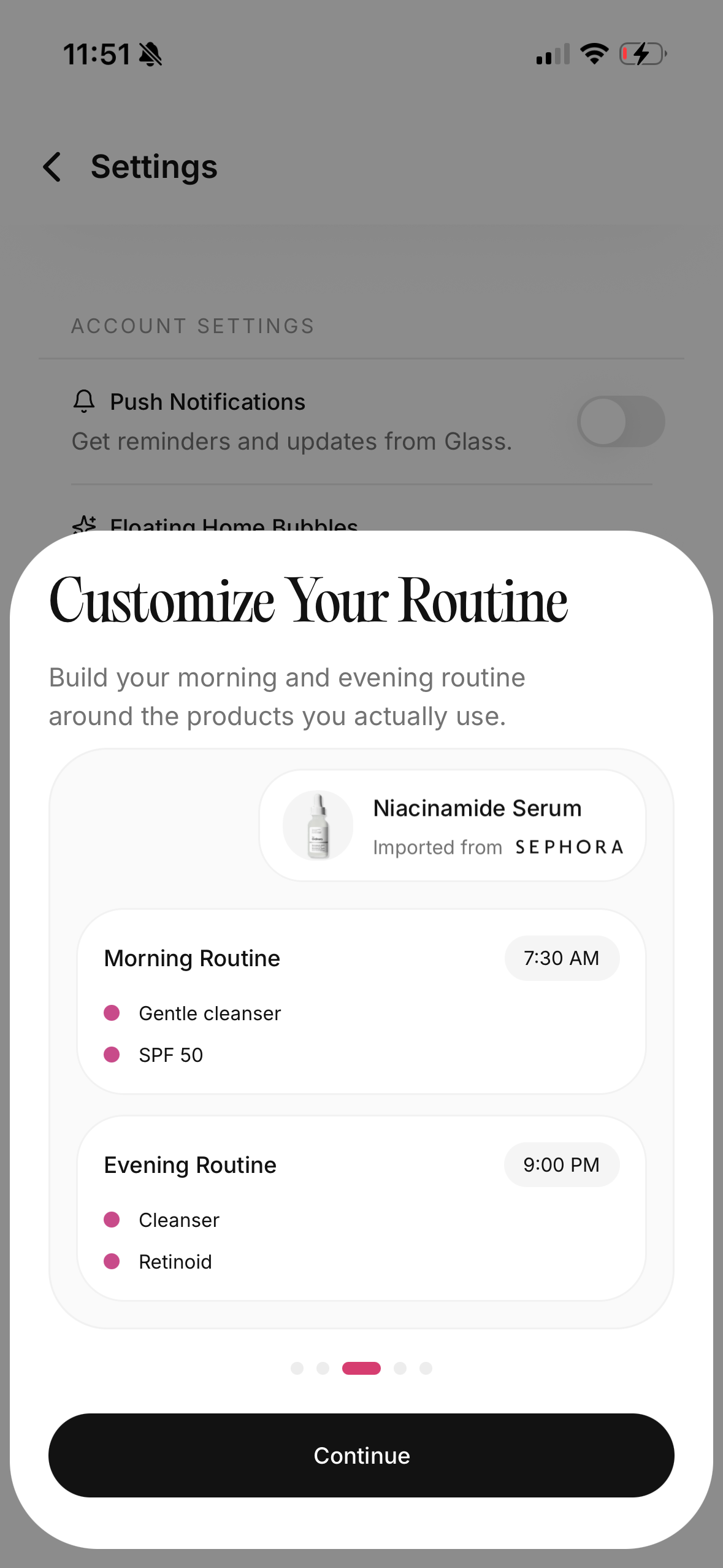
This is where Glass can be practical. A product card and routine log can show when a new product entered your routine, which matters because breakouts often get blamed on the wrong thing.
Ingredient myths to avoid
It is tempting to memorize lists of "pore-clogging" ingredients. The problem is that ingredient behavior changes with concentration, formula type, processing, and the rest of the product. A single ingredient name does not tell the whole story.
Common oversimplifications:
- "All oils clog pores." Not true for everyone.
- "Oil-free means safe." It can still irritate or clog.
- "Natural means acne-safe." Poison ivy is natural too.
- "Silicones suffocate skin." Many people tolerate silicones well.
- "If it is non comedogenic, I can sleep in makeup." No.
Use ingredient lists to guide choices, not to create fear around every formula.
Best textures for acne-prone skin
Texture is not everything, but it is useful.
| Product type | Usually lighter | Usually heavier |
|---|---|---|
| Moisturizer | Gel, gel-cream, lotion | Balm, thick cream, ointment |
| Sunscreen | Fluid, gel, milk | Rich cream, heavy sport formula |
| Makeup | Thin skin tint | Full-coverage long-wear layers |
| Treatment | Serum, gel | Occlusive treatment balm |
For oily or breakout-prone skin, a gel-cream like Skinfix Barrier Restoring Gel Cream can be easier to place in a routine than a very rich cream. For blemish-prone redness, The Ordinary Azelaic Acid Suspension 10% is an example of an active category that can fit better than piling on drying spot treatments.
How to build a non comedogenic routine
Start with the products that cover the most skin for the longest time.
Morning:
- Gentle cleanser or rinse.
- Lightweight moisturizer.
- Non comedogenic sunscreen.
- Makeup only where needed.
Night:
- Remove sunscreen and makeup thoroughly.
- Gentle cleanser.
- Acne treatment if used.
- Moisturizer.
If you wear heavy sunscreen or makeup, double cleansing can help, but the first cleanser should still rinse clean. Do not scrub your face raw to prove it is clean.
Non comedogenic makeup
Makeup is a common breakout suspect because it sits on the skin all day and often gets layered.
Helpful habits:
- Choose non comedogenic base products.
- Wash brushes and sponges.
- Avoid applying foundation over open or weeping pimples.
- Remove makeup before sleep.
- Replace old products.
- Watch for chin and jaw congestion from concealer blending.
If acne worsens only where makeup is applied, simplify base layers before blaming every skincare product underneath.
When you need acne treatment, not a label
Non comedogenic products can reduce friction in an acne-prone routine. They do not treat moderate to severe acne by themselves.
Consider a real acne plan if you have:
- Frequent inflamed pimples.
- Painful nodules.
- Scarring.
- Breakouts on face plus chest or back.
- Persistent clogged pores despite product changes.
- Acne affecting confidence or daily life.
Acne treatments can include over-the-counter options, prescription topicals, oral medications, hormonal options for some patients, or isotretinoin for severe acne. A clinician can match treatment to acne type and health history.
How to read a product change
One of the hardest parts of acne-prone skincare is timing. A product can irritate you immediately, but clogged pores often appear later. If you change cleanser, moisturizer, sunscreen, and foundation in the same week, you lose the ability to read the result.
I would treat each new leave-on product like a small experiment. Keep the routine steady, add the product in one place, and give your skin enough time to respond unless there is obvious irritation. If your cheeks stay calm but the chin gets bumpy where a rich balm migrates, that is useful information. If your whole face burns on day one, that is useful too, but it points more toward irritation than slow pore clogging.
A useful shopping rule
When two products look equally appealing, choose the one that creates the least confusion.
For breakout-prone skin, that often means lighter texture, fewer fragrance cues, clear usage instructions, and a role your routine actually needs. A non comedogenic label is a plus, but it should not convince you to buy a product that duplicates three things you already own.
Red flags
Stop a product and seek advice if you develop swelling, hives, blistering, severe burning, eye-area swelling, spreading rash, or signs of infection. See a dermatologist for acne that scars, hurts, keeps returning, or does not improve after a consistent routine.
The better 2026 definition
In practice, non comedogenic should mean "lower risk," not "no risk."
The best product choice is the one that fits your skin, climate, routine, acne pattern, and tolerance. The label helps you shortlist. Your skin decides the rest. Keep the routine readable, track changes, and avoid turning one word on a package into a promise your pores never agreed to.
The label still needs a real-life test
I treat non comedogenic as a helpful clue, not a guarantee. A product can be designed to reduce clogging risk and still feel wrong on your skin because of texture, layering, weather, sunscreen, makeup, or individual sensitivity. I would test one new product at a time and watch the pattern for at least a couple of weeks. If small closed bumps appear exactly where the product sits heaviest, that is useful information. If breakouts appear everywhere during a stressful month, the label may not be the main story. The best test is boring, consistent, and honest about what else changed.