
I wanted the scan to be right.
Not perfect.
Just useful.
That is the quiet hope behind most skin analysis apps. You take a photo, wait a few seconds, and hope the result can explain what the mirror keeps making confusing. Is my skin dry or irritated? Are my pores actually worse, or is the lighting brutal? Did the new serum help, or am I giving credit to a good sleep week?
I have been on both sides of that feeling. I have wanted a simple answer badly enough to trust a number too quickly. I have also dismissed useful feedback because one scan felt too harsh. Neither reaction helped my skin.
The better way sits in the middle.
An AI skin analysis app can be genuinely helpful when you treat it like a pattern tool, not a verdict. It can help you notice changes, compare weeks, log what you used, and stop rewriting history every time your face has a bad morning. It should not replace a dermatologist, diagnose medical issues, or make you panic-buy five new products because one score moved.
That is the difference.
Use the app to see your routine more clearly. Do not let it run your routine for you.
The scan is only as useful as the question you ask it
The first mistake is scanning your face and asking, "Is my skin good?"
That question is too vague. It turns your skin into a grade, and grades make people weird. A high score makes you relax when you may still need consistency. A low score makes you overcorrect when your skin may only be tired, flushed, oily from heat, or photographed in bad light.
I get more out of a scan when I ask narrower questions:
| Better question | Why it helps |
|---|---|
| Is my redness trending down or just moving around? | Redness can look dramatic in one photo and calmer over a week. |
| Is texture improving while breakouts are still healing? | Progress is not always evenly distributed. |
| Did oiliness spike after I stripped my routine? | Shine can be a reaction, not just a skin type. |
| Are dark marks fading slowly even if acne is still active? | Old marks and new breakouts need different decisions. |
| Is my skin less irritated when I keep the routine boring? | The boring routine is often the one that teaches you the most. |
That is where scanning becomes useful. It gives you something steadier than mood. It also gives you a record of what your skin looked like before you started editing the story in your head.
I do not need an app to flatter me. I need it to help me make fewer chaotic decisions.
What a good skin analysis app should actually do
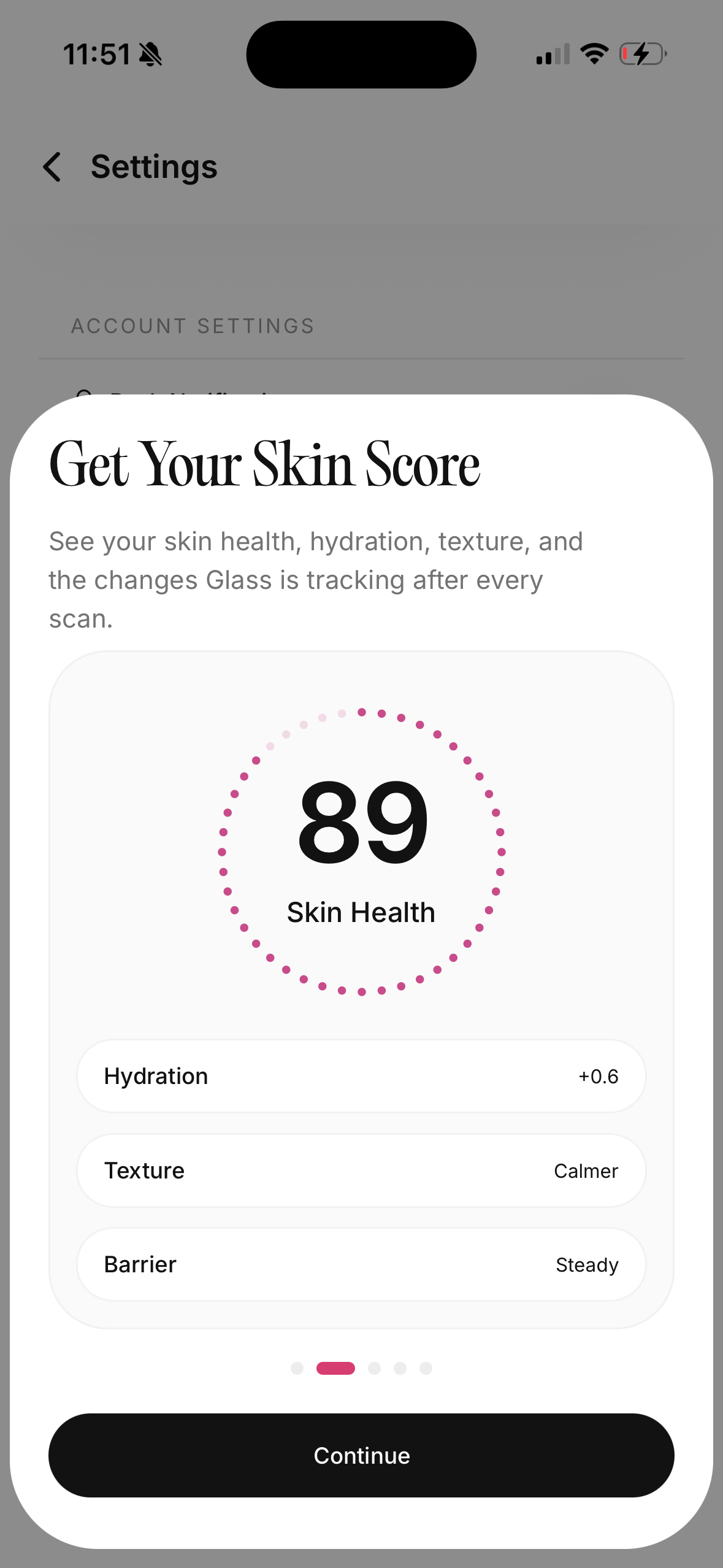
A skin analysis app should not stop at a face score.
That was the pattern I noticed fast. The weak version of this category is built around one shiny moment: upload a selfie, get a number, see a few concerns, then get pushed toward products. The stronger version keeps helping after the novelty wears off.
The app has to connect the scan to the routine.
If it tells you your skin looks dehydrated, it should help you look at moisturizer consistency, cleanser harshness, weather, actives, and whether your face feels tight after washing. If it says texture is up, it should help you separate clogged pores from irritation, rough dry patches, and post-breakout unevenness. If it says your tone is uneven, it should remind you that sunscreen consistency matters more than chasing the strongest brightening serum in the room.
That is why I care about four things more than the score itself:
- Can I track morning and night routines next to the scans?
- Can I see progress photos without digging through my camera roll?
- Can I log product changes clearly enough to know what changed first?
- Can I add notes about sleep, stress, cycle timing, travel, sweating, or weather when those things obviously matter?
Without that context, the scan is floating. It may be interesting, but it is not anchored to your real life.
The lighting rule I wish everyone followed
Bad lighting can make good skin look worse.
It can also make irritated skin look fine.
That is why I do not treat one scan like evidence unless the photo conditions are repeatable. Same room. Same window if possible. Same time of day if you can manage it. Clean face or at least the same stage of your routine. No heavy makeup. No warm bathroom light turning redness into a crime scene.
The goal is not professional photography. The goal is consistency.
If you scan under bright daylight on Monday and under yellow overhead light on Thursday, the app may still give you a result, but you have made the comparison messier. Shadows can exaggerate pores and texture. Direct sun can wash out redness. Night lighting can make hyperpigmentation look deeper. Front camera smoothing can quietly lie to you before the app even starts.
My rule is simple: I scan when my face is calm and the light is boring.
Boring light is underrated. It keeps the scan from becoming a drama machine.
What I trust from AI skin analysis
I trust trends more than snapshots.
That is the whole thing.
One scan can be wrong, noisy, or overly sensitive. Ten scans taken under similar conditions can start telling a more useful story. If redness keeps dropping while my routine stays steady, I pay attention. If texture gets worse right after I increase exfoliation, I pay attention. If hydration looks low on every morning after I skip moisturizer at night, I do not need a mystery. I need to stop skipping moisturizer.
The most useful signals tend to be directional:
| Signal | I trust it most when |
|---|---|
| Redness | The photos are taken in similar lighting and the change holds for several days. |
| Texture | I can compare the same zones over time instead of obsessing over one close-up. |
| Oiliness | I pair the scan with how my face feels by midday. |
| Dark marks | I compare weekly, not daily, because pigment moves slowly. |
| Dryness or dehydration | I combine the scan with tightness, flaking, and moisturizer behavior. |
I do not trust a scan to understand my entire skin history. It does not know whether I changed laundry detergent, started a medication, slept four hours, had a hard workout, got sun exposure, or used a strong active three nights in a row unless I tell the system.
That is not a flaw if you understand it.
It just means the best skin analysis app is not only a camera. It is a routine memory.
What I do not trust from an app
I do not trust an app with fear.
If a spot is changing, bleeding, painful, spreading, or worrying you, that is not a skincare-optimization problem. That is a medical question. A consumer skin scanner is not the right authority for that. Neither is a comment section. Neither is a product quiz.
I also do not trust an app when it pushes urgency too hard. Skincare already has enough pressure built into it. A good app should make you calmer and clearer. It should not make every pore feel like an emergency or every mark feel like proof that you are behind.
I am especially careful with:
- sudden recommendations to add multiple actives at once
- product lists that do not explain why each step belongs
- routines that ignore sensitivity or barrier damage
- scores that change wildly when the lighting changes
- advice that treats acne, irritation, dark marks, and dryness like one problem
That last one matters. Different skin concerns can overlap on the same face. A breakout does not mean your barrier is fine. Dryness does not mean you need a richer routine if the real issue is over-cleansing. Dark marks do not mean you should exfoliate aggressively if your skin is already reactive.
The scan should help you separate those problems. It should not flatten them into one shopping list.
The routine audit I run after a scan
When a scan flags something, I do not start by buying.
I start by auditing.
The first pass is basic:
- Did I actually follow my routine this week?
- Did I introduce anything new?
- Did I increase the frequency of an active?
- Did I skip moisturizer, sunscreen, or cleansing more than usual?
- Did anything outside skincare change enough to matter?
That last question is where a lot of people lose the plot. Skin is attached to a person, not a shelf. Stress, sleep, travel, workouts, sweating, climate, hormones, and picking at breakouts can all change what you see.
Once I know what changed, I decide whether the routine needs action.
If my skin looks a little dull but feels comfortable, I do not rush. If my skin burns when moisturizer touches it, I take that seriously. If one cheek has new clogged texture after I started a heavier sunscreen, I look at the sunscreen. If my whole face is tight and shiny, I look at cleanser, exfoliation, and barrier support before I assume I am simply "oily."
That is the value of pairing scans with routine tracking. You stop guessing from a single symptom.
How I would use Glass for this
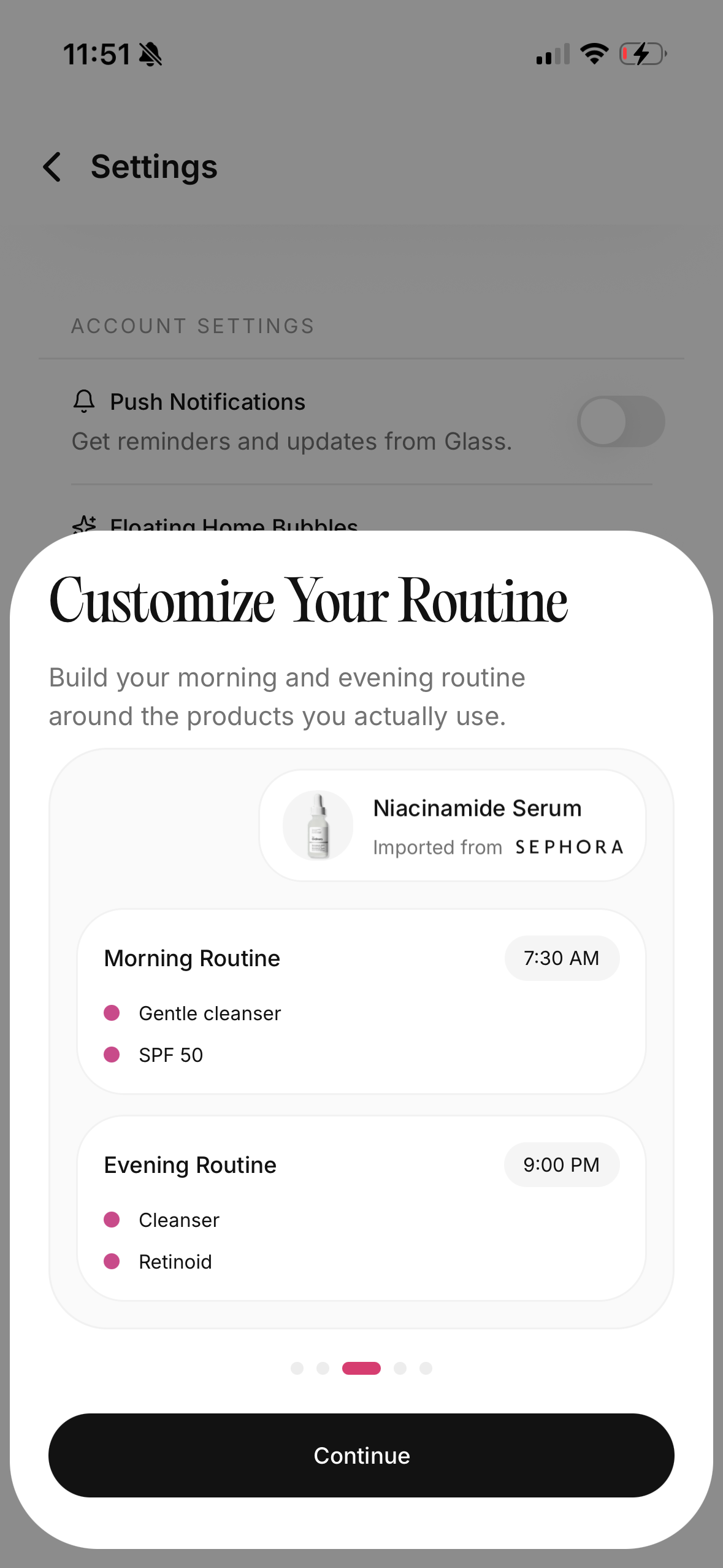
Glass makes the most sense when you want the scan and the routine to live together.
I would set it up like this:
| Glass feature | How I would use it | The decision it helps with |
|---|---|---|
| Skin analysis | Scan under the same conditions a few times a week | See whether the change is a pattern or a one-off |
| Routine builder | Keep morning and night steps realistic | Know what I was supposed to use before judging results |
| Product tracking | Log new products before I forget the timeline | Identify what changed before irritation or improvement |
| Progress context | Compare scans and photos over time | Avoid overreacting to one bad mirror day |
| Skin Assistant | Ask narrower follow-up questions | Turn a result into a calmer next step |
The main thing I like about this shape is that it respects how skincare actually fails.
Most routines do not fail because someone lacks one magic serum. They fail because the routine is too complicated, the timeline is unclear, the person keeps changing too many variables, or the product that looks good on paper does not fit their skin in practice.
A scan can point at the visible problem. The routine record helps explain why it may be happening.
That combination is much more useful than a score by itself.
How often I would scan
Daily scanning sounds responsible, but it can make some people obsessive.
I would choose frequency based on temperament.
If you are calm with data, daily morning scans can be useful. They create a strong baseline and help you catch patterns quickly. If you are the kind of person who spirals when a number drops, scan two or three times a week instead. That is enough to see a trend without turning your face into a daily performance review.
For most people, I like this rhythm:
- Scan at baseline before changing the routine.
- Scan two or three times a week under similar lighting.
- Take one clearer progress photo weekly.
- Log product changes the day they happen.
- Review the pattern every two to four weeks, not every four hours.
The review window matters. Some irritation shows up quickly. Some improvements take weeks. Dark marks can take longer. Retinoids and acne routines can look messy before they look stable. If you judge everything daily, you will punish slow progress for being slow.
That is how people end up abandoning routines that were starting to work.
The product rule that keeps scans from getting expensive
One scan should not create five new purchases.
I mean that seriously.
If a skin analysis app tells you hydration is low, the next move might be using your current moisturizer more consistently. If it says texture is up, the answer might be reducing irritation before adding exfoliation. If it says redness is worse, the answer might be pausing strong actives, checking your cleanser, and giving your barrier a quieter week.
The cheapest fix is often consistency.
The second-cheapest fix is removing the thing that is causing the problem.
Buying comes later.
When I do buy, I want the purchase to answer one clear need. Not a fantasy routine. Not a full reset. One need.
| Scan pattern | First move before buying |
|---|---|
| More redness | Pause recent irritants and simplify for a few days. |
| More dryness | Check cleanser, moisturizer amount, and night routine consistency. |
| More oiliness | Look for stripping before assuming you need harsher oil control. |
| More dark marks | Check sunscreen consistency before adding another brightener. |
| More texture | Separate clogged pores from irritation and flaky dryness. |
That is how the app saves money instead of creating a shopping problem.
When the app should push you toward professional help
A good skin app should know its lane.
If acne is painful, cystic, scarring, or not improving after a fair attempt with gentle over-the-counter care, I would not keep trying to solve it through scans alone. If a rash spreads, burns, crusts, or keeps coming back, I would not treat that like routine feedback. If a mole or spot changes in size, shape, color, sensation, or bleeding, I would not ask a beauty app to make the call.
That does not make the app useless.
It makes the boundary clear.
The app can help you prepare for a better appointment. It can show what changed, when it changed, what you used, and how consistent you were. That is more useful than walking in and trying to remember six weeks of skin behavior while sitting under bright office lights.
For everyday skincare, a scanner can help you stay grounded.
For medical uncertainty, it should help you escalate.
The best result is fewer changes, not more
The biggest surprise is how often a good scan makes me do less.
If the trend is improving, I leave the routine alone. If the trend is noisy but my skin feels comfortable, I wait. If the trend gets worse after I changed three things, I stop pretending I can identify the cause and go back to a simpler baseline.
That is not as exciting as a new product haul.
It works better.
Skincare gets easier when you stop trying to win every morning. You are not trying to beat yesterday's photo. You are trying to understand the pattern well enough to make the next decision calmly.
That is what I want from a skin analysis app in 2026.
Not drama.
Not panic.
Not a perfect answer.
Just a clearer relationship between what I use, what my skin does, and what I should leave alone long enough to learn from.
If you use Glass for that, the scan becomes more than a score. It becomes a way to stop guessing.