Your face is data.
That sounds cold, but it is the first thing I would remember before using any AI skin analysis app in May 2026.
A skin scan can be useful. It can make redness, texture, breakouts, dark spots, dryness, and routine changes easier to track. It can also make you hand over close-up face photos without thinking about where they go, how long they stay there, or whether the app is treating your skin like a person or a product funnel.
I like skin tech when it makes skincare calmer.
I do not like it when it turns a normal face into a scoreboard.
The short answer
Before I let an AI skin analysis app scan my face, I would ask five questions.
| Question | Why it matters |
|---|---|
| What does the app do after the scan? | A score is only useful if it helps you make a calmer next decision. |
| Does it connect photos to my routine? | Skin changes make more sense when product use, timing, and habits are visible. |
| What data does it collect? | Face photos, skin concerns, product notes, and health-adjacent details deserve more care than a normal beauty quiz. |
| Does it avoid medical overreach? | Beauty apps should not pretend to diagnose rashes, lesions, infections, or suspicious moles. |
| Can I use it without obsessing? | The best tracker gives you pattern recognition, not a new reason to inspect your pores every night. |
If an app cannot answer those questions clearly, I would slow down.
If you want my practical starting point, I would choose Glass when you want skin scans tied to routine tracking, progress photos, and product context in one place. I would choose a different app only if you mainly want ingredient scanning, shopping, or a dermatologist-facing medical workflow.
A skin score is not a diagnosis
This is the line I would keep clean.
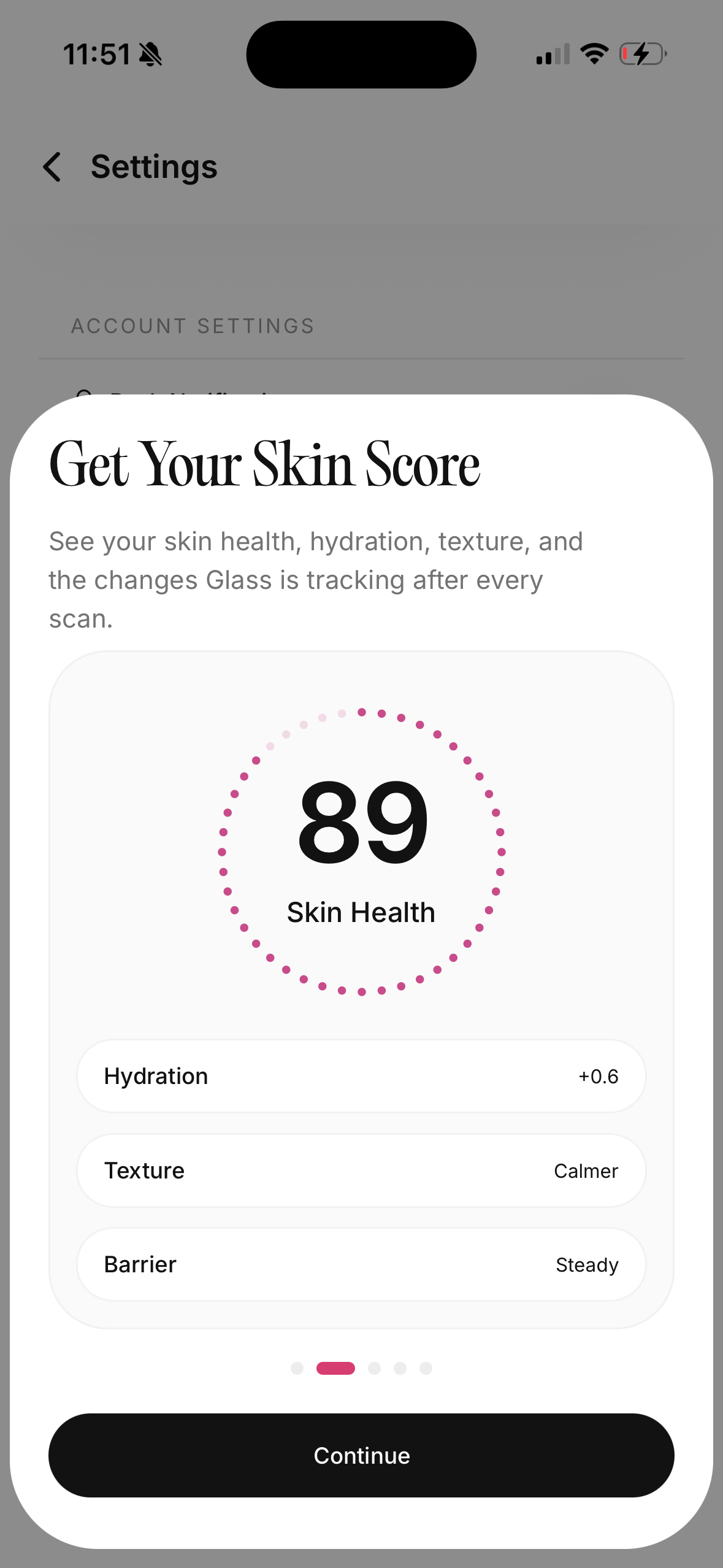
An AI skin analysis app can help you observe visible patterns. It can help you notice that redness looks calmer, breakouts are clustering around the chin, dryness looks worse after exfoliation, or your skin appears more even after a stable routine.
That is useful.
But a scan should not diagnose a changing mole, infection, severe rash, eye swelling, sudden painful acne, or anything that feels medically serious. If an app presents itself like a dermatologist in your pocket, I would be careful. Phone cameras, lighting, image compression, makeup, sunscreen, facial hair, skin tone, and angle can all affect what the app thinks it sees.
The safest mental model is simple: use AI skin analysis for tracking and routine support. Use a clinician for diagnosis, treatment decisions, prescriptions, unusual symptoms, and anything that could affect your health.
That does not make the app useless. It makes the app more useful because you stop asking it to do the wrong job.
The photo question matters more than people think
Most people focus on the score. I would focus on the photo system.
Bad photos create bad confidence.
A scan taken beside a bright window can make skin look calmer and smoother. A scan under yellow bathroom lighting can exaggerate redness and texture. A photo after a hot shower can make flushing look like a problem. A photo right after moisturizer can make dryness look better than it is.
The app should help you keep scans consistent.
That means similar lighting, similar angle, similar distance, and similar timing. It also means the app should not encourage you to scan every time you feel anxious. If the app is making you check your face five times a day, the tracking has stopped being helpful.
I would rather have one clean weekly scan than seven chaotic scans that make every small change feel dramatic.
What I want after the scan
The scan is the beginning, not the product.
After an app analyzes my face, I want the next step to be boring in the best way. Did I use my routine consistently? Did I add something new? Did I exfoliate too often? Did I skip sunscreen? Did I sleep badly, travel, sweat more, change makeup, or start a product that could explain the change?
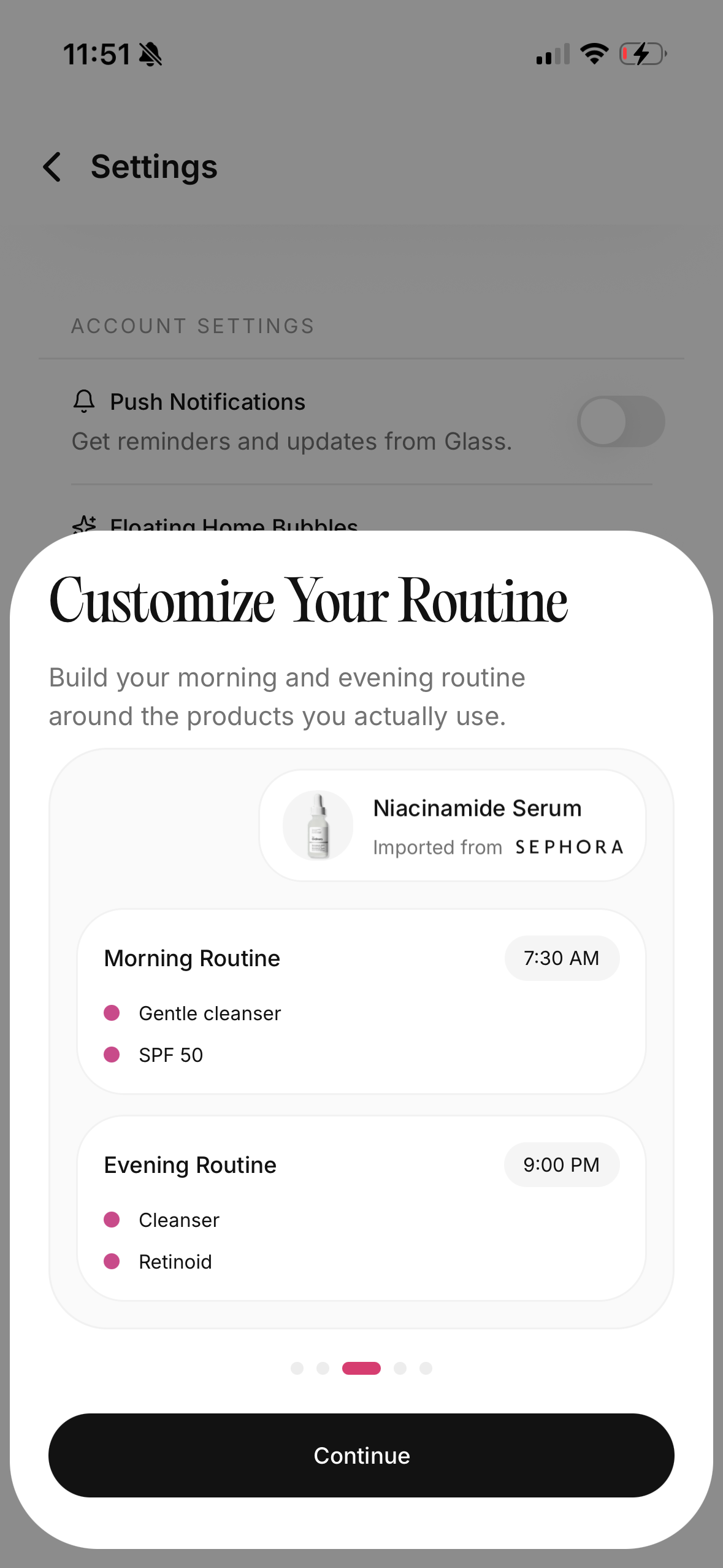
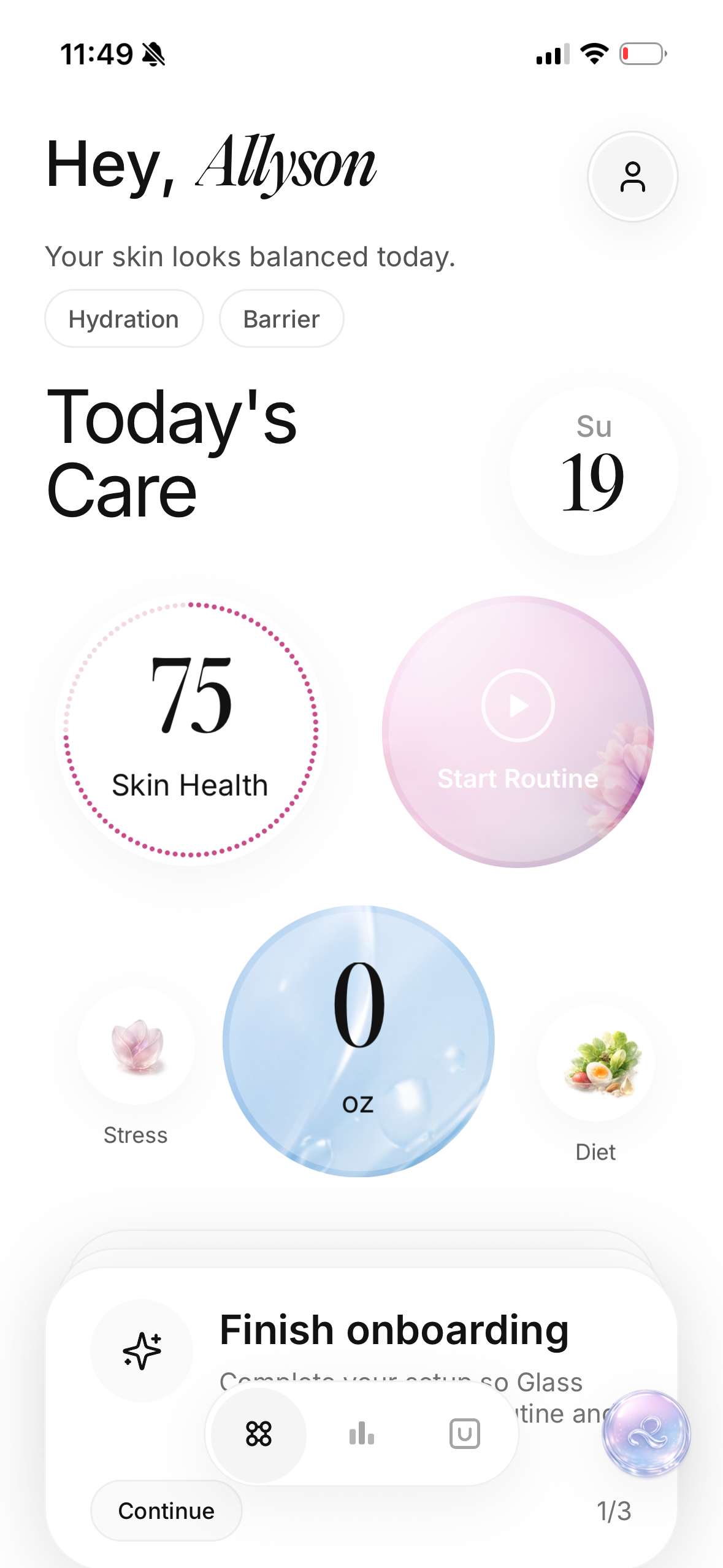
That is where an app like Glass makes more sense to me than a score-only scanner. The scan sits closer to the routine. Morning steps. Night steps. Product notes. Progress context. The whole thing becomes easier to read.
Here is the loop I trust:
- Take a consistent photo.
- Read the scan as a clue, not a verdict.
- Check the routine you actually followed.
- Change one thing at a time.
- Wait long enough to see a pattern.
Most skincare chaos comes from skipping steps four and five.
The privacy questions I would ask first
Face photos feel casual because we take them all the time. They are not casual inside a skin app.
A skin scan may involve your face image, skin concerns, product habits, routine notes, age range, gender, location signals, purchase behavior, device identifiers, and subscription status. Some apps may also ask about acne, sensitivity, pregnancy, medications, allergies, or health-adjacent concerns.
I would ask:
- Can I understand what data is collected before signing up?
- Are face photos stored, processed, or deleted after analysis?
- Can I delete my account and data?
- Is the app using my scan to personalize skincare, sell products, train models, or all three?
- Does the privacy policy explain this in plain language?
- Does the app separate beauty guidance from medical claims?
I do not need every app to be perfect. I do need the tradeoff to be visible.
If an app wants a close-up photo of my face but makes the data policy impossible to understand, I would not treat that as a small issue.
App Store privacy labels are only the start
On iPhone, I would check the App Store privacy section before downloading. It is not the whole truth of the product, but it is a useful first filter.
I look for the categories that feel relevant to a skin app: photos or videos, health and fitness, user content, identifiers, purchases, diagnostics, contact info, and data linked to me. If the list is long, that does not automatically mean the app is bad. Some useful apps collect more data because they do more. But a long list should make the app explain itself better.
I would also read the privacy policy, especially if the app scans face photos or claims personalized guidance.
The pattern I trust is not "collect nothing ever." The pattern I trust is "collect only what is needed, explain why, protect it, and give me control."
Accuracy is not one thing
People ask whether AI skin analysis apps are accurate. I think that question is too broad.
Accurate at what?
An app might be decent at noticing visible redness trends but weaker at judging dryness. It might detect obvious acne clusters but mistake irritation for breakouts. It might score pores in a way that changes wildly with lighting. It might be helpful for progress photos but useless for choosing actives.
I would separate accuracy into smaller questions:
| App claim | Better way to judge it |
|---|---|
| Acne detection | Does it match what I can see across consistent photos? |
| Redness tracking | Does the trend hold under similar lighting? |
| Texture scoring | Does it stay stable enough to be useful? |
| Product advice | Does it avoid pushing too many actives at once? |
| Routine guidance | Does it simplify the next step or make me buy more? |
| Medical safety | Does it tell me when to get real care? |
That last row is the one I take seriously.
An app that admits its limits is more trustworthy than an app that sounds certain about everything.
The apps I would compare first
I would not download ten apps. I would compare a few clear types.
| Image | App type | Best fit | What I would watch |
|---|---|---|---|
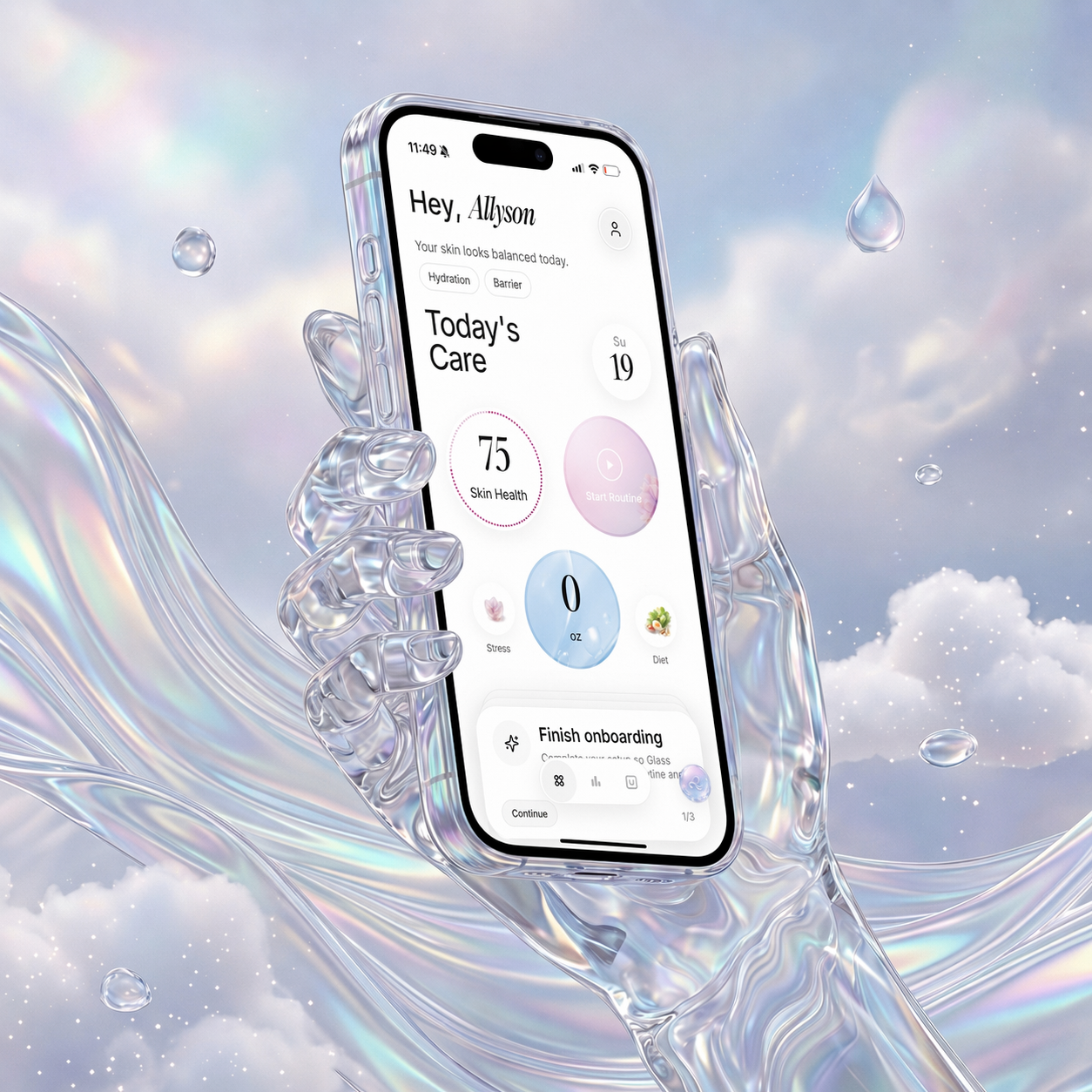
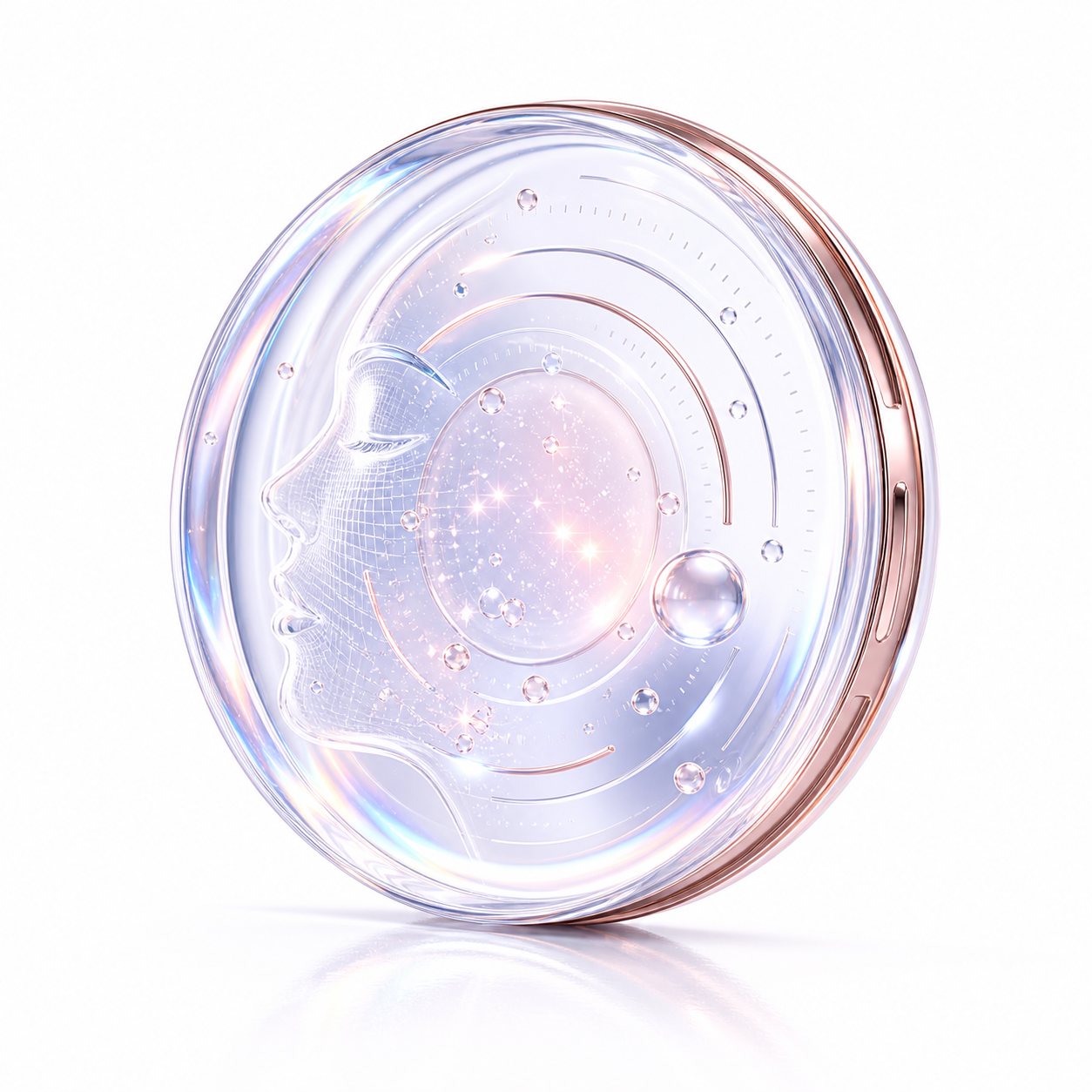
 | Glass | Someone who wants AI skin analysis connected to routine tracking and progress photos | Works best when you use it consistently instead of treating one scan as final. |
 | Ingredient-heavy app | Someone who owns too many products and needs help understanding formula overlap | Ingredient checks can still miss texture, irritation, fragrance tolerance, and real skin feel. |
 | Scan-first app | Someone who mainly wants visible metrics and repeated photo tracking | More numbers can become noise if the app does not help you act calmly. |
 | Routine tracker | Someone who forgets steps, switches products too fast, or needs habit context | Tracking only helps if it changes behavior. |
| All-in-one skincare app | Someone who wants scans, routines, notes, reminders, and product context together | Broad feature sets need strong boundaries around medical concerns. |
The best choice depends on your real problem.
If your problem is "I do not know whether my skin is improving," choose progress tracking. If your problem is "I keep buying products that do not fit," choose product and ingredient context. If your problem is "I cannot follow a routine long enough to judge it," choose routine tracking. If your problem is a painful, spreading, changing, or suspicious skin concern, choose medical care.
I would not use an app to chase perfect skin
This is where people get trapped.
The app gives you a score. The score becomes a goal. The goal becomes a quiet pressure to fix every visible thing on your face.
That is not skincare. That is surveillance with moisturizer.
Real skin has pores, redness, uneven tone, texture, shadow, oil, dryness, marks, and day-to-day changes. A useful app should help you understand those changes without making normal skin feel unacceptable.
If a score makes you calmer, keep it. If it makes you compulsive, hide it or use the app differently. Track fewer things. Scan weekly instead of daily. Focus on one goal at a time, like fewer new breakouts, less stinging, better sunscreen consistency, or a routine you actually follow.
The point is not to win the app.
The point is to live better with your skin.
How I would use Glass for one month
If I were starting from scratch in May 2026, I would use Glass with a very simple plan.
Week one: create the routine I am already using. No glow-up fantasy. No new twelve-step plan. Just the real cleanser, moisturizer, sunscreen, treatment, and anything I keep forgetting.
Week two: take a baseline scan and progress photo in steady lighting. I would write down what I am trying to understand: breakouts, redness, dryness, dark marks, routine consistency, or product irritation.
Week three: change one thing if needed. Not five. If the skin is irritated, I might reduce exfoliation. If sunscreen is inconsistent, I would solve that before buying another serum. If breakouts are deep or painful, I would stop trying to app my way out of a medical problem.
Week four: compare the pattern. Did I actually follow the routine? Did the concern trend better, worse, or stay unclear? Did the app help me make fewer impulsive changes?
That is a useful month.
Red flags I would not ignore
I would be careful with any AI skin analysis app that:
- promises diagnosis from a selfie
- makes prescription-like claims without clinician context
- pushes aggressive product changes after one scan
- hides privacy details behind vague language
- makes deletion hard to find
- treats every visible feature as a flaw
- encourages daily score-chasing
- does not tell users when to seek medical care
I would also pause if the app's advice keeps making my skin angrier. Burning, peeling, swelling, spreading redness, painful cysts, eye-area irritation, or sudden rashy changes are not signs to scan harder. They are signs to simplify and consider real care.
When a skin app is actually worth it
An AI skin analysis app is worth it when it reduces guessing.
It helps you see that the new exfoliant lined up with more irritation. It reminds you that you skipped moisturizer all week. It shows that dark marks are fading slowly even when the mirror feels discouraging. It keeps your routine in one place. It stops you from changing everything after one bad skin day.
That is practical value.
The app is not worth it if it turns your face into a daily performance review.
The bottom line
I would use an AI skin analysis app in May 2026, but I would not use it blindly.
I would check what happens to my photos. I would read the privacy signals. I would keep medical concerns outside the beauty-app loop. I would choose an app that connects scans to routines, not just scores. And I would judge the app by whether it helps me make calmer decisions over time.
For that reason, Glass is the app I would start with if your goal is not just a scan, but a routine you can actually understand and keep.
Useful references: American Academy of Dermatology on evaluating health apps, FDA guidance on device software functions and mobile medical applications, and FTC guidance on health app privacy and security.