
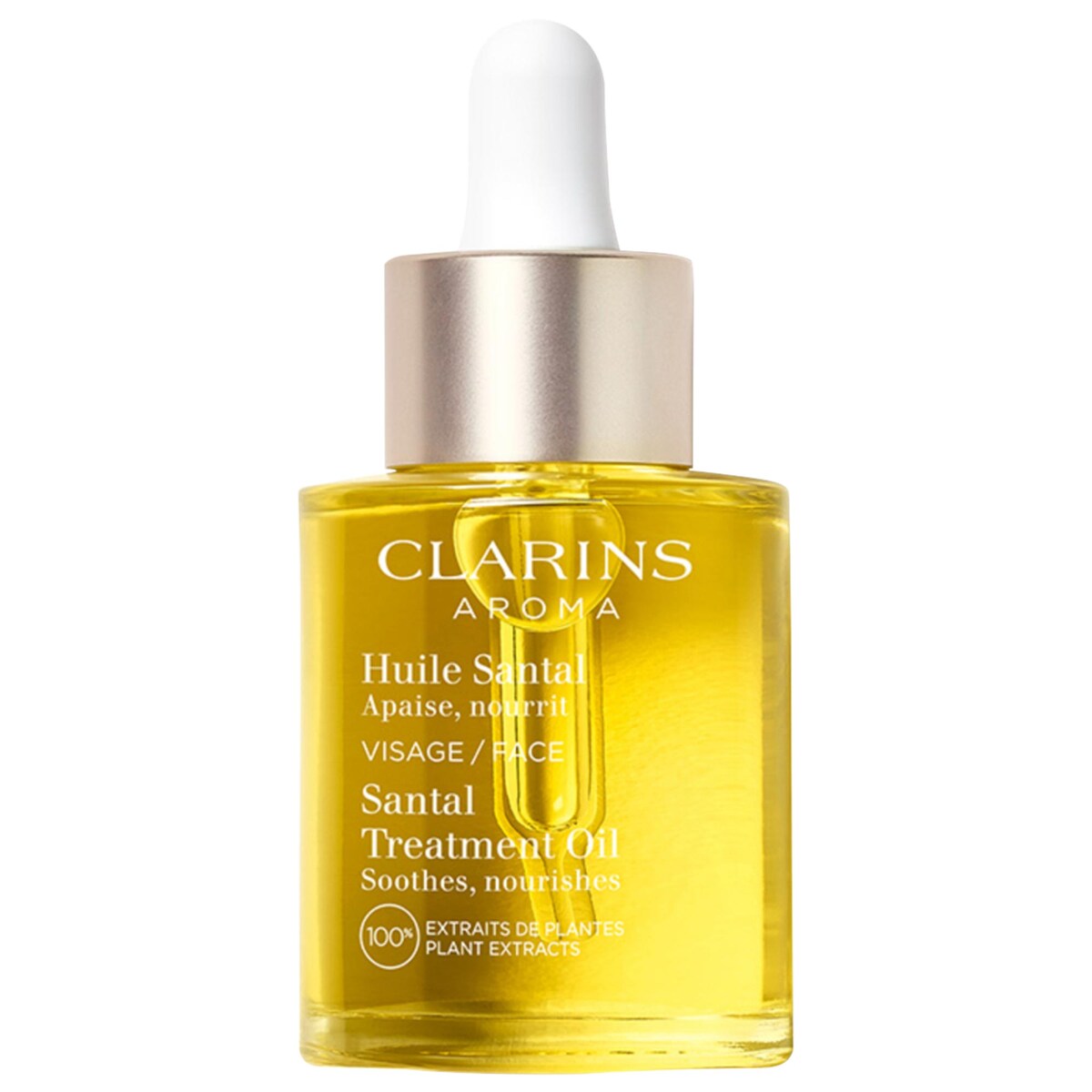
Clarins Santal Soothing & Hydrating Face Treatment Oil is the kind of product that sounds simple until you try to place it in a real routine.
It is not a moisturizer in the usual cream sense. It is not a water serum. It is not a retinoid, exfoliant, or brightening treatment. It is a dry-skin face oil built around hazelnut oil plus sandalwood, cardamom, and lavender essential oils, with a very specific evening-use ritual: apply three to five drops while skin is still damp after cleansing and toning, press from the center of the face outward, avoid the eye area, and blot excess.
That tells me a lot about the fit.
I would look at Clarins Santal Soothing & Hydrating Face Treatment Oil as a comfort step for normal-to-dry skin that likes a richer evening ritual and tolerates aromatic formulas. I would not treat it like a universal barrier repair product, and I would be careful with it if my skin tends to flush, sting, clog, or react to fragranced products.
The Quick Answer
If I were deciding in May 2026, I would put Clarins Santal Face Treatment Oil in the "dry-skin night comfort" category.
It makes the most sense when the routine already has a gentle cleanser and a hydrating layer, but the skin still wants a flexible oil finish at night. It is priced like a prestige ritual product at $68, and the appeal is the combination of plant-oil cushion, aromatic sensorial feel, and a small-drop application style.
The main caveat is obvious from the ingredient list: this is an essential-oil and fragrance-containing face oil. Some dry skin loves that kind of plush, spa-like finish. Some sensitive skin does not. I would rather be honest about that split than pretend every dry-skin product fits every dry face.
Product Snapshot
| Detail | Clarins Santal Face Treatment Oil |
|---|---|
| Brand | Clarins |
| Product type | Evening face oil |
| Glass product page | Clarins Santal Face Treatment Oil |
| SKU | 1682319 |
| Product ID | P392522 |
| Price | $68 |
| Rating snapshot | About 4.81 from 32 reviews |
| Skin types | Normal and dry |
| Concerns | Dryness, dullness, fine lines |
| Main oils | Hazelnut oil plus sandalwood, cardamom, and lavender essential oils |
| Use direction | Evening, three to five drops on damp skin after cleansing and toning |
That profile is narrow in a useful way. This is not trying to be a gel-cream for oily skin, a fragrance-free recovery balm, or a daytime sunscreen-friendly hydrator. It is a small-dose evening oil for people who want comfort and glow without rebuilding the whole routine.
What It Is Trying To Do
The product promise is hydration, visible toning, softness, and comfort for dry skin. I would translate that into three practical jobs.
First, it can make the last step of a dry-skin evening routine feel more flexible. Creams can feel padded but static. Oils can add slip, glow, and a softer finish when used lightly.
Second, it can help a dry routine feel less flat. Dullness is not always a pigment problem. Sometimes skin looks tired because it is dry, rough, or lacking surface softness. A face oil can make that surface look smoother right away, even when deeper texture needs more time.
Third, it can make the routine feel more intentional. That matters because dry skin often responds better to consistency than panic shopping. A product you actually enjoy using can help you keep the rest of the routine boring and steady.
The Formula Personality
The base ingredient that stands out is hazelnut oil. In a face oil, I look for how the oil is supposed to sit: heavy and sealing, light and silky, or somewhere in between. Hazelnut oil gives this product a classic facial-oil identity rather than a petrolatum balm identity or a gel moisturizer identity.
Then there are the aromatic oils: sandalwood, cardamom, lavender, and parsley oil appear in the full ingredient list, along with fragrance components like linalool, limonene, citral, and alpha-isomethyl ionone.
That makes the product feel more like a sensorial treatment oil than a bare-minimum barrier product. I would expect the experience to matter here. If I wanted a completely plain recovery step, I would choose something else. If I wanted a dry-skin oil that feels like a night ritual, this would make more sense.
Who I Would Put In The Yes Column
I would consider this oil for someone with normal-to-dry skin that feels tight at night but does not need an ointment-level seal.
The strongest fit is probably a person who already has a simple evening routine and wants one richer finishing step. For example: gentle cleanse, hydrating toner or serum, moisturizer if needed, then a few drops of oil pressed into damp skin or over the areas that still feel dry.
It also fits someone who likes aromatic products and knows their skin handles them. That is a real preference. Some people do not want every routine to feel clinical and silent. They want a product that feels calming in the bathroom, not just technically useful on paper.
I would also consider it for dry skin that looks dull because the surface is rough, flat, or under-moisturized. Oil will not replace sunscreen, retinoids, or pigment care, but it can make dry skin look softer when the routine has been too matte or too stripping.
Who I Would Tell To Slow Down
I would be more cautious if the skin is reactive, rosacea-prone, acne-prone, or easily bothered by scent.
Essential oils are not automatically bad, but they are not invisible either. If my skin were currently stinging from moisturizer, flushing after cleansing, or breaking out around the cheeks and chin, I would not add a fragrant oil as the next experiment. I would first calm the routine down with simpler steps.
I would also pause if the main problem is oily shine. A face oil can look beautiful on dry cheeks, but it can be the wrong answer for a T-zone that already gets slick by lunch. In that case, I would rather fix hydration with a light serum and use cream only where needed.
If eye-area dryness is the concern, this is not the product I would choose. The directions say to avoid the eye area, which is worth respecting.
How I Would Use It At Night
The official use pattern is very specific, and I would not overcomplicate it.
At night, after cleansing and toning, keep the skin slightly damp. Add three to five drops to the palms. Press onto the face and neck, working from the center outward. Avoid the eye area. If the skin looks too shiny or feels overloaded, blot the excess with tissue.
I would start closer to three drops than five. Face oils are easy to overuse, especially if the skin feels dry before bed. More oil is not always more comfort. Sometimes it is just more residue on the pillow.
If I were introducing it to a routine with serum and moisturizer, I would keep the rest simple for the first week: gentle cleanser, one hydrating step, this oil, and maybe a light cream only if the skin still needs it.
Where It Fits Around Moisturizer
This is where face oils get confusing.
Clarins frames Santal as an oil used after cleansing and toning while the skin is damp. In a minimal routine, that can be the main comfort step. In a fuller routine, I would place it late, after watery layers and before or after moisturizer depending on how dry the skin is and how the textures behave.
If the skin is dry but not cracked, I would try the oil on damp skin before cream and see whether the cream still spreads well.
If the skin wakes up tight, I would try moisturizer first, then press one or two drops of oil only on cheeks, smile lines, or neck.
If the skin clogs easily, I would not put it all over the T-zone. I would treat it like a dry-patch tool, not a face-wide requirement.
The broader routine logic is similar to the one in my dry night routine guide: put water-friendly steps first, comfort steps later, and stop adding layers once the skin feels settled.
What I Would Expect For Dryness
For dryness, I would expect this oil to help most with surface comfort and the feeling of a softer finish.
If skin is dry because the cleanser is too harsh, the oil may help temporarily but not solve the main issue. If skin is dry because the room is dry, the oil may help slow that tight feeling on top of a hydrating layer. If skin is dry because a retinoid or exfoliant is being used too often, the oil may feel nice but the schedule still needs adjusting.
That is why I would not judge this product in isolation. I would judge the whole night routine.
Does the skin feel comfortable after twenty minutes?
Does it still feel comfortable the next morning?
Does the oil make dry areas softer without creating new congestion?
Those answers matter more than whether the bottle looks like a perfect dry-skin fix on its own.
What I Would Expect For Dullness And Fine Lines
I would keep expectations measured.
Face oils can make skin look more luminous because they improve surface slip and reduce that dry, flat look. That can soften the appearance of fine lines that become more visible when the skin is dehydrated or matte.
But I would not treat this like a wrinkle treatment in the same lane as retinoids, sunscreen, or procedures. It is better understood as a comfort-and-finish product. If fine lines look sharper when the face is dry, a good oil can make the skin look smoother. If the concern is deeper aging, this is supporting cast, not the whole plan.
For dullness, I would ask whether the dullness comes from dryness, buildup, irritation, or uneven tone. This oil is best for the dryness version. If dullness is coming from heavy dead-skin buildup, too much self-tanner, or post-breakout marks, the plan needs a different center.
The Essential Oil Caveat
This is the section I would not skip.
Sandalwood, cardamom, and lavender essential oils are part of the identity of this product. So is fragrance. That can make the product feel elegant and calming for people who enjoy aromatic skincare. It can also be a dealbreaker for people who react to scented formulas.
If I had sensitive skin, I would apply a tiny amount to a small area for several nights before using it widely. I would not test it for the first time on the same night as a peel, retinoid, new vitamin C, or exfoliating toner.
If a product burns, itches, or leaves the face red in a way that feels wrong, I would stop using it. Dry skin should feel comforted by a night oil, not challenged by it.
Price And Value
At $68, this has to be more than a random oil step.
The value makes sense if a few drops last a long time, the scent and ritual make the routine easier to keep, and the skin genuinely feels softer overnight. It makes less sense if the user only wants a plain barrier seal or if most of the face is oily.
I would not buy it because every routine needs a face oil. Every routine does not. I would buy it because a specific dry-skin routine has room for a polished evening oil and the skin has a history of tolerating aromatic formulas.
For tighter, more barrier-focused dryness, I would also read the tight-skin-after-moisturizer guide before deciding whether the missing step is oil, cream, cleanser, or a lighter hydration layer.
How I Would Track The Fit
I would give the oil a narrow job and track that job.
For seven to ten nights, I would note:
- how skin feels right after application
- whether the finish feels comfortable or greasy
- whether cheeks feel less tight in the morning
- whether new bumps appear in the areas where oil was used
- whether redness, itching, or stinging shows up
- whether the routine still feels simple enough to repeat
Glass is useful here because the routine builder can keep the product role clear. I do not want a face oil floating around as a vague glow step. I want to know where it sits, how often it is used, and whether it is helping the actual dry-skin problem.

My Bottom Line
Clarins Santal Soothing & Hydrating Face Treatment Oil is best treated as a dry-skin evening oil with a strong sensorial identity.
I would consider it for normal or dry skin that wants nighttime comfort, surface softness, and a polished oil ritual. I would be careful if the skin is reactive, fragrance-sensitive, very acne-prone, or already irritated. I would start with three drops, keep the rest of the routine calm, and judge it by how the skin feels the next morning, not just by how glossy it looks at bedtime.
For the right skin, it can be a beautiful last step. For the wrong skin, it is too aromatic and too specific to force.