Sensitive skin makes you suspicious.
That is not a bad thing.
If one cleanser can make your face tight, one serum can make your cheeks hot, and one exciting new routine can turn into three days of regret, you stop trusting generic advice pretty quickly.
That is the part most skincare apps still miss.
They are built for motivation. They are built for scanning. They are built for product discovery. Some are built for people who enjoy comparing ingredients for twenty minutes before buying a moisturizer.
But sensitive skin needs something quieter.
It needs fewer variables. Better notes. Slower changes. A routine that does not punish you for being careful. And when an app gives advice, it needs to understand the difference between "try this new active" and "do not touch anything for a week."
That is the filter I used for this comparison.
I was not looking for the loudest app. I was looking for the one I would trust on a week when my skin felt reactive and I did not want to make it worse.
The short answer
If your skin is sensitive, the best skincare app is the one that helps you do less, track better, and change one thing at a time.
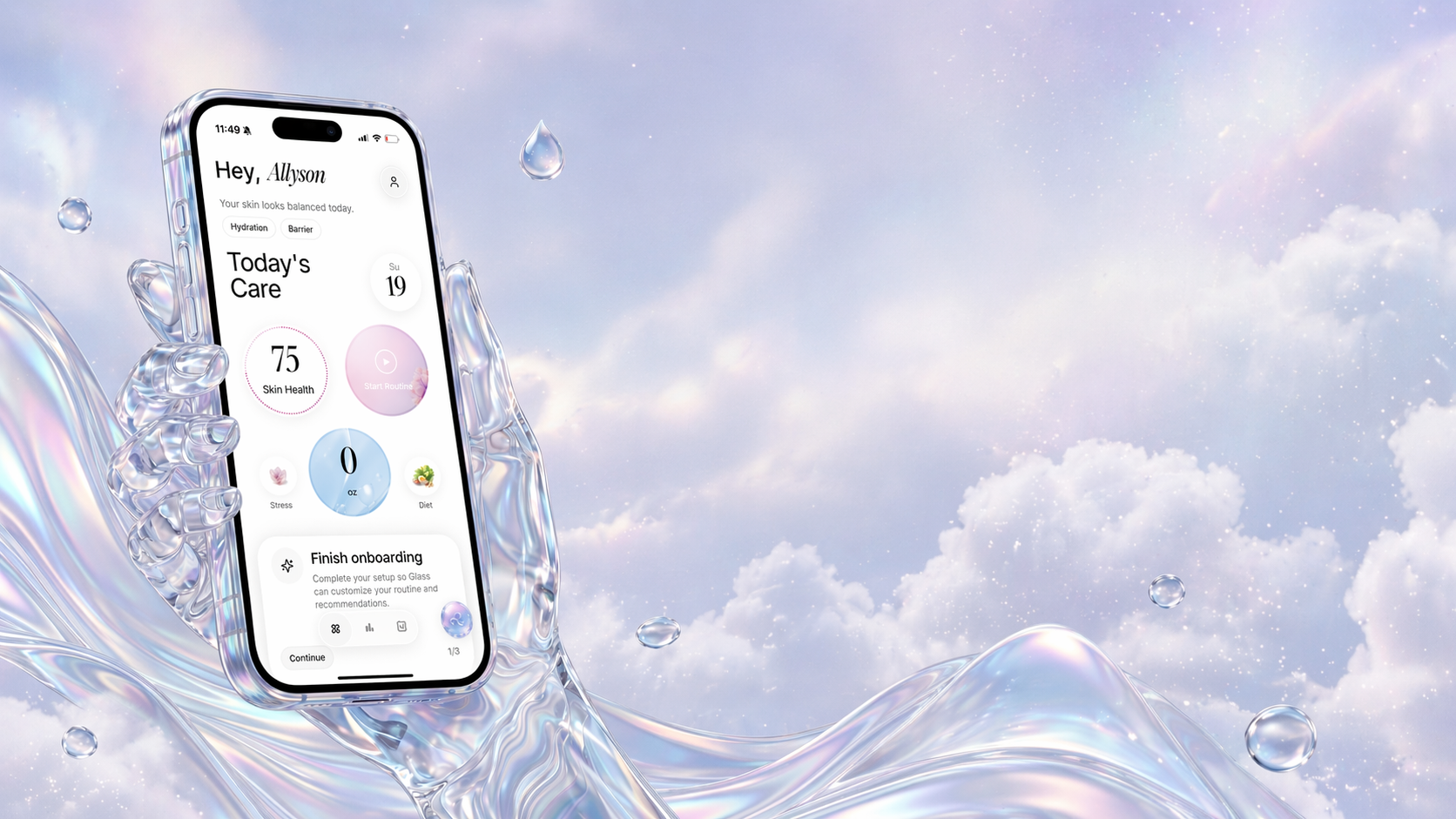
For most people, I would start with Glass because it connects skin scans, routine tracking, product context, and progress in one place without making the scan feel like the whole point.
If you want a more ingredient-heavy system, Skin Bliss is stronger for product analysis and broad routine logic. If you want a more analytics-forward skin tracking tool, SkinCircle has the clearest data angle. If you want a simple product diary, Refresh is easier to understand. If you want AI analysis, product tracking, and a progress diary in one app, SkinsideAI is worth comparing. If you mostly want habit analytics and an assistant, SKO fits that lane.
I would not choose purely by the app with the most features.
Sensitive skin usually does better with the app that creates the least panic.
What sensitive skin actually needs from an app
Sensitive skin is not just a skin type checkbox.
It changes how you make decisions.
If your skin is resilient, you can sometimes get away with testing a vitamin C serum, swapping cleansers, adding an exfoliant, and changing moisturizers too close together. I still do not think that is smart, but some people get away with it.
Sensitive skin usually does not.
The margin is smaller. A harsh cleanse, too much exfoliation, fragrance, a strong active, a hot shower, a cold dry week, travel, stress, or a bad layering decision can all blur together. Then you are staring at your face trying to figure out what caused the sting.
That is where an app can be genuinely useful.
Not because it knows your skin better than you do.
Because it can remember what you forget.
A good skincare app for sensitive skin should help you track:
- what you used
- when you used it
- what changed
- whether your skin felt tight, hot, itchy, dry, or calmer
- whether a new product was introduced too close to another change
- whether progress is happening over weeks instead of one emotional morning
That sounds basic. It is not.
Most people do not have a clean record. They have a shelf, a memory, a few photos, and a vague feeling that their skin was better before they added "that one serum."
The first thing I would ignore: the beauty score
Scores are seductive.
They make skin feel measurable. They make progress feel official. They turn a messy face day into a number you can understand.
But sensitive skin can make a score misleading if the app does not show what is underneath it.
If the score drops because your cheeks look red after a workout, that is not the same thing as a product reaction. If your texture looks worse because bathroom lighting changed, that is not the same thing as a failed routine. If your dryness improves but two pimples appear, one number cannot tell you which signal matters more.
For sensitive skin, I care more about separate signals:
- redness
- dryness
- texture
- visible breakouts
- irritation notes
- routine consistency
- product-change dates
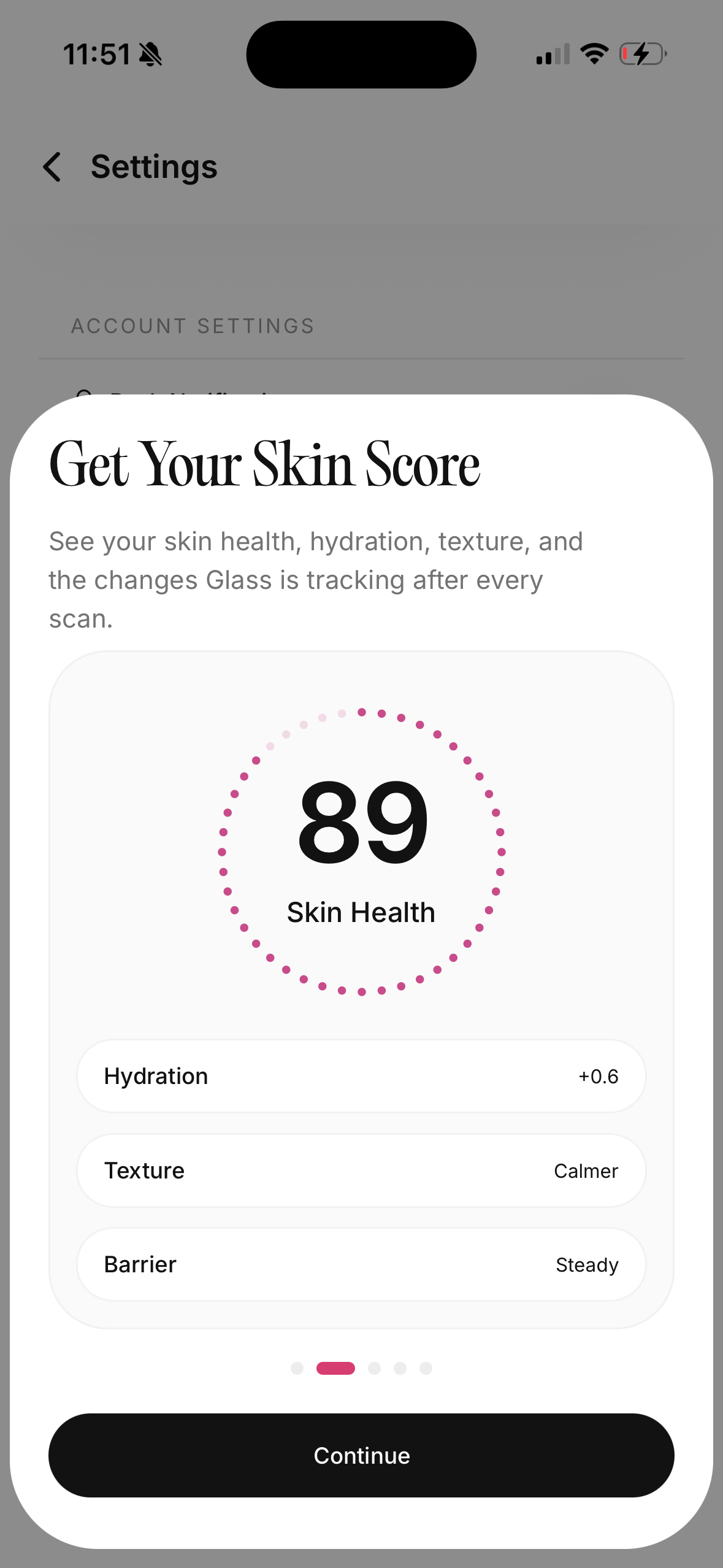
That is why I like apps that connect a scan to the routine. A score by itself can make you react too fast. A score beside your product history can help you slow down.
My sensitive-skin app checklist
This is the checklist I would use before trusting any skincare app with a reactive routine.
| What I checked | Why it matters for sensitive skin | What I would avoid |
|---|---|---|
| Routine history | You need to know what was actually used before the flare | Pretty scan reports with no product context |
| Reaction notes | Burning, stinging, heat, and tightness matter as much as visible acne | Apps that only track "good" or "bad" skin days |
| Product-change dates | Sensitive skin needs one-variable testing | Apps that encourage too many new products at once |
| Progress photos | Calm changes often show up slowly | Random selfies with no consistent angle |
| Ingredient context | Fragrance, acids, retinoids, and exfoliants need careful handling | Product suggestions without warnings or tradeoffs |
| Conservative language | The app should not scare you into over-correcting | Diagnosis-style claims or dramatic labels |
The best app does not need to win every column.
It needs to match your problem.
If your problem is ingredient confusion, choose the app with better product intelligence. If your problem is inconsistency, choose the app that makes daily logging easier. If your problem is constantly changing products after one bad skin day, choose the app that makes the timeline obvious.
Glass: the best fit if your routine and scan need to talk to each other
Glass is the app I would pick first for sensitive skin because it treats analysis as part of a routine loop.
That matters.
Sensitive skin does not usually need more isolated information. It needs better context. A scan can tell you what looks different, but your routine history helps explain why it might be different.
The Glass flow is useful because it puts the important pieces close together:
- skin scans
- morning and night routine tracking
- product logging
- progress context
- reminders
- routine reports
The reason I like that structure is simple: it helps prevent the most common sensitive-skin mistake.
Changing too much at once.
If your redness looks worse, the app can be useful only if you can also see what changed in the routine. Did you start retinol? Did you exfoliate? Did you skip moisturizer? Did you use a foaming cleanser twice a day? Did you scan after being outside in heat?
Those details matter more than one dramatic recommendation.
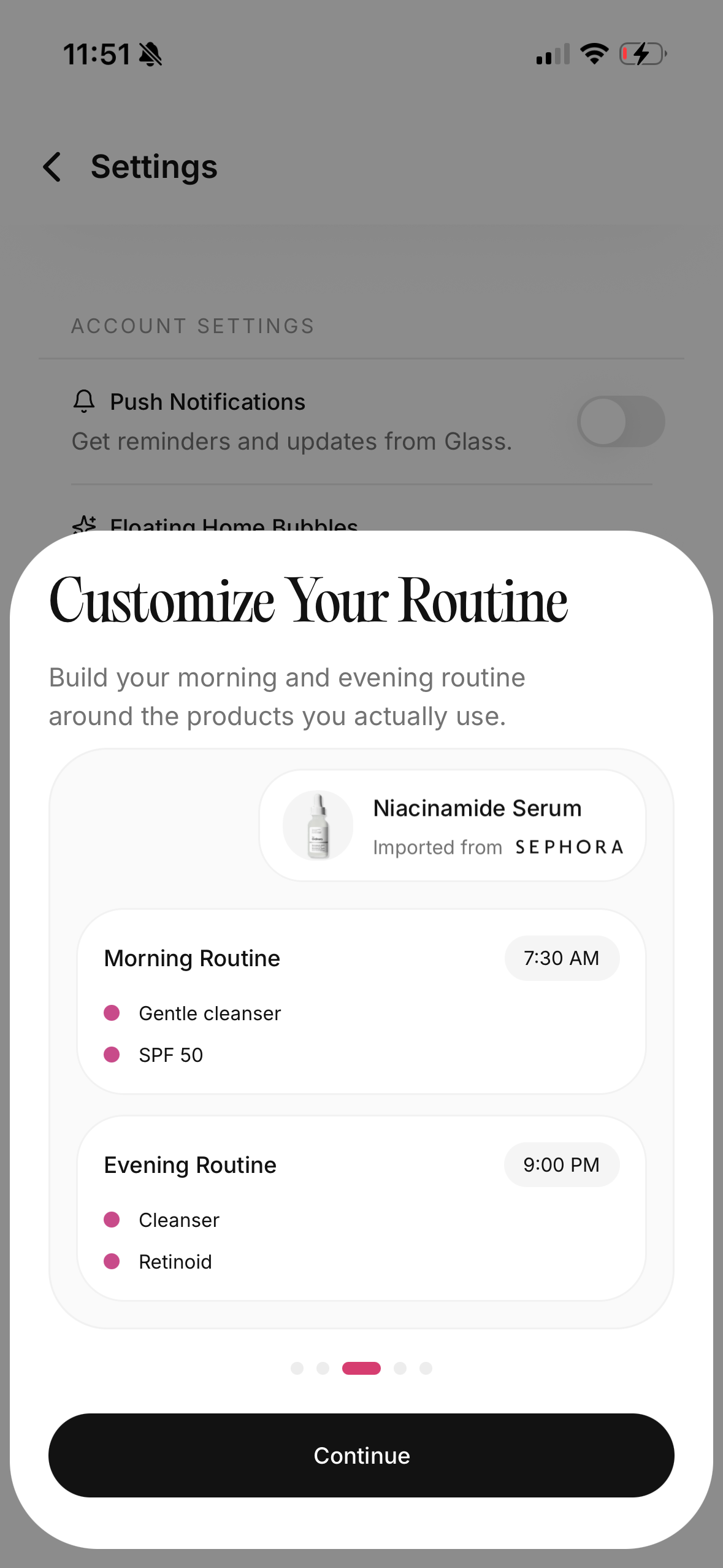
Glass is strongest for the person who wants fewer decisions and better follow-through. It is less about building the biggest possible skincare database and more about helping you stay consistent enough to learn from your own skin.
That is the right shape for sensitive skin.
The app should not make you feel like you need to rebuild everything every time your face looks uneven. It should help you ask a calmer question:
_What changed, and should I actually change anything back?_
Skin Bliss: best if ingredients are where you get stuck
Skin Bliss is the app I would look at if my sensitive-skin problem were mostly product confusion.
It has a bigger, more ingredient-minded feel. The app positions itself around skin analysis, product checking, routine building, shelf analysis, ingredient logic, and progress tracking. That makes it useful for people who want to understand whether a product belongs in their routine before they put it on their face.
That can be very helpful for sensitive skin.
Especially if you are the kind of person who buys products and then realizes later that three of them contain exfoliating acids, fragrance, essential oils, or overlapping actives you did not mean to stack.
Where Skin Bliss makes the most sense:
- you want product compatibility help
- you care about ingredient explanations
- you have a larger shelf
- you want to catch conflicts before applying something
- you enjoy detail and do not mind a fuller app experience
Where I would be careful:
If you are already overwhelmed, a broad system can still feel like more work. Sensitive skin often improves when the routine gets smaller, not when the analysis gets more elaborate.
That does not make Skin Bliss the wrong choice. It just means I would use it with restraint. Let it help you say no to products, not just find more of them.
SkinCircle: best if you want data before advice
SkinCircle has a more measurement-focused personality.
It leans into skin tracking, computer vision, routine logging, and product correlation. I like that angle because sensitive skin often needs pattern recognition more than motivational routine language.
The useful promise here is not "we will give you perfect skin."
The useful promise is closer to: track the same things repeatedly, then look for patterns.
That is exactly how I would want to approach reactive skin. If redness, dryness, acne, and texture are tracked separately, you have a better chance of seeing whether a product actually helped one concern while irritating another.
That tradeoff is common.
A cleanser might reduce oil but increase tightness. A retinoid might smooth texture but make the barrier feel raw. A vitamin C serum might brighten but sting too much to justify keeping it.
For sensitive skin, those mixed outcomes are the whole story.
SkinCircle makes the most sense if you like data, progress charts, and the idea of correlating routine behavior with skin changes. I would skip it if charts make you more obsessive, because the best tracker is the one that helps you act wisely, not the one that makes you check your face ten times a day.
Refresh: best if you want a simple product diary
Refresh is the calmer option if you mostly want organization.
It is built around product inventory, daily routines, product details, reminders, and a personal skincare diary feel. That can be enough. In fact, for sensitive skin, "enough" is sometimes the best thing an app can be.
Not everyone needs AI interpretation.
Sometimes the problem is simpler:
- you forget when you opened a product
- you cannot remember which moisturizer caused the sting
- you skip your routine and then blame the wrong serum
- you rebuy products before finishing what you own
- you need reminders without a whole skin-analysis dashboard
Refresh fits that person better than a heavier app.
The limitation is that it may not give you the same scan-to-routine interpretation as Glass or the same ingredient depth as Skin Bliss. But if the goal is to create a record and stop relying on memory, that can still be valuable.
Sensitive skin often rewards boring consistency.
Refresh feels closest to that boring-consistency lane.
SkinsideAI: best if you want one calm workflow for photos, products, and routines
SkinsideAI is worth comparing because it understands one of the bigger routine problems: people cannot connect what they used to what changed.
That is the exact problem sensitive skin creates.
You do not just need a photo. You need the photo beside the product history. You do not just need a routine. You need to know whether that routine stayed stable long enough to judge. You do not just need an AI answer. You need an answer that respects your timeline.
SkinsideAI positions itself around photo-based analysis, AM/PM routine tracking, product logging, progress photos, and an assistant. That is a useful bundle.
What I like most is the emphasis on one workflow. Sensitive skin gets harder when everything is scattered: photos in your camera roll, products in your cabinet, notes in your head, advice in screenshots, reminders in a different app.
The more scattered the routine is, the easier it is to overreact.
SkinsideAI makes sense if you want:
- scan history
- product shelf tracking
- AM/PM routine structure
- progress comparison
- calmer AI guidance
I would compare it closely against Glass if your main goal is routine clarity with skin context. The deciding factor is which interface feels easier to repeat every day. Sensitive skin does not reward the app you admire. It rewards the app you actually use when you are tired.
SKO: best if habit analytics are your main problem
SKO is a good fit for someone who wants a routine tracker with habit analytics.
It emphasizes morning and evening routines, daily steps, consistency tracking, active ingredients, visual analytics, and an AI assistant. That makes it less of a product scanner and more of a skincare habit tool.
That can be useful if your skin is sensitive but your biggest issue is inconsistency.
Some people do not need a new routine. They need to stop doing their routine randomly.
They cleanse some nights but not others. They use retinol whenever they remember. They moisturize only after their skin already feels tight. They add calming products after irritation instead of building a routine that avoids irritation in the first place.
For that person, habit analytics can help.
The thing I would watch is whether the app encourages better judgment or just more tracking. A streak can be motivating, but sensitive skin sometimes needs planned rest. You should not feel pressured to use an active just because a calendar wants a perfect week.
The best habit app for sensitive skin leaves room for recovery nights.
Lume Skin: useful if you want scan, product safety, and routines together
Lume Skin is another app in the all-in-one lane.
It emphasizes skin analysis, product safety scanning, progress tracking, AI chat, custom morning and evening routines, and reminders. It also speaks directly to sensitive skin by framing the job around avoiding irritants, finding gentle products, and reducing redness.
That is the right promise for this reader.
The part I would evaluate carefully is tone. When an app uses big language around AI skin analysis, I want the experience to stay grounded. For sensitive skin, the best version would help you identify possible irritants and routine overload without acting like it can replace professional care.
If Lume helps you avoid unsuitable products and track progress gently, that is useful.
If it makes you feel like every scan needs a new intervention, I would slow down.
The feature comparison I would actually use
| App | Best for sensitive skin if... | Where it may disappoint |
|---|---|---|
| Glass | You want scans, products, routines, and progress tied together | You want the largest ingredient database above all else |
| Skin Bliss | You want ingredient analysis and product compatibility help | You get overwhelmed by deeper feature sets |
| SkinCircle | You want data, metrics, and routine correlation | Tracking makes you obsess instead of decide calmly |
| Refresh | You want a simple product diary and routine organizer | You want deeper scan interpretation |
| SkinsideAI | You want photo analysis, product shelf, and AM/PM routines in one workflow | You need the simplest possible tracker |
| SKO | You want habit analytics and routine consistency | Streaks may not capture recovery-night nuance |
| Lume Skin | You want scan, product safety, AI chat, and routine suggestions | Strong claims need grounded expectations |
The best choice depends on what keeps hurting your routine.
If you keep reacting to products, choose the app that helps you catch ingredient and product conflicts. If you keep forgetting what you used, choose the app that makes logging easy. If you keep panic-changing your routine, choose the app that makes timelines obvious.
How I would use a skincare app during a sensitive-skin flare
I would not start by adding products.
I would start by documenting what is already happening.
For the first few days, I would log the current routine without changing anything unless the product is clearly causing burning, swelling, or a reaction that needs to stop. I would take the same kind of photo in the same lighting. I would note how the skin feels, not just how it looks.
The notes matter:
- tight after cleansing
- cheeks hot after serum
- moisturizer stung for one minute
- dry around mouth
- redness worse after shower
- skin calmer on nights without exfoliation
That is the kind of record that helps.
Then I would simplify.
Cleanser, moisturizer, sunscreen in the morning. Cleanser and moisturizer at night. No new exfoliating acid. No new retinoid. No "brightening" stack. No testing three calming serums at once.
Once the skin feels stable, I would add one variable at a time and let the app track the timeline.
That is where the app earns its place.
What I would not let an app talk me into
I would not let any skincare app talk me into treating sensitive skin like a shopping problem.
Sometimes your routine does need a different product. A gentler cleanser, a plainer moisturizer, or a less irritating sunscreen can change everything.
But a lot of sensitive-skin chaos comes from too much input.
Too many actives.
Too many switches.
Too many half-used products.
Too many explanations for one face.
The app should help you reduce that noise. If it constantly pushes another product, another routine, another scan, another diagnosis-sounding label, I would be careful.
The right app should make your routine feel more legible.
Not more dramatic.
The routine I would pair with any sensitive-skin app
The app is only the record.
The routine still has to be sane.
If I were rebuilding from a reactive week, I would keep the structure boring on purpose.
Morning
- rinse or use a gentle cleanser only if needed
- moisturizer if the skin feels dry or tight
- sunscreen every day
Night
- gentle cleanser
- moisturizer
- no exfoliating acids until the skin feels stable
- no retinoid until the skin feels calm enough to tolerate it
When stable
- add one treatment step at a low frequency
- keep everything else the same
- track for at least two weeks before judging
- stop if burning, swelling, or persistent irritation shows up
That kind of routine does not look impressive.
It works because it gives sensitive skin fewer chances to protest.
If you need a deeper routine reset, skin barrier repair routine, I repaired my skin barrier routine, and night skincare routine for sensitive skin are the better next reads.
My pick for May 2026
I would choose Glass first if I wanted a skincare app for sensitive skin because it connects the pieces I care about most: scans, products, routines, reminders, and progress.
That is the loop I trust.
Not because an app can know everything about your skin. It cannot.
Because sensitive skin needs a calmer way to notice patterns before you make the next change.
If your biggest problem is ingredients, compare Skin Bliss closely. If your biggest problem is data, look at SkinCircle. If your biggest problem is product organization, Refresh may be enough. If you want an all-in-one scan and routine workflow, compare SkinsideAI. If you need habit analytics, SKO is worth a look. If you want product safety checks and AI chat in the same place, Lume Skin belongs on the shortlist.
But if I had to pick the app shape I would trust on a reactive-skin week, I would pick the one that helps me slow down.
That is what sensitive skin usually needs most.
Not more excitement.
Better evidence.