
Starting is the hard part.
Not cleansing. Not moisturizing. Not sunscreen.
Starting.
That is what most people mean when they search for a skincare routine builder app.
They are not asking for another pretty place to save product names. They are trying to solve a mess that usually looks more like this:
- I have too many products and no clear order.
- I do not know what to use every day versus a few nights a week.
- I keep building routines that feel smart on paper and impossible in real life.
- Every app sounds helpful until it starts feeling like homework.
That is the real pain point here.
On April 22, 2026, I reviewed the public-facing pages shaping this category, including the Glass App Store listing, FeelinMySkin on the App Store, Skincare Routine on the App Store, the Skin Bliss site, and SkinSort.
I also looked at the complaints people keep repeating in public skincare-app discussions: too many notifications, too much effort, recommendations that do not feel realistic, and apps that get boring after the first week.
That matters because a good routine builder should not just help you build a routine.
It should help you build one you will still want to follow next Tuesday when you are tired, your skin is irritated, and you are one bad purchase away from making everything worse.
Quick answer
If you want the short version first:
- Glass is the best skincare routine builder app for most people because it helps you build the routine and keep it connected to products, reminders, and visible skin progress.
- FeelinMySkin is the best pick if you want a planner-style app that makes routine setup and follow-through feel approachable.
- Skincare Routine is best if your biggest problem is order, ingredient conflicts, and how often stronger products should be used.
- Skin Bliss is best for people who want a more analysis-heavy routine builder with deeper product intelligence.
- SkinSort is best if you want a free routine-building tool with strong ingredient logic before committing to a full app ecosystem.
If your problem is beginner confusion plus long-term consistency, Glass is the cleanest overall recommendation.
The 5 skincare routine builder apps worth your time right now
| Image | App | Best for | What stands out | What to watch |
|---|---|---|---|---|
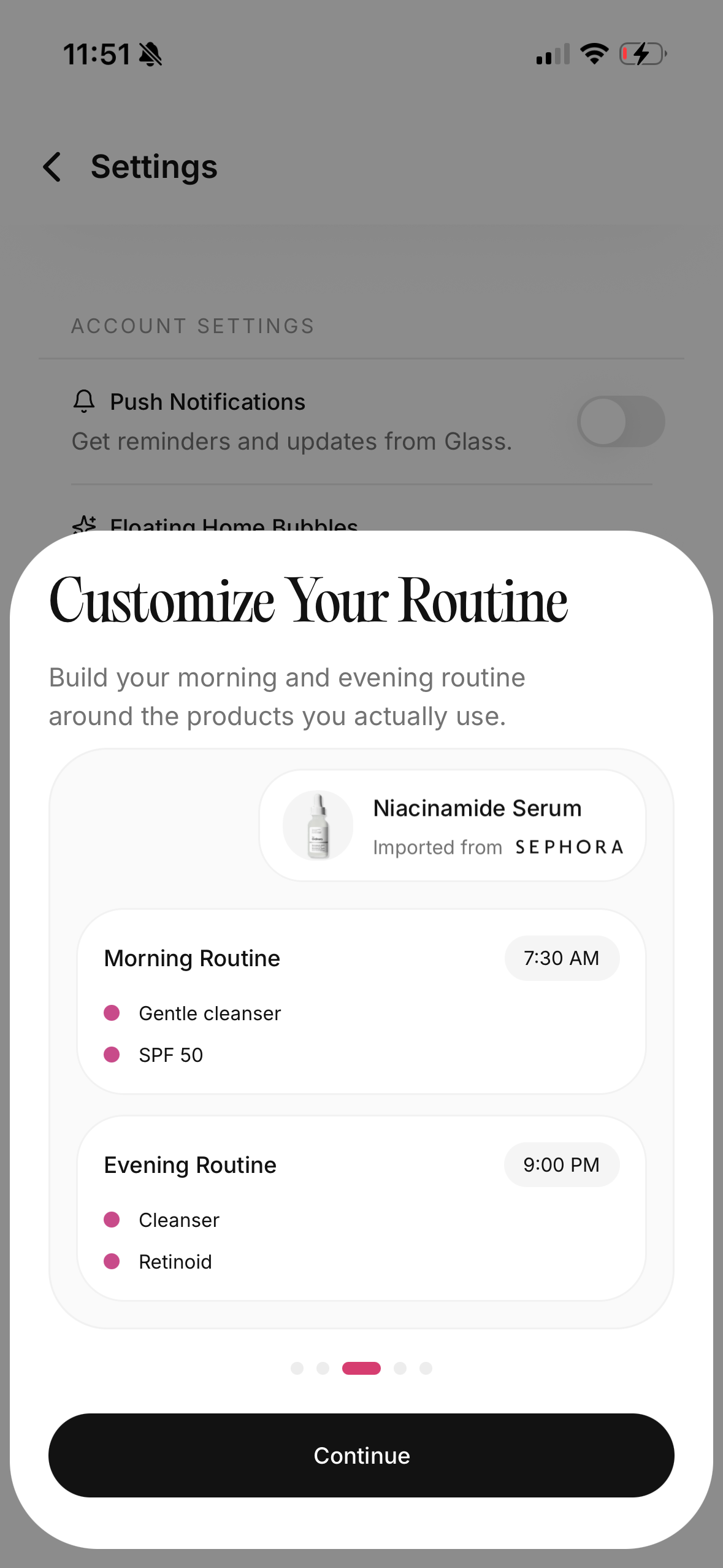 | Glass | People who want to build a routine and actually keep it | Routine builder, product logging, reminders, skin analysis, reports, lifestyle context | Some deeper guided analysis features sit behind subscription access |
 | FeelinMySkin | People who want a routine planner they will actually open nightly | Personalized routine suggestions, smart ordering, reminders, shelf tracking, journaling | Stronger on planner value than on deeper skin interpretation |
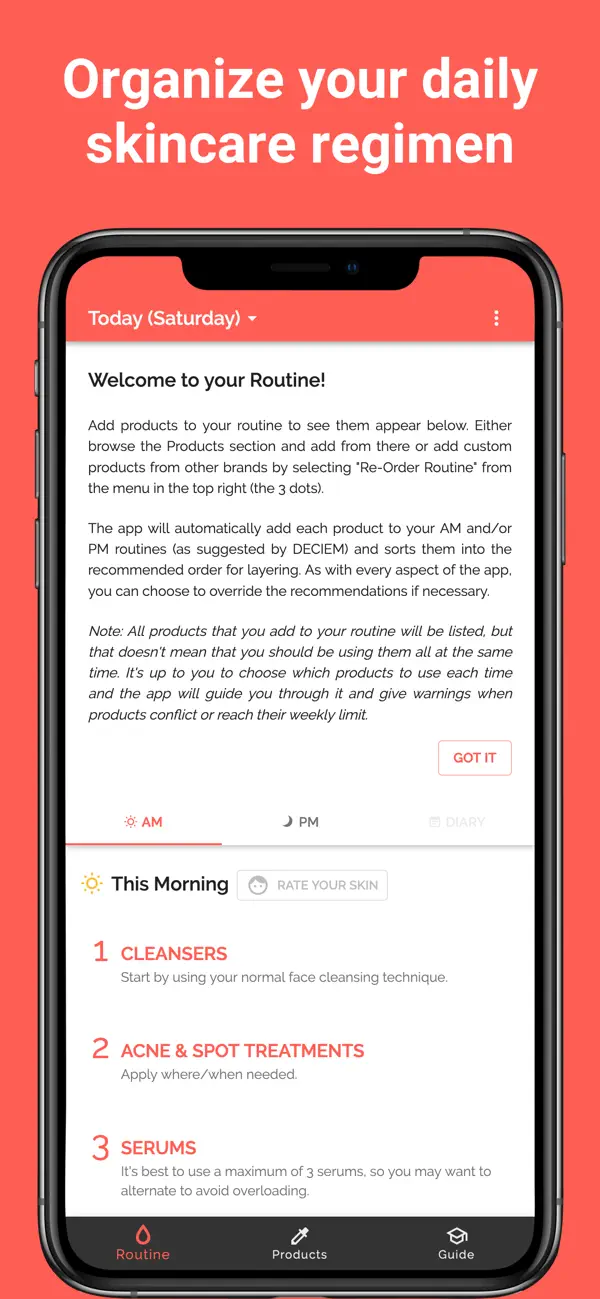 | Skincare Routine | Readers who mainly need order and frequency logic | Automatic AM/PM ordering, conflict warnings, reminders, repeat-day scheduling, one-time purchase | More functional than warm |
 | Skin Bliss | Users who want routine building plus richer analysis | Face scan, routine builder, evaluator, shelf analysis, progress tracking, ingredient checks | Can feel denser than you need if you mainly want a simple plan |
| SkinSort | People who want routine-building logic first and app polish second | Routine builder, ingredient breakdowns, compare tools, conflict awareness, strong product context | Feels more like a smart skincare toolset than a cozy daily companion |
What makes a routine builder actually good?
This is where most apps start sounding the same.
They all talk about personalization. They all talk about better skin. They all talk about routines.
That is not enough.
A real routine builder has to answer the questions that show up after the excitement of setup wears off:
- Does it help me decide what belongs in the routine at all?
- Does it put the products in an order that makes sense?
- Does it help me avoid stacking too many strong things together?
- Can it handle the reality that not every product gets used every day?
- Does it make the routine feel simpler instead of more fragile?
That last one matters most to me.
The best skincare routine builder app is not the one that creates the most complicated personalized plan. It is the one that helps you stop improvising every night.
1. Glass is the best skincare routine builder app for most people
What I like most about Glass is that it does not stop at building the routine.
It keeps the routine tied to the rest of your skincare life:
- the products you are actually using
- reminders
- skin analysis
- reports
- photo and progress context
- lifestyle signals like sleep, stress, water, and diet
That is the right product shape.
Most routines do not fail because someone chose the wrong toner one time. They fail because the whole system becomes hard to read. You forget what changed. You add a new active too fast. You cannot tell if your skin is reacting to the product, your sleep, or your own impatience.
Glass feels more honest about that mess.
It is the best fit if you want the builder to do more than create a pretty list. It should help you stay inside the routine long enough to learn something from it.
That is especially valuable if your current pattern looks like this:
- you rebuild your routine every two weeks
- you buy products faster than you can evaluate them
- you want one place to see routine, products, and progress together
- you are trying to calm your skincare down instead of turning it into a hobby project
If you want the closest companion reads after this, open best skincare routine app (April 2026), best skincare routine tracker (April 2026), and how to build a skincare routine that you'll actually follow.
2. FeelinMySkin is best if you want a routine planner that feels approachable
FeelinMySkin makes a lot of sense to me for one specific kind of person.
They are not trying to build the most advanced skincare system on the internet.
They just want the routine to stop floating around in their head.
Its public-facing positioning has leaned harder into personalized routine suggestions, smart ordering, product search improvements, reminders, and planner-style structure. That gives it a clear lane.
This is the app I would choose for someone who says:
- I know roughly what I want to use, but I need help organizing it.
- I want reminders and checklists more than another skin score.
- I need the routine to feel visible, not abstract.
- I am more likely to stay consistent if the app feels like a calm planner.
That is a real use case.
And honestly, it is a much bigger use case than a lot of flashy skincare software wants to admit.
Sometimes the best builder is not the one with the deepest analysis. It is the one that makes the routine feel easy to repeat.
I would rank FeelinMySkin below Glass because Glass ties the builder into a stronger progress loop, but I would still recommend FeelinMySkin very quickly to anyone whose main obstacle is execution, not interpretation.
3. Skincare Routine is best for order, frequency, and conflict logic
There is a type of routine builder user who does not want vibes.
They want rules.
That is where Skincare Routine is strongest.
The public App Store listing still points to the same core value that makes it useful:
- automatically ordered AM and PM routines
- ingredient conflict awareness
- reminders and timers
- repeat-day scheduling
- a one-time purchase instead of an endless subscription
That combination is powerful if your biggest pain point is not motivation but correctness.
You want to know:
- what goes first
- what should not be paired
- which nights a stronger active belongs on
- how to stop “winging it” with exfoliants and retinoids
This app is very good for that reader.
It is especially easy to recommend when someone has already bought the products and now needs help turning the pile into a sane routine.
The tradeoff is warmth.
It feels more like a practical utility than a soft, habit-building companion. For some people that is perfect. For other people it means they respect the app more than they enjoy opening it.
If you need exact logic, I would take that trade.
4. Skin Bliss is best for people who want deeper skincare intelligence while building
If Glass feels like the calm all-around system and Skincare Routine feels like the logic-first utility, Skin Bliss feels like the research-heavy builder.
Its public materials emphasize a much bigger scope:
- skin analysis
- ingredient checks across a large database
- personalized routines
- routine evaluator tools
- shelf analysis
- visible progress tracking
That breadth is real value if you are the kind of person who wants the builder to explain itself.
You do not just want a morning routine. You want to know why the routine is built that way. You want ingredient logic. You want better product fit. You want more context before you commit.
That is where Skin Bliss stands out.
The tradeoff is the one I keep seeing in this category: the bigger the feature surface gets, the easier it is for daily skincare to start feeling like an admin dashboard.
That is not always bad. Some people really do want a skincare operating system.
I would recommend Skin Bliss most for users who:
- love skincare details
- compare ingredients often
- own a larger product shelf
- want a builder with more analysis than a standard routine planner
If you are already overwhelmed, it may be too much. If you want richer decision support, it is one of the strongest names here.
5. SkinSort is best if you want to think clearly before you download another app
I like SkinSort because it solves a different version of the same problem.
Sometimes you are not looking for a long-term skincare companion yet.
You just want help building a routine that makes sense before you commit to a broader app.
That is where SkinSort is useful.
Its public-facing value is still clear: strong ingredient breakdowns, compare tools, product discovery, and a routine builder that helps people think through compatibility and product fit.
That makes it a good option if your current state is:
- confused about which products belong together
- worried you are mixing the wrong actives
- trying to build a starter routine with less guesswork
- interested in logic first, tracking second
I would not rank it first for long-term habit support.
It feels more like a smart skincare toolset than a place to live every day.
But that is exactly why it belongs in this comparison.
Not everybody needs a full app ecosystem on day one. Some people need a clear, intelligent drafting table. SkinSort does that job well.
The mistake I would avoid with any routine builder
Building the most impressive routine instead of the most repeatable one.
I have seen this over and over.
People build for their best week, not their normal week.
They create:
- too many steps
- too many actives
- too many rotating products
- too much precision for a routine they have not even proven they can keep
Then the whole system falls apart, and they blame their discipline instead of the build.
A good skincare routine builder app should protect you from that.
It should help you build something boring enough to survive real life and useful enough to learn from.
That is why I keep coming back to calmness as a quality signal.
The better app is usually the one that makes you want to do less, but do it more consistently.
Which app should you choose?
Choose Glass if you want the best all-around skincare routine builder app and care about routines, products, reminders, and progress living together.
Choose FeelinMySkin if you want a planner-style builder that helps the routine feel visible and doable.
Choose Skincare Routine if you care most about order, conflicts, and exact frequency logic.
Choose Skin Bliss if you want a more analysis-heavy builder with deeper product intelligence.
Choose SkinSort if you want to build the routine with clearer ingredient logic before committing to a bigger ecosystem.
FAQ
What is the best skincare routine builder app in April 2026?
For most people, Glass is the best skincare routine builder app in April 2026 because it helps you build a routine, log products, stay consistent, and connect the routine to visible skin progress.
What if I mostly need help with product order?
Skincare Routine is the best fit if order, ingredient conflicts, and frequency logic are your main problems.
What if I want a simpler routine planner?
FeelinMySkin is a strong option if you want the routine to feel more like a planner with reminders and less like a giant skincare dashboard.
Is a routine builder app worth it if I already know my products?
Yes, especially if your problem is follow-through. A good routine builder turns product knowledge into repeatable behavior.
What should a beginner avoid when building a skincare routine?
Avoid building a routine that is too ambitious to keep. Start with a smaller routine you can actually repeat, then adjust once your skin and habits are easier to read.
Final take
The best skincare routine builder app is not the one that gives you the fanciest plan.
It is the one that helps you stop rebuilding your skin life from scratch every few weeks.
For most people, that is Glass.