PHYLAacne treatmentTreat step

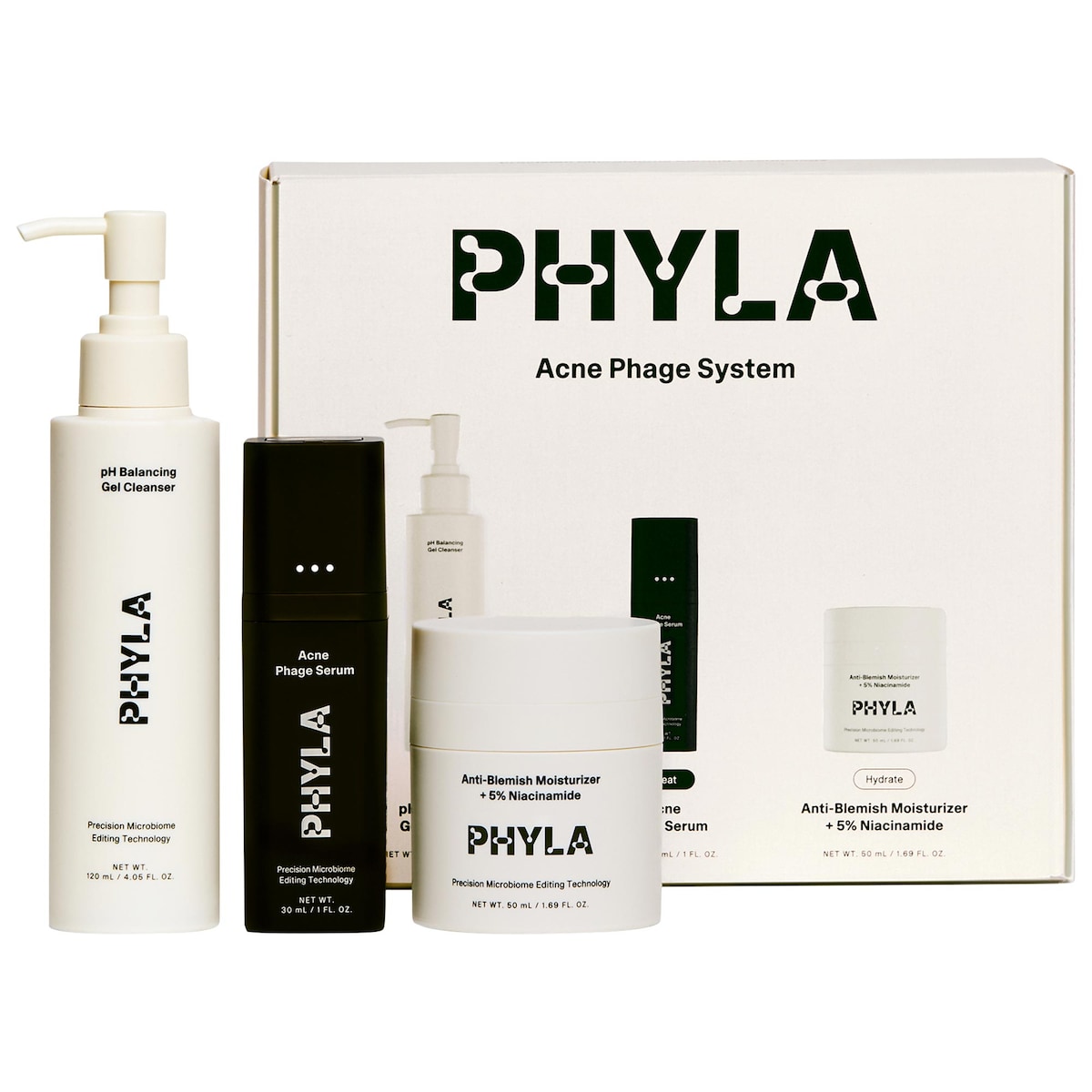
PHYLA Acne Phage System

This system offers a multi-step approach to tackling acne, focusing on eliminating acne-causing bacteria with phage technology and supporting the skin barrier. It aims to clear existing blemishes and prevent future ones while addressing post-acne marks.

Sephora price

$120.00

Price matters most when you are trying to learn whether this lane belongs in your routine without turning the test into a luxury gamble.

Sephora reviews

4.8 / 5

About 100 reviews on the current Sephora source, so there is real volume behind the reputation.

Shoppers keep mentioning

Good for: Acne/BlemishesClean at SephoraGood for: PoresGood for: Skin BarrierNiacinamideGood for: Dark spotsC. Acnes Bacetriophage: Phages kill acne-causing bacteria without side effects.Niacinamide 5%: Helps fade the look of post-breakout marks, discoloration, and dark spots.Green Tea Extract: Calms irritation, soothes redness, and evens out the look of discoloration. Phyla's Phage Technology precisely targets acne-causing bacteria (C. Acnes) while nurturing your skin's microbiome. Phages kill acne without side effects and are effective against hormonal, cystic, blackheads, whiteheads, inflammatory, nodular, and teen acne.Dark SpotsPoresand Acne and Blemishes

These are the shopper themes that keep showing up around this listing and shape why people open it in the first place.

Glass take

4.8 / 5 overall fit

A comprehensive system for acne that targets bacteria and supports skin barrier health. The phage technology is a unique approach to clearing breakouts.

PHYLA Acne Phage System

Sephora snapshot refreshed April 23, 2026

Price, rating, review count, and source status come from Sephora. Glass adds the routine fit, overlap risk, and what to compare next.

View Sephora

What Sephora says

What this product is supposed to do

An advanced probiotic system powered by phages to eliminate acne, fade post-acne marks, and restore your skin’s microbiome balance for clear skin.

NormalDryCombinationand OilyDark SpotsPoresand Acne and Blemishes

pH Balancing Gel Cleanser: Put one to two pumps on wet hands, rub together into a light lather, and massage into face and neck. Rinse thoroughly and use twice daily, in the morning and at night.

Acne Phage Serum: Cleanse skin thoroughly before use. Apply a thin layer to the entire face and affected area twice daily, in the morning and at night. Can be applied to both the face and body, wherever breakouts occur. Tip: Healthy skin has phages, while acne-prone skin doesn’t. PHYLA is phages in a bottle. By adding phages to your daily skincare routine, you’re boosting your skin’s microbiome and paving the way for visibly clear, balanced skin for life.

Anti-Blemish Moisturizer + 5% Niacinamide: Press for one to two pumps in the morning and at night. Apply to clean, dry skin on the face and neck.

What Glass adds

What actually matters before you buy it

A promising system for those struggling with persistent acne. The inclusion of phages is a novel approach to microbiome support, and the niacinamide in the moisturizer is a good addition for post-blemish care.

Unique technology

Users are intrigued by the phage technology and its targeted approach to acne bacteria.

Visible results

Many report seeing a reduction in breakouts and improvement in skin clarity with consistent use.

Best for

When this is a smart buy

  • Acne-prone skin
  • Oily and combination skin
  • Those seeking microbiome support
  • Users looking to fade dark spots

Skip if

When this is the wrong lane

  • You have very dry or sensitive skin and are concerned about multiple active steps
  • You prefer a minimalist routine with only one or two products

Routine fit

How to integrate the Acne Phage System

Start by cleansing with the pH Balancing Gel Cleanser, morning and night. Follow with the Acne Phage Serum, applying a thin layer to the entire face and any affected body areas. Finish by pressing the Anti-Blemish Moisturizer + 5% Niacinamide into clean, dry skin. Introduce the system gradually if your skin is sensitive.

Why it works

Where it earns the slot and where it does not

The useful question is not whether this product is good in a vacuum. It is whether it makes your routine easier to run or just adds one more bottle with a familiar ingredient on it.

What it actually does well

  • Innovative phage technology for acne bacteria
  • Addresses multiple acne concerns (bacteria, marks, barrier)
  • Includes niacinamide for post-blemish care
  • Designed as a complete system

Where it starts to feel redundant

  • Higher price point
  • Requires consistent use of three products
  • May be too much for very sensitive skin without careful introduction

Routine fit

Where it belongs in the stack

Morning and Night

This system is designed for twice-daily use, covering both your morning and evening skincare routines.

Glass rating

How this formula scores in real life

4.8/ 5 overall

A comprehensive system for acne that targets bacteria and supports skin barrier health. The phage technology is a unique approach to clearing breakouts.

Routine fit

4.5 / 5

This system is designed to be used twice daily, covering cleansing, treatment, and moisturizing steps. It fits well as a complete acne-focused routine.

Full ingredient breakdown

Every ingredient, what it does, and whether I care

Solvent

Water

Badness

0.0 / 10

The base for many skincare formulations.

Usually helps with

Hydration

Watch for

Humectant

Propanediol

Badness

0.0 / 10

A plant-derived ingredient that helps to draw moisture into the skin.

Usually helps with

Hydration

Watch for

Active

Niacinamide

Badness

2.0 / 10

A versatile ingredient that helps with oil control, pore appearance, and fading dark spots. In this system, it's in the moisturizer.

Usually helps with

Oiliness, visible pores, uneven tone

Watch for

Can sometimes cause flushing or irritation in high concentrations or for sensitive skin.

Emollient

Squalane

Badness

0.0 / 10

A skin-identical lipid that helps to moisturize and soften the skin.

Usually helps with

Dryness, barrier support

Watch for

Emollient

Cetearyl Alcohol

Badness

0.0 / 10

A fatty alcohol that helps to soften and smooth the skin, and acts as an emulsifier.

Usually helps with

Softening skin

Watch for

Humectant

Glycerin

Badness

0.0 / 10

A common and effective humectant that draws water to the skin.

Usually helps with

Hydration

Watch for

Emollient

Dicaprylyl Carbonate

Badness

0.0 / 10

A lightweight emollient that improves skin feel and spreadability.

Usually helps with

Softening skin

Watch for

Emollient

Dipentaerythrityl Hexahydroxystearate/Hexastearate/Hexarosinate

Badness

0.0 / 10

A complex emollient that provides a smooth feel and helps with product texture.

Usually helps with

Skin feel

Watch for

Emollient

Bis-Diglyceryl Polyacyladipate-2

Badness

0.0 / 10

An emollient that helps to condition and soften the skin.

Usually helps with

Softening skin

Watch for

Humectant

Pentylene Glycol

Badness

0.0 / 10

A humectant that also has antimicrobial properties.

Usually helps with

Hydration

Watch for

Emollient

Diisostearyl Malate

Badness

0.0 / 10

An emollient that improves skin texture and feel.

Usually helps with

Skin feel

Watch for

Emulsifier

Hydroxyethyl Acrylate/Sodium Acryloyldimethyl Taurate Copolymer

Badness

0.0 / 10

A synthetic polymer used to create stable emulsions and thicken formulations.

Usually helps with

Product texture

Watch for

Humectant

1,2-Hexanediol

Badness

0.0 / 10

A humectant that also acts as a preservative booster.

Usually helps with

Hydration

Watch for

Occlusive

Dimethicone

Badness

1.0 / 10

A silicone that forms a breathable barrier on the skin, helping to prevent moisture loss and providing a smooth feel.

Usually helps with

Moisture retention, skin feel

Watch for

Can sometimes feel heavy or occlusive for very oily skin types.

Emulsifier

Glyceryl Stearate Se

Badness

0.0 / 10

An emulsifier that helps to blend oil and water ingredients.

Usually helps with

Product texture

Watch for

Emulsifier

Cetearyl Glucoside

Badness

0.0 / 10

A gentle emulsifier derived from plant sugars.

Usually helps with

Product texture

Watch for

Humectant

Caprylyl Glycol

Badness

0.0 / 10

A humectant that also has preservative properties.

Usually helps with

Hydration

Watch for

Emulsifier

Hydrogenated Lecithin

Badness

0.0 / 10

A modified form of lecithin that helps to stabilize emulsions.

Usually helps with

Product texture

Watch for

Emollient

Stearic Acid

Badness

0.0 / 10

A fatty acid that helps to soften and smooth the skin.

Usually helps with

Softening skin

Watch for

Preservative

Ethylhexylglycerin

Badness

0.0 / 10

A skin-conditioning agent with preservative properties.

Usually helps with

Preservation

Watch for

Emulsifier

Polysorbate 60

Badness

1.0 / 10

An emulsifier used to blend oil and water.

Usually helps with

Product texture

Watch for

Can be a source of concern for some due to potential ethoxylation.

Emulsifier

Sorbitan Isostearate

Badness

0.0 / 10

An emulsifier that helps to stabilize formulations.

Usually helps with

Product texture

Watch for

Emollient

Simmondsia Chinensis (Jojoba) Seed Oil

Badness

0.0 / 10

A plant oil that closely mimics the skin's natural sebum, providing moisture without greasiness.

Usually helps with

Moisturizing, balancing oil

Watch for

Chelating Agent

Sodium Phytate

Badness

0.0 / 10

A natural ingredient derived from rice that helps to improve the stability of formulations.

Usually helps with

Product stability

Watch for

pH Adjuster

Citric Acid

Badness

0.0 / 10

Used to adjust the pH of the product.

Usually helps with

pH balance

Watch for

Emollient

Adansonia Digitata Seed Oil

Badness

0.0 / 10

Baobab seed oil, rich in fatty acids, known for its moisturizing and skin-conditioning properties.

Usually helps with

Moisturizing

Watch for

Emollient

Citrullus Lanatus (Watermelon) Seed Oil

Badness

0.0 / 10

Watermelon seed oil, rich in linoleic acid, known for its lightweight moisturizing properties.

Usually helps with

Lightweight moisture

Watch for

Emollient

Ceramide Np

Badness

0.0 / 10

A type of ceramide that helps to restore the skin's natural barrier.

Usually helps with

Barrier repair

Watch for

Antioxidant

Tocopherol

Badness

0.0 / 10

A form of Vitamin E, an antioxidant that helps protect the skin from environmental damage.

Usually helps with

Antioxidant protection

Watch for

Soothing Agent

Aloe Barbadensis Leaf Juice

Badness

0.0 / 10

Known for its soothing and hydrating properties.

Usually helps with

Soothing, hydration

Watch for

Emollient

Ceramide Ns

Badness

0.0 / 10

A type of ceramide that helps to strengthen the skin barrier.

Usually helps with

Barrier repair

Watch for

Antioxidant

Adansonia Digitata Fruit Extract

Badness

0.0 / 10

Extract from the baobab fruit, rich in antioxidants.

Usually helps with

Antioxidant protection

Watch for

Emollient

Cholesterol

Badness

0.0 / 10

A skin-identical lipid that helps to support the skin barrier.

Usually helps with

Barrier support

Watch for

Emulsifier

Glyceryl Caprylate

Badness

0.0 / 10

An emulsifier and skin-conditioning agent.

Usually helps with

Product texture, skin conditioning

Watch for

Preservative

Glyceryl Undecylenate

Badness

0.0 / 10

A preservative derived from castor oil.

Usually helps with

Preservation

Watch for

Emollient

Phospholipids

Badness

0.0 / 10

Essential components of cell membranes, they help to moisturize and support the skin barrier.

Usually helps with

Barrier support, hydration

Watch for

Active

Phytosphingosine

Badness

1.0 / 10

A lipid that is a component of the skin barrier, known for its anti-inflammatory and antimicrobial properties.

Usually helps with

Barrier repair, anti-inflammatory

Watch for

Thickener

Xanthan Gum

Badness

0.0 / 10

A polysaccharide used to thicken formulations.

Usually helps with

Product texture

Watch for

Emollient

Ceramide Ap

Badness

0.0 / 10

A type of ceramide that helps to reinforce the skin barrier.

Usually helps with

Barrier repair

Watch for

Emollient

Ceramide As

Badness

0.0 / 10

A type of ceramide that helps to improve skin barrier function.

Usually helps with

Barrier repair

Watch for

Humectant

Sodium Hyaluronate

Badness

0.0 / 10

A form of hyaluronic acid that attracts and holds moisture in the skin.

Usually helps with

Hydration

Watch for

Emollient

Ceramide Eop

Badness

0.0 / 10

A type of ceramide that helps to maintain skin hydration and barrier integrity.

Usually helps with

Barrier repair, hydration

Watch for

Compare before you buy

The next pages that make this product more useful

A good product page should push you into the next decision, not trap you inside one product page forever. These are the cleaner next clicks.

FAQ

The fast answers people actually need

What is phage technology?

Phage technology uses bacteriophages, which are viruses that specifically infect and kill bacteria. In skincare, it's used to target acne-causing bacteria like C. acnes without harming beneficial skin microbes.

Can this system be used on body acne?

Yes, the Acne Phage Serum can be applied to the face and body wherever breakouts occur.

How does the niacinamide in the moisturizer help?

The 5% niacinamide in the Anti-Blemish Moisturizer helps to fade the appearance of post-breakout marks, dark spots, and discoloration, while also supporting barrier function.

PHYLA Acne Phage System Review and Routine Fit | Glass