
The name travels.
That matters.
Chapter Aesthetic Studio is not one tiny neighborhood room with one provider, one menu, and one rhythm. It is a multi-location aesthetic studio brand. In New York alone, Chapter lists locations including Cicero, Fayetteville, New Hartford, Orchard Park, Rochester, and Tonawanda.
That can be convenient.
It can also make the choice feel cleaner than it really is.
When a brand has several studios, you are not only choosing the logo. You are choosing the exact location, the person treating you, the service category, the product or device, the follow-up path, and the amount of pressure you are willing to tolerate around packages or memberships.
If I were checking Chapter Aesthetic Studio near me in May 2026, I would not start with, "Is Chapter good?"
I would start with the question that protects the whole appointment:
Which Chapter am I actually booking, who will touch my face or body, and what would make me walk away?

The quick answer
Before booking Chapter Aesthetic Studio, I would confirm the exact studio, provider name, treatment category, product or device, total cost, pre-care, aftercare, follow-up, and membership terms. Chapter's public site describes services such as Botox, dermal filler, medical-grade facials, laser hair removal, chemical peels, CoolSculpting, microneedling, and a free VISIA skin assessment.
That is a broad menu.
Broad menus need better questions.
| If you are considering | Ask this before booking |
|---|---|
| Botox or Dysport | Who injects me, how units are chosen, and what result we are trying to avoid |
| Filler | Which product, how much, whether it can be dissolved, and what the complication plan is |
| Laser hair removal | Which laser is used, whether it fits my skin tone and hair color, and how burns or pigment issues are handled |
| Facials or peels | How aggressive the treatment is and what I need to pause before and after |
| Microneedling | Whether my barrier is calm enough and what downtime is realistic |
| CoolSculpting or body contouring | How candidacy is judged and what outcome would be realistic for my body |
| Skin assessment | Whether the plan stays optional or turns into a package pitch |
| Membership | What gets charged, what rolls over, what expires, and how cancellation works |
If the answer is vague, I would slow down.
Choose the exact Chapter location first
"Chapter Aesthetic Studio near me" can mean several different places.
That is the first split I would make. The brand may share a menu, but the visit happens inside one studio with one provider on one day. A clean brand page does not tell you whether the Rochester injector matches your taste. A polished promotion does not tell you whether the Orchard Park location has the appointment you need. A good experience in one city does not automatically answer whether another location is right for your concern.
For New York, I would start with the exact local page:
| Area clue | Glass page to open first | What I would verify |
|---|---|---|
| Syracuse, Cicero, Fayetteville, or New Hartford | Chapter Aesthetic Studio near Syracuse | Exact studio address, provider availability, and whether your service is offered there |
| Buffalo, Orchard Park, or Tonawanda | Chapter Aesthetic Studio near Buffalo | Orchard Park vs Tonawanda fit, injector schedule, and package or membership terms |
| Rochester or Pittsford | Chapter Aesthetic Studio in Rochester | Address, treatment availability, review patterns, and follow-up convenience |
This step sounds basic. It prevents the easiest mistake: reading the right brand and booking the wrong location.
Follow-up convenience matters more than people admit. Botox may need a check-in. Filler swelling can change. Laser hair removal and body treatments often happen in a series. If the studio is annoying to reach, you may skip the follow-up that would have made the plan safer and cleaner.
I treat a studio chain differently
A multi-location aesthetic studio can be useful.
The upside is structure. A larger brand may have clearer online booking, a standardized menu, recognizable treatment categories, regular promotions, a skin assessment process, and enough locations that you can find an appointment without waiting months.
The tradeoff is variation.
The provider still matters. The room still matters. The local team still matters. The tone of the consult still matters. You can like the brand and still need to judge the exact person doing the work.
That is why I would not book based only on a broad service page or a discount. I would use the brand page to understand what is possible, then use the consult to decide what is appropriate.
Convenience is nice.
It is not a substitute for judgment.
The free skin assessment can be useful if you frame it correctly
Chapter promotes a free VISIA skin assessment with a stated $500 value. Used well, that kind of imaging can help you see pigment, redness, pores, texture, sun damage patterns, and areas where your skin may be more reactive than it looks in bathroom lighting.
I like that kind of information.
I do not like when information becomes pressure.
The useful version sounds like this: "Your pigmentation is heavier on the cheeks, your barrier looks irritated around the nose, and I would not start with an aggressive peel today."
The less useful version sounds like this: "You need the package."
I would go in with one rule: the scan is information, not an obligation. A good assessment should make the decision clearer. It should not make you feel like you failed a test.
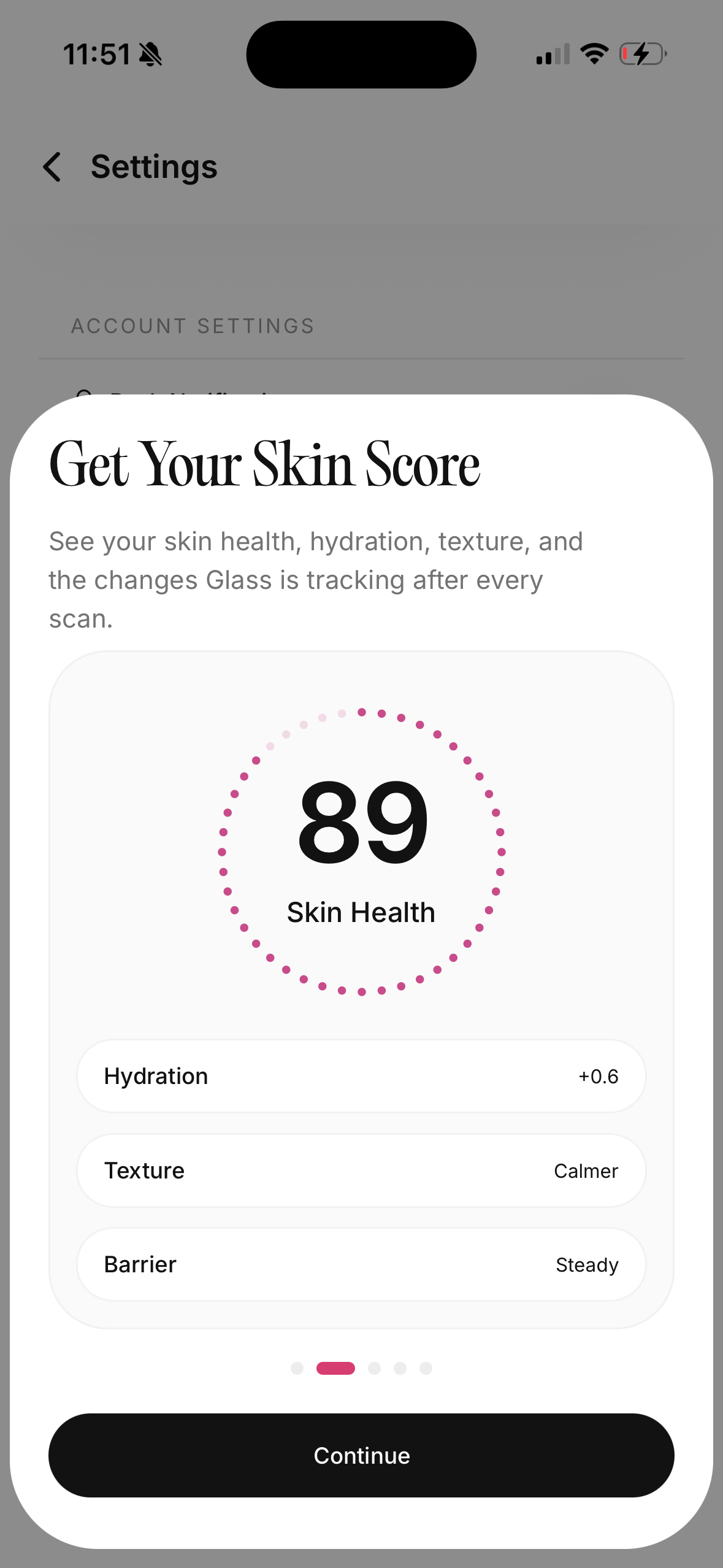
Glass can help here because you can keep your routine, product notes, and progress photos organized before the consult. The studio sees one appointment. You live with the pattern every day.
Botox questions I would ask
Botox is common enough that people start treating it like maintenance.
It is still an injection.
Before wrinkle relaxer treatment at Chapter, I would ask who is injecting, what their license and training background are, which product is being used, how dosing is decided, what areas are being treated, and when the result should peak.
The question I care about most is this:
What are we trying to avoid?
A thoughtful injector can talk about brow heaviness, frozen forehead, uneven movement, smile changes, Spock brow, eyelid heaviness, and over-treating a first-time patient. That kind of answer tells me they are not only chasing smoothness. They are protecting expression.
For a first visit, I would rather start lighter and reassess. It is easier to add later than to spend weeks waiting for an overdone result to soften.
I would also ask about timing. If you have a wedding, photos, travel, a work event, or a vacation coming up, say that early. Wrinkle relaxers do not settle instantly, and the best appointment date may not be the soonest appointment date.
Filler is where I slow down the most
Filler can change the face quickly.
That is why I do not treat it like a casual add-on.
If filler is recommended, I would ask:
| Question | Why it matters |
|---|---|
| Which filler are you using? | Different products behave differently in lips, cheeks, folds, chin, jaw, and under-eyes |
| Is it hyaluronic acid? | Some HA fillers can be dissolved, which matters if correction is needed |
| Why this area first? | Good injectors prioritize balance, not random volume |
| How much are you placing? | Small, staged changes often look better than chasing drama |
| What is the complication plan? | Vascular issues are uncommon but time-sensitive |
| What follow-up is included? | Swelling and settling need a clear check-in path |
| What would you leave alone? | Restraint tells you more than a dramatic promise |
The American Academy of Dermatology recommends asking who will perform a cosmetic procedure, what training they have, what results are realistic, what risks exist, and what happens if complications occur. That is not overthinking. That is informed consent.
I would also ask to see the product packaging before treatment. A provider who handles that request calmly earns trust.
Laser hair removal needs skin-tone questions
Laser hair removal is often sold like a simple appointment.
The details matter.
Skin tone, hair color, tanning, recent sun exposure, medication history, pregnancy status, irritation, and the actual laser device can all affect the plan. Darker skin tones are not automatically excluded, but the device, settings, and provider judgment matter more.
Before laser hair removal at Chapter, I would ask:
- Which laser are you using?
- Is it appropriate for my skin tone and hair color?
- Should I avoid sun or self-tanner before treatment?
- What medications or skincare products should I disclose?
- What does a normal reaction look like?
- What would a burn or pigment issue look like?
- Who do I contact if the area blisters, darkens, or hurts?
I would not book laser treatment on freshly sunburned, irritated, or recently exfoliated skin. If the provider seems casual about that, I would leave.
Facials, peels, and microneedling should fit your barrier
Facials and peels sound less intimidating than injectables.
They can still wreck your week if they are too aggressive for your skin.
If Chapter recommends a facial, chemical peel, or microneedling series, I would ask what problem it is meant to solve: congestion, dullness, texture, post-acne marks, sun damage, fine lines, redness, or dehydration. A treatment that makes sense for thick, oily, resilient skin may be too much for sensitive, barrier-damaged skin.
I would also ask what to pause before and after:
- retinoids
- exfoliating acids
- benzoyl peroxide
- strong vitamin C
- prescription acne products
- waxing
- shaving over the treated area
- heavy sun exposure
If a provider does not ask about your routine before resurfacing, peeling, lasering, or needling your skin, they are missing part of the picture.
This is where I would be especially honest. If your skin burns when you apply moisturizer, say that. If you started tretinoin two weeks ago, say that. If you had a bad peel once and hyperpigmented for months, say that. A good provider can work with real information. They cannot protect you from details you hide because you want to seem easy.
Body contouring needs expectation control
Body treatments are especially vulnerable to vague promises.
I would want the provider to be specific about candidacy, timing, discomfort, expected change, follow-up, and what the treatment cannot do. CoolSculpting, tightening, toning, and body contouring services are not weight-loss substitutes. They are usually better framed as contour or spot-treatment options for the right candidate.
I would ask:
- Am I actually a candidate?
- What area are we treating and why?
- How many sessions are typical?
- What result would be realistic for me?
- What are the common side effects?
- What rare side effects should I know about?
- How do we measure progress?
If the pitch sounds like a transformation guarantee, I would not trust it.
Memberships and packages need a clean exit
Chapter's site has promoted savings, member discounts, and offers tied to larger purchases. I do not have a problem with memberships when the rules are clear and the math works.
I do have a problem with pressure.
Before joining any med spa membership, I would ask:
| Rule | Question to ask |
|---|---|
| Monthly cost | What is charged each month and on what date? |
| Credits | Do unused credits roll over? |
| Discounts | Which services are excluded? |
| Cancellation | How much notice is required? |
| Expiration | Do credits expire after cancellation? |
| Refunds | Are credits refundable or service-only? |
| Transfer | Can credits be used at another Chapter location? |
The best membership is boring to understand.
If it takes ten minutes to explain the exceptions, I would not sign during the first appointment.
I would also separate "I will use this every month" from "I feel excited right now." Those are not the same thought. Aesthetic memberships can make sense for someone who already gets recurring treatments and understands the menu. They make less sense when you are still learning whether the studio, provider, and plan fit you.
Reviews: read the exact studio, not the brand average
Reviews are helpful, but I read them as patterns.
For Chapter, I would look at the exact studio: Syracuse-area, Orchard Park, Tonawanda, Rochester, or whichever location I am booking. I would pay more attention to detailed reviews than star averages.
Good signs:
- the provider explained options
- results looked natural
- pricing was clear
- follow-up was easy
- no one felt rushed
- the plan matched the person's actual concern
Yellow flags:
- pressure to join a membership
- surprise pricing
- rushed consults
- unclear provider names
- complaints about being oversold
- poor handling of complications or dissatisfaction
One bad review does not define a location. A repeated pattern does.
I also care about the date. A studio can change staff. A provider can leave. A front desk process can improve or get worse. I would give more weight to recent, detailed, location-specific comments than old praise about the brand in general.
What I would bring to the appointment
I would bring a simple list, not a binder.
| Bring this | Why it helps |
|---|---|
| Current skincare routine | Actives can affect peels, lasers, microneedling, and irritation |
| Medication and supplement list | Some items affect bruising, healing, or eligibility |
| Prior treatments | Past filler, Botox, lasers, and peels change the plan |
| Allergy or reaction history | Helps avoid numbing, adhesive, or product issues |
| Photos in normal lighting | Makes progress and baseline easier to discuss |
| Budget ceiling | Keeps the consult from turning into a package spiral |
| Upcoming events | Timing changes what should or should not be done now |
I would also bring my own goal in plain language. "I want my forehead softer but not frozen" is more useful than "make me look better."
One clear priority protects you. If you arrive wanting everything, it becomes easier to sell you everything. If you arrive with one main concern, the provider has to build a plan around it.
What would make me walk away
I would not book if I could not identify the person treating me.
I would also walk away from:
- no clear medical supervision
- vague filler product answers
- no written aftercare
- pressure to treat more areas than I asked about
- a package push before a real consult
- a laser plan that ignores skin tone or sun exposure
- treating irritated skin casually
- promises of perfect results
- unclear pricing until the last second
- dismissing normal safety questions
The emotional signal matters. If I feel embarrassed for asking normal questions, that is enough information.
What would make me comfortable
Green flags are usually calm.
I like providers who say no. I like conservative first treatments. I like written aftercare. I like a clear follow-up path. I like when a provider explains why one service should wait. I like when they ask about events, travel, workouts, pregnancy status, cold sores, medication changes, and past reactions.
I also like when the plan has order. Maybe Botox first, then reassess. Maybe a gentle facial before any peel. Maybe no filler until the skin is calmer. Maybe the scan shows a concern, but the provider does not rush you into buying a series.
That feels like care.
How I would use Glass before and after
I would treat the appointment like a controlled change, not a blur.
Before booking, I would log my routine, take baseline photos, and write down the one concern I want addressed. After the appointment, I would track swelling, bruising, redness, dryness, pigment changes, product changes, and when the result actually settles.
That matters because memory gets messy. If you check the mirror ten times a day, every normal change can feel dramatic. If you only remember the before photo in your head, you may overestimate or underestimate what changed.
For subtle aesthetic care, tracking gives you a calmer record.
My Chapter booking checklist
Before booking Chapter Aesthetic Studio, I would confirm:
- The exact studio location.
- The provider name, license, and training.
- The treatment being recommended.
- The product, device, or method being used.
- The realistic result and what it cannot do.
- The total price before treatment.
- The membership or package terms, if offered.
- The pre-care and aftercare.
- The normal side effects.
- The symptoms that require a call.
- The follow-up plan.
The checklist is not meant to make the appointment tense. It is meant to make it clean. When a studio answers these questions well, you can stop guessing and focus on whether the plan actually fits you.
The bottom line
Chapter Aesthetic Studio can be a convenient option if you want Botox, filler, laser hair removal, facials, peels, body treatments, or a skin assessment near one of its locations. I would still choose the exact studio carefully, ask provider-specific questions, understand the membership terms, and avoid treating the free assessment like a required purchase path.
A good aesthetic appointment should make you feel informed before it makes you look different.
Useful references: Chapter locations, Chapter treatments, Chapter New York locations, American Academy of Dermatology cosmetic safety questions, and American Society of Plastic Surgeons cosmetic statistics.