
Names repeat.
That is the first thing I noticed.
You search for Allure Med Spa, and you are not always looking at one place. You may be looking at an El Paso med spa. You may be looking at a Scarborough, Maine med spa. You may be looking at a different Allure-named clinic entirely. The name is familiar, but the provider, address, treatments, pricing, supervision, and patient experience can be completely different.
That matters before you book.
A med spa appointment is not like buying a cleanser. Botox, fillers, lasers, chemical peels, microneedling, and weight-loss services all deserve a slower check. The goal is not to be suspicious of every clinic. The goal is to know exactly which clinic you are choosing and whether the visit feels medically clean, clear, and aligned with your face.
If I were checking Allure Med Spa in May 2026, I would not start with the prettiest before-and-after. I would start with identity, provider credentials, treatment fit, consultation quality, and aftercare.
The quick answer
Before booking an Allure Med Spa appointment, confirm the exact location, the licensed provider who will treat you, the medical supervision model, the treatment being recommended, the realistic downtime, the full cost, and the complication plan. If the clinic cannot answer those cleanly before you pay, I would slow down.
For the Allure name specifically, I would separate the locations:
| Location clue | Glass directory page | What I would check first |
|---|---|---|
| El Paso, Texas | Allure Med Spa in El Paso | Injector credentials, Botox/filler plan, skin rejuvenation menu, consultation process |
| Portland / Scarborough, Maine | Allure Med Spa near Portland | Treatment menu, laser devices, provider background, follow-up process |
That split alone can prevent a lot of confusion. Do not judge one Allure location by another Allure location's reviews, photos, or treatment menu unless you have confirmed they are the same business.
Why I slow down with med spas
Med spas can be excellent.
They can also be uneven.
That range is why I do not book from vibes alone. A calming website, smooth photos, and a five-star average can be part of a good clinic, but they are not enough by themselves. I want to know who is holding the syringe, who supervises medical care, what happens if swelling looks wrong, and whether the recommendation sounds like a treatment plan or a sales script.
Cosmetic demand is not small. The American Society of Plastic Surgeons reported more than 25 million cosmetic minimally invasive procedures in 2023, including neurotoxin injections, fillers, skin resurfacing, and other non-surgical treatments. Popular does not mean casual. It means more people are making decisions in a market where the difference between a careful provider and a careless one matters.
That is the mindset I bring into any med spa search. I am not trying to scare myself away. I am trying to avoid handing my face to a clinic before I understand the basics.
Confirm the exact clinic first
The first question is boring:
Which Allure Med Spa?
I would match the name, city, address, phone number, and website before reading too much into reviews. If I am booking in El Paso, I do not want to accidentally read Scarborough reviews for twenty minutes. If I am booking near Portland, I do not want to compare treatment pricing from a Texas location and assume it applies in Maine.
For El Paso, I would expect the clinic identity to line up with the El Paso page, the Zaragoza Road address, and the treatments listed for that location. For Scarborough, I would expect the Mussey Road address, the Maine treatment menu, and the provider details to match.
If a booking link, map listing, website footer, and directory page disagree, pause. Sometimes it is just stale web data. Sometimes it means you are looking at the wrong business.
Check who actually treats you
This is the question I care about most.
Who performs the treatment?
Not just who owns the clinic. Not just who appears in the photos. The person treating you should be licensed, trained for the specific procedure, and able to explain what they are doing without making you feel rushed or foolish.
For injectables, I would ask:
- What is your license and training background?
- How often do you perform this exact treatment?
- Who is the medical director or supervising physician?
- Are they on site, available by phone, or only attached on paper?
- What happens if I have a complication after hours?
- What product are you using, and can I see the packaging before treatment?
The American Academy of Dermatology recommends asking who will perform a cosmetic procedure, what training they have, what results are realistic, what risks exist, and what happens if complications occur. That is not overthinking. That is the minimum adult version of consent.
The consultation should feel specific
A good consultation should not feel like a menu upsell.
If I ask about Botox, the answer should not immediately become filler, laser, weight loss, skincare, and a package. There may be a reason to discuss multiple treatments, but the provider should connect each recommendation to my face, my skin, my history, my tolerance for downtime, and my budget.
I listen for specificity:
- "Your dynamic forehead lines are the main target here."
- "I would not treat that area today because the risk is higher than the benefit."
- "Your skin tone changes the laser settings and the post-care."
- "This may soften the line, but it will not lift the lower face."
- "If you want no downtime before an event, this is not the right week."
That kind of language feels grounded. It gives limits. It does not pretend every treatment solves every concern.
The weaker version sounds like this: "You are a perfect candidate for everything." I do not trust that.
Botox questions I would ask
Botox and other wrinkle relaxers can look simple because the appointment is fast. The decision is still medical.
I would ask what product is being used, how many units are recommended, which muscles are being treated, what result they expect, when it peaks, when it wears off, and what side effects would require a call. I would also ask whether they prefer a conservative first treatment or a stronger correction.
For a first appointment, I like conservative thinking. You can usually add more later. You cannot instantly undo an over-treated forehead, heavy brow, or smile change.
The provider should be able to explain placement in plain English. If they cannot describe why they are treating one area and avoiding another, I would not let the speed of the appointment rush me into saying yes.
Filler questions I would ask
Filler requires even more caution.
The upside can be real: restored volume, lip shape, facial balance, softened folds. The downside can also be real: swelling, lumps, asymmetry, vascular issues, overfilling, migration, or a look that does not match your face.
Before filler, I would ask:
| Question | Why it matters |
|---|---|
| Which filler are you using? | Different products behave differently in lips, cheeks, folds, and under-eyes |
| Why this area first? | Good injectors prioritize structure, not random volume |
| How much are you placing? | Small amounts can be smarter than chasing a dramatic change |
| Can it be dissolved? | Hyaluronic acid fillers have a different reversibility profile than some other fillers |
| What is the emergency plan? | Vascular complications are rare but time-sensitive |
| What should I avoid afterward? | Aftercare affects swelling, bruising, and recovery |
The American Society for Dermatologic Surgery has warned that filler safety depends heavily on trained, qualified providers. That is the standard I would use. Cheap filler from a vague source is not a deal. It is a risk with a discount sticker on it.
Laser and skin treatment questions
Lasers, IPL, microneedling, chemical peels, and resurfacing treatments need a different kind of screening.
I would ask what device or peel is being used, whether it is appropriate for my skin tone, what downtime looks like, what could go wrong, and how many sessions are realistically needed. I would also ask what skincare I need to stop before and after.
This is where people make preventable mistakes. They book a treatment, keep using retinoids or acids too close to the appointment, skip sunscreen afterward, then wonder why the skin reacts badly.
For any treatment that intentionally irritates, heats, exfoliates, punctures, or resurfaces the skin, I want written pre-care and aftercare. I also want the clinic to tell me when to call.
I would not accept vague aftercare like "just keep it moisturized." That may be part of it, but it is not enough.
Reviews are useful, but I read them differently
I do read reviews.
I just do not read them like a scoreboard.
A five-star average is nice, but I care more about patterns. Do people mention feeling educated? Do they say the provider was conservative? Do they mention natural results, clear aftercare, clean rooms, and follow-up? Or do reviews mostly sound like quick compliments without enough detail to be useful?
I also look at negative reviews without panic. One bad review does not define a clinic. A pattern does. If multiple people mention rushed consultations, surprise pricing, poor follow-up, pressure to buy packages, or results that were dismissed instead of addressed, I pay attention.
The best reviews are not always the most emotional. They are the ones that describe what actually happened.
Pricing should be clear before treatment
I do not need every clinic to be the cheapest.
I do need the price structure to be understandable.
For Botox, is it per unit or per area? For filler, is it per syringe? For lasers, is it per session or package? For weight-loss services, what is included in the monthly cost? For facials and peels, are add-ons optional or bundled?
If a clinic avoids pricing until you are already emotionally committed in the room, that is a yellow flag. Some pricing depends on the consult, but the structure should still be explainable.
I would also ask about deposits, cancellation rules, package expiration, financing, and whether follow-up visits are included.
Money confusion ruins trust fast.
The appointment should not compete with your skincare routine
Your skincare routine matters before a med spa visit.
If you are using retinoids, exfoliating acids, benzoyl peroxide, strong vitamin C, prescription acne treatment, or anything that makes your skin peel, tell the clinic before treatment. Do not assume "skincare" is too minor to mention.
I would bring a quick list:
- cleanser
- moisturizer
- sunscreen
- retinoids
- exfoliating acids
- acne treatments
- pigment treatments
- recent peels or lasers
- medications and supplements that affect bruising or healing
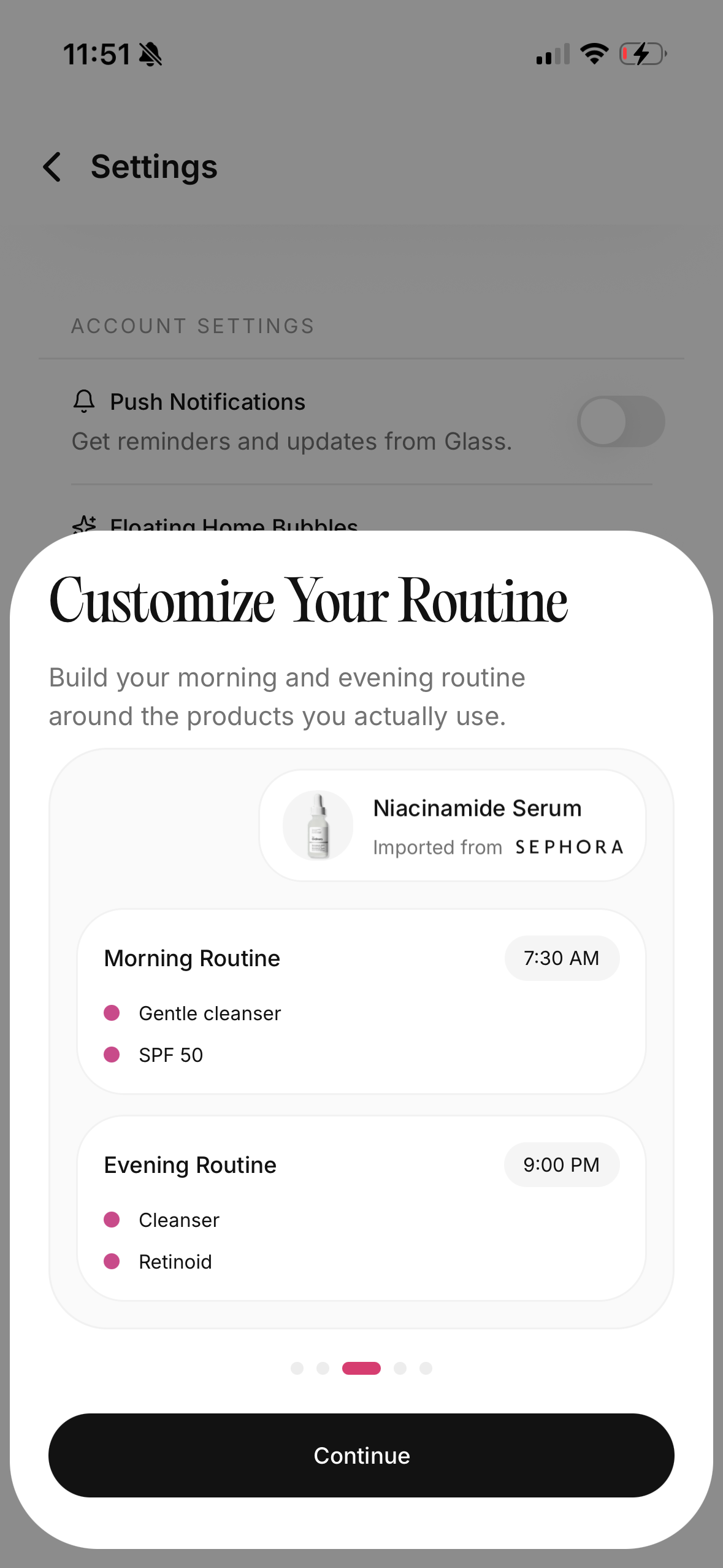
Glass is useful here because you can keep products, progress photos, and routine changes in one place instead of trying to remember everything under appointment pressure. The point is not to make the app the provider. The point is to walk into the consult with cleaner information.
What would make me walk away
I would leave or not book if a clinic:
- cannot say who will perform the treatment
- will not explain medical supervision
- pressures me to treat more areas than I asked about
- dismisses questions about risk
- offers filler without discussing complications
- treats active infection, irritated skin, or recent procedure areas casually
- cannot explain aftercare
- makes pricing unclear until the last second
- promises perfect results
- makes me feel embarrassed for asking normal questions
That last one matters. A provider who resents informed questions before treatment may not become more careful after treatment.
What would make me more comfortable
Green flags are quieter.
I like a clinic that explains what not to do. I like a provider who says no when a treatment is not appropriate. I like before-and-after photos that look like real faces, not one overfilled style repeated on everyone. I like written aftercare. I like conservative first sessions. I like a clear contact path if swelling, pain, color change, rash, or unusual symptoms appear.
I also like when the provider asks about my actual life. Events, workouts, travel, sun exposure, budget, anxiety around needles, history of cold sores, acne medication, pregnancy status, and prior reactions can all change the plan.
Aesthetic care should still feel like care.
My Allure Med Spa booking checklist
Before booking, I would confirm:
- The exact Allure location, address, and phone number.
- The provider who will perform the treatment.
- The medical director or supervision structure.
- The treatment product, device, or peel being used.
- The realistic result and what it will not do.
- The full cost and package terms.
- The pre-care and aftercare instructions.
- The downtime and event timing.
- The complication plan.
- The follow-up policy.
That checklist is not dramatic. It is how you keep a beauty appointment from becoming a guessing game.
Bottom line
Allure Med Spa can refer to more than one clinic, so the first step is confirming the exact location and provider before you judge reviews, services, or pricing. From there, I would treat the appointment like a medical-aesthetic decision: ask who is treating you, how they are supervised, what product or device they are using, what result is realistic, what it costs, and what happens if something does not heal normally.
The right med spa should make you feel informed before you feel sold.
Useful references: AAD cosmetic procedure questions, ASDS filler safety guidance, and ASPS 2023 procedure statistics.